TL;DR: AI can match human trainers on programming quality. It struggles with accountability. The tools that track when you drift — and intervene before you quit — will define the next decade of fitness technology.
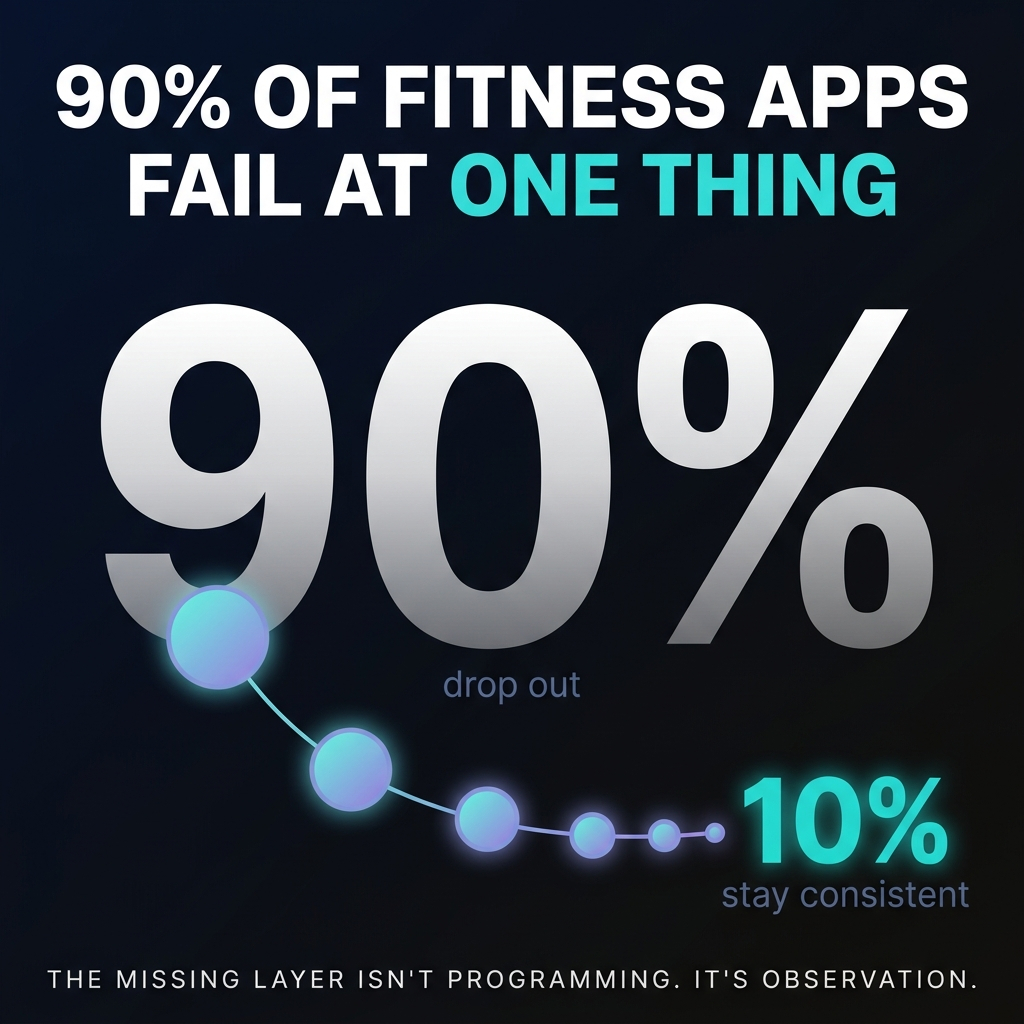
Only 10.1% of fitness app users remain adherent at 12 months; 70% quit within 100 days.
Human trainers' core advantage is proactive accountability, detecting missed workouts and declining adherence before the user gives up.
AI accountability works because the brain responds to observed commitment, not necessarily human care.
The AI fitness market is growing fast, primarily serving people who never had access to a human trainer.
The real design problem: most AI tools dispense plans but never react when engagement starts to decay.
Why the AI vs. Human Trainer Debate Misses the Point
I build AI fitness systems for a living. People ask me almost weekly if AI can replace a human personal trainer.
The honest answer is more interesting than yes or no.
The debate usually covers the same territory: programming quality, judgment, emotional support, experience, and price. Those comparisons matter. After years of building FitPocket, I've come to believe one factor sits above all of them.
Accountability.
Trainers on Reddit repeat this point constantly. When they list what keeps clients paying month after month, workout design rarely tops the list. The thing that keeps clients showing up is a person who notices when they don't.
The Bottom Line on This Section
Key Point: The AI vs. human trainer debate centers on the wrong variable. Programming quality has largely been solved. Accountability has not.
What the Dropout Numbers Actually Say
Start with what actually happens when people use fitness apps.
Only 10.1% of beginner fitness app users remain adherent at 12 months, and the median dropout time lands at 19 weeks. The average fitness app retains just 3 to 4% of users at day 30, with 70% quitting within the first 100 days.
Read those numbers again. They describe an industry, an entire category of software, failing at its one job.
For years the industry blamed the user. Lack of discipline. Lack of motivation. Lack of commitment.
I see it differently. When 90% of people fail with the same tool, the tool has a design flaw. Weather changes. Schedules collapse. Bodies respond differently than the chart predicts. Most fitness software treats those events as user error. Real life treats them as Tuesday.
💡 If a system requires willpower to maintain, the system is broken. That's the operating principle behind everything I build.
The Bottom Line on This Section
Key Point: A 90% failure rate is not a user problem — it is a design problem. The infrastructure failed, not the individual.
What Human Trainers Actually Sell
Here's where the AI versus human comparison gets sharp.
An AI can generate a technically sound training program in seconds. Programming quality has largely been solved. Users confirm this in their own behavior, though. One firsthand account of using an AI coach put it plainly: the biggest issue was lack of accountability to it. The same person completed every scheduled class with other humans present, then skipped the solo workouts the AI prescribed.
The plan was fine. The follow-through structure was missing.
A good human trainer runs a quiet detection system:
You missed Tuesday's session. They text you.
Your adherence dropped three weeks in a row. They ask what changed at work.
You stopped logging meals. They notice before you admit it.
Your lifts stalled. They adjust the program before you get discouraged.
None of this requires genius programming. It requires attention, timing, and intervention. That's the product. The workout plan is the packaging.
The Bottom Line on This Section
Key Point: The human trainer's real product is proactive detection and timely intervention — not the workout plan itself.
Why Most AI Coaches Fail at Accountability
Most AI fitness tools operate as vending machines. You ask, they dispense. A workout, a meal plan, a calorie count.
Vending machines never call you when you stop showing up.
This is where I think the industry misread the assignment. Teams poured resources into generation quality, better exercise selection, smarter periodization, more precise macros. Meanwhile the actual failure point sat untouched: nothing in the system reacts when engagement starts to decay.
The signals are all there. Missed workouts. Declining adherence. Unlogged meals and water. Stalled progress photos and measurements. Every one of these is detectable, and each one predicts dropout weeks before it happens.
The research supports acting on them. AI can flag clients at risk of dropping off by tracking engagement and workout consistency, and proactive interventions based on those patterns help retain them.
Detection turns into intervention. Observation turns into architecture. That shift matters more than any improvement in workout generation.
The Bottom Line on This Section
Key Point: Dropout signals are detectable weeks in advance. Most AI tools collect the data and do nothing with it.
How AI Accountability Actually Works
Here's the part that surprised me most in my own work.
People assume accountability requires empathy — a human on the other end who genuinely cares. The evidence points somewhere else. One writer who used AI as an accountability coach described the mechanism precisely:
It works "not because it's human, but because it tricks your brain into believing someone's watching. Even if that someone is made of code."
The active ingredient is observed commitment. Your brain responds to the sense that your actions register somewhere, that a missed workout produces a consequence, even a small one, like a follow-up message that names the miss.
This is buildable. It requires three things:
Continuous signal collection. Workouts, meals, water, sleep, body scans, measurements, photos. Real progress is multidimensional, and single-metric tracking misses the early warnings.
Pattern recognition across time. One missed workout is noise. Three missed Tuesdays in a row is a signal about Tuesdays.
Proactive outreach that adapts. The intervention has to fit the context. Someone traveling needs a hotel-room substitution, and someone burned out needs a lighter week.
⚠️ Most apps stop at step one. Data without context is noise, and context without action is theater.
Key Point: Accountability does not require a human. It requires a system that observes, recognizes patterns, and responds in context.
Where Human Trainers Still Hold Ground
I want to be honest about the current limits.
A 2025 systematic review found that engagement and retention ran high across AI, human, and hybrid coaching. Satisfaction told a different story. It was typically higher with human-delivered coaching, and participants reported a stronger sense of connection with humans, even within hybrid programs.
Consumer preference confirms it. The Les Mills 2026 Global Fitness Report, which surveyed more than 10,000 people across five continents, found only 10% of consumers globally prefer AI workout guidance over a human coach.
The emotional layer remains distinct from the operational layer. A human who has watched you struggle through a hard season carries meaning that code currently lacks.
The professionals themselves already understand where this is heading. 64% of certified trainers use AI tools regularly, and over 70% report meaningful efficiency gains. AI is amplifying certified professionals, and their work is changing shape rather than disappearing.
Key Point: Human trainers maintain a clear edge in emotional connection and satisfaction. The majority of certified trainers are already using AI to amplify their work.
The Real Opportunity: People Trainers Never Reach
The AI personal trainer market is projected to grow from USD 16.86 billion in 2025 to USD 35.26 billion by 2030. That growth is happening while only 10% of consumers say they prefer AI coaching. Both facts hold at once because the market for AI coaching is largely made of people who never had a human coach to begin with.
A good personal trainer costs more per month than most people spend on their entire fitness life. Scheduling one requires a stable calendar. Millions of people work shifts, travel constantly, parent alone, or live far from a quality gym.
For them, the choice was never AI versus human. The choice was AI versus nothing.
That's the population I build for. The person whose Tuesday collapsed. The person training in a hotel room. The person who quit three apps already and internalized that as a personal failure when it was an infrastructure failure the whole time.
Key Point: The AI fitness market is not stealing clients from human trainers. It is reaching a population that never had access to coaching at all.
What Intelligent Accountability Looks Like in Practice
If you're evaluating AI fitness tools, or building one, here's the standard I hold myself to:
Detection before generation. The system should know you skipped before it knows what to prescribe next.
Context as a first-class input. Weather, location, equipment, schedule. These are design constraints from day one. Treating them as edge cases produces the 70% dropout rate.
Intervention without shame. The follow-up after a missed week should offer an adjusted plan, because the plan failed to fit the week. Shame drives quiet uninstalls.
Multidimensional progress. Body scans, measurements, photos, trends. When the scale stalls, other signals keep people anchored to real change.
Conversation as infrastructure. Voice and text access, so logging and adjusting fits into a commute or a kitchen, at the moments life actually happens.
Key Point: Intelligent accountability is a structural design choice. Detection, context, intervention, multidimensional tracking, and accessible conversation all working together.
My Answer to the Original Question
Can AI replace a personal trainer? For the person with the budget, the schedule, and the desire for human connection, a great trainer remains hard to beat, and the satisfaction data backs that up.
For everyone else, the question dissolves. The real work is building systems that notice when you drift and adapt before you quit. Accountability is an engineering problem, and engineering problems get solved.
The dropout statistics tell me the industry spent a decade optimizing the wrong layer. The next decade belongs to whoever builds the layer that watches, adapts, and reaches out.
I'd genuinely like to hear your experience. If you've used an AI coach, a human trainer, or both, tell me which one noticed when you stopped showing up. That answer reveals more about the future of this industry than any feature list.
Frequently Asked Questions
Can AI fully replace a human personal trainer?
For most capabilities, AI now matches human trainers on programming quality. Where AI still falls short is emotional connection, nuanced satisfaction, and the kind of spontaneous accountability a human naturally provides. For people with access to a quality trainer, human coaching remains preferable. For everyone else, AI offers something that did not previously exist.
Why do most fitness apps fail to retain users?
The average fitness app retains 3 to 4% of users at day 30, and 70% quit within 100 days. The primary cause is not poor programming. It is the absence of any system that detects declining engagement and intervenes before the user disengages completely.
What is the accountability gap in AI fitness coaching?
The accountability gap is the absence of proactive intervention. Most AI tools respond to user inputs but do not initiate contact when users go silent. A human trainer texts you when you miss a session. Most AI coaches do not.
Does AI accountability actually work if it is not human?
Evidence suggests it can. The mechanism is observed commitment. The brain responds to the perception that actions are being tracked and that inaction produces a response, even when that response comes from software rather than a person.
What signals predict fitness app dropout before it happens?
Missed workouts, declining login frequency, unlogged meals or water, stalled progress measurements, and reduced engagement with program suggestions. Each of these is detectable, and each one predicts dropout weeks before the user officially quits.
How are human trainers responding to AI?
64% of certified trainers already use AI tools regularly, and over 70% report meaningful efficiency gains. The professional role is shifting toward higher-value coaching functions rather than disappearing.
Who is the AI fitness market actually serving?
Primarily people who never had access to a human trainer: those with irregular schedules, limited budgets, frequent travel, or no quality gym nearby. The AI market is expanding the addressable population, not cannibalizing existing trainer clients.
What should I look for in an AI fitness tool to ensure accountability?
Look for tools that proactively contact you after missed sessions, adapt plans based on context (travel, schedule disruptions, fatigue), track progress across multiple metrics rather than just weight, and offer voice or text access for frictionless logging.
Key Takeaways
AI matches human trainers on programming quality. Accountability remains the critical gap.
70% of fitness app users quit within 100 days. A design failure, not a motivation failure.
The human trainer's core product is proactive detection and intervention, not the workout plan.
Observed commitment, the sense that actions are tracked and inaction produces a response, is the active ingredient in accountability, and it is buildable in software.
AI fitness tools must collect signals, recognize patterns across time, and initiate context-appropriate interventions to close the accountability gap.
Human trainers retain a clear advantage in emotional connection and client satisfaction.
The AI fitness market serves people who never had access to coaching at all, therefore growth and human trainer demand are not in direct competition.