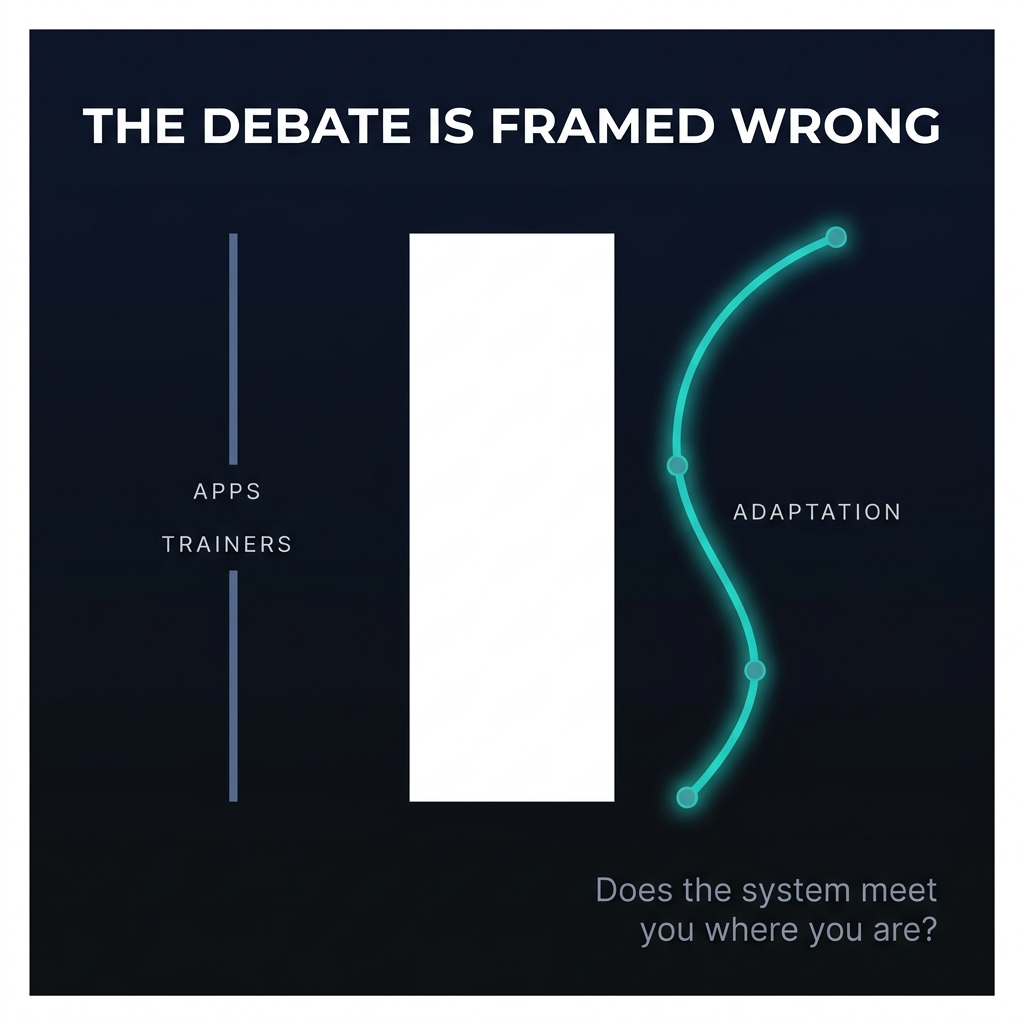
I run a fitness technology company. People assume I have a rehearsed answer ready when someone asks me: apps or human trainers?
I don't. What I have instead is seven years of data and a conclusion that makes most fitness companies uncomfortable: the question itself is the wrong question.
Most people who quit a fitness program weren't lazy. They weren't undisciplined. They were using a tool designed for a life they don't actually have. That distinction matters more than any app feature or trainer credential.
Here is what I found when I investigated both sides honestly — and what it means for anyone who has ever started strong and faded by month three.
The answer changed how I build. It should change how you choose.
The Case for Human Trainers Is Stronger Than the App Industry Wants You to Know
I'll start with the evidence that works against my own business, because that's the only way honest analysis earns trust.
Research tracking thousands of participants found that 73% of people working with personal trainers achieve their fitness goals. Only 8% of people training alone get there.
That is a ninefold difference in outcomes. Not a slight edge — nine times the success rate.
The same data shows beginners with trainers build strength 2.1 times faster than self-directed beginners. 83% continue training past six months, compared to 14% going it alone.
A good trainer watches your form in real time. Notices your energy drop before you say a word. Holds a calendar slot you feel obligated to keep. These are not soft advantages — they are structural ones.
Any app company that dismisses these numbers is selling something. I won't do that here.
The Cost Structure Locks Out 85% of the People Who Need This Most
Here is where the investigation changes direction.
A gym membership plus a personal trainer costs $8,500 to $9,000 per year. A premium fitness app runs $180 to $360 annually. Per session, a well-designed app costs under $1. A trainer session runs between $4 and $37, depending on how often you actually show up.
The result: only about 15% of gym members ever work with a personal trainer.
That number is usually described as a preference. It is not a preference. People want guidance. The price excludes them from it.
Run the arithmetic on what this actually means:
The most effective fitness method we know of reaches roughly 15% of gym members.
The remaining 85% are training inside the 8% success bracket — and most of them think it's their own fault when they stop.
The gap between those two groups is not a motivation problem. It is a pricing problem that got reframed as a character flaw.
💡 Tip: Before comparing options, calculate your real cost per completed workout over the past six months. Divide what you spent by sessions you actually finished. That number tells you more than any brochure.
Apps Have Their Own Failure Pattern — and It Explains Most Fitness Failures You've Personally Experienced
I would lose credibility pretending apps solved this cleanly. The adherence data is uncomfortable reading for anyone who builds them.
A large analysis found that only 18.1% of beginner users remained adherent to their fitness app at six months. Dropout was steady across age groups and genders.
The industry I work in loses more than four out of five beginners before they reach the six-month mark. That is not a user problem. That is an industry problem.
For years, the standard explanation blamed the user. Lack of discipline. Lack of motivation. Lack of commitment. The fitness industry built its entire tone of voice around this assumption.
I stopped believing it when I looked at exactly how people quit.
They quit when the plan said leg day and their kid got sick. They quit when the program assumed a gym and they were in a hotel room. They quit when it rained on running day and the app had no answer except a red missed-workout badge staring back at them.
The app didn't adapt. So the user absorbed the failure. And they called it a personal weakness.
Most fitness apps digitized the rigidity of a bad training program and called it convenience. The medium changed. The demand for conformity stayed exactly the same.
⚠️ Warning: An app that penalizes missed workouts without offering an adapted alternative is measuring your life against its own template. The six-month dropout curve will apply to you.
There Is One Signal Buried in the Data That Changes Everything
The same research that shows mass dropout also contains the finding that changed how I design products.
Training consistency in the first 28 days was the strongest predictor of whether someone was still active a year later. Systems that reduce friction in those first four weeks change outcomes for the entire year that follows.
Separate clinical research supports this: apps providing personalized, guided plans kept users engaged 40% longer than self-directed alternatives. Personalized video exercises produced significant improvements in physical function and confidence.
Put those two findings together and the picture becomes very clear:
Digital delivery works. Rigid digital delivery fails. The variable that decides everything is whether the system adapts to the user's real conditions — or demands the user adapt to it.
This is the principle I build on now: if something requires consistent willpower to maintain, the system is broken. Willpower is not a character trait. It is a finite resource being asked to compensate for a design failure.
What Trainers Actually Do That Produces a 73% Success Rate
Once I understood adherence as an infrastructure question, I went back to the trainer data and asked a different question: what, specifically, produces that result?
1. Adaptation
A trainer sees you walk in exhausted and rewrites the session on the spot. The plan bends around your reality every single time.
2. Context
A trainer knows your injury history, your schedule, your available equipment, your travel pattern. Every recommendation carries that knowledge.
3. Accountability without judgment
A good trainer treats a missed week as information, then adjusts. The relationship absorbs imperfection rather than punishing it. That is why people come back.
Look at that list closely. Adaptation. Context. Responsive judgment.
Physical presence is not on the list. Presence is the delivery mechanism humans have always used for those three functions — priced at $9,000 a year because human attention scales linearly with cost. The functions themselves are not inherently tied to a body standing in the same room.
Exercise adherence research shows that combining live support with digital engagement produces the highest adherence rates overall. The functions matter. The delivery mechanism is negotiable.
Where This Industry Is Heading — and Why It Matters for Your Decision Right Now
The market already reflects this shift. The fitness app market was valued at $22.36 billion in 2026 and is projected to reach $56.9 billion by 2030. AI-driven personalization is the primary engine behind that growth — because demand for systems that actually adapt keeps rising.
Growth alone proves nothing about quality. It proves demand. Millions of people are actively looking for guidance they can afford, and the six-month dropout data makes clear that most current products still fail to hold them.
The products that close that gap will share one architectural trait: they treat context as a primary input, not an afterthought. Weather, schedule, equipment, location, energy levels, and progress data from photos, body scans, and measurements — processed the way a great trainer processes the look on your face when you walk through the door.
Intelligence in a system means adapting to signal. Complexity without adaptation is just noise wearing a price tag.
My Honest Recommendation — After All of This
Here is where I land after seven years of building and reading the data.
Choose a human trainer if you can absorb $8,500+ per year, you are learning complex movements where form errors cause injury, or you know from your own history that a scheduled human appointment is the only structure you actually keep. The 73% success rate is real and it is earned.
Choose an app if budget, schedule, or location rules out in-person coaching. Apply one filter ruthlessly before committing: test how the app responds when your week falls apart. Miss a session on purpose. Change your available equipment. A system that adjusts around the disruption earns your next month. A system that shames you for it will lose you by month six — along with 82% of its other users.
Watch the hybrid space either way. That is where the evidence points for the next decade of this industry.
The deeper truth underneath all of this data is simple, and it took me seven years of building to fully accept it.
People who quit fitness programs were almost never weak. They were using tools designed for a life they don't have.
The right question was never app versus trainer.
The right question is this: does the system meet you where you actually are? Everything in the data — the 28-day adherence window, the 73% coaching success rate, the mass six-month dropout — flows from that single design decision.
Judge every option you consider by it. And the next time you quit a fitness program, ask whether the program quit on you first.