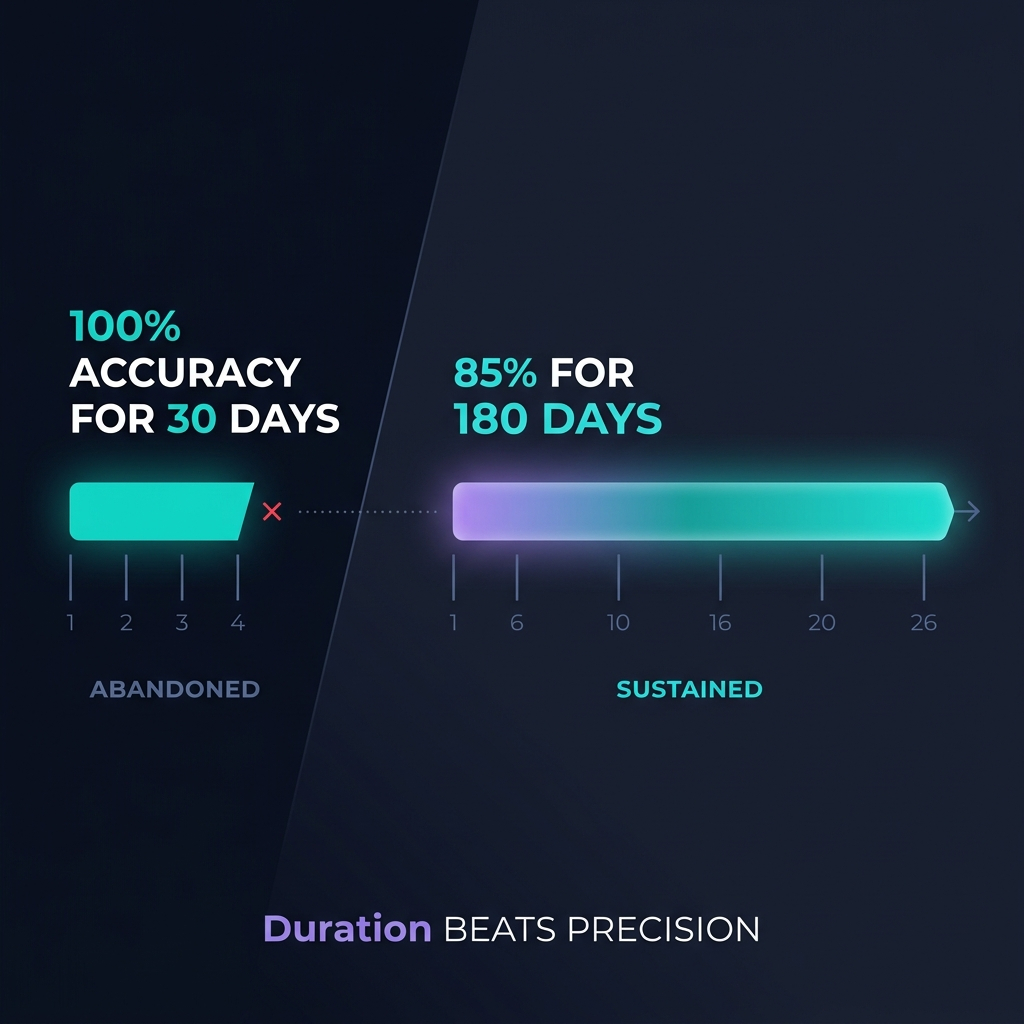
TL;DR: Weighing every ingredient produces near-perfect caloric data. Most people stop doing it within weeks. A photo-based log produces roughly 85% accuracy at a fraction of the effort, and people keep using it. Sustained imperfect data beats precise data that was never collected.
High-accuracy tracking (weighing ingredients) achieves near 100% precision but carries friction so high that 70% of users abandon it within two weeks.
Photo-based logging reaches roughly 85% accuracy with friction reduced to about 20% of detailed weighing — and users sustain it far longer.
85% accuracy over 180 days produces more actionable data than 100% accuracy over 30 days.
Drop-off is a friction problem, not a motivation problem. Reminders and streak counters address the wrong variable.
The best tracking method is the one the user will still be using in month six.
I spent months studying why people quit tracking their food.
The reason they want to quit is obvious. Logging every meal in precise detail is tedious, time-consuming, and unforgiving. The question I kept returning to was more specific: at what point does the friction of a method outweigh its benefit?
The answer changed how I think about measurement entirely.
Why High-Accuracy Tracking Has a Survival Problem
Weighing every ingredient before eating is the most accurate tracking method a consumer can use. Nutritionists recommend it. Studies are built on it. Done correctly, it produces close to 100% precision.
The problem is execution rate.
When I looked at adherence data across the industry, the pattern was consistent. Research shows that 70% of users abandon nutrition tracking apps within two weeks when the process feels too complex, and retention falls to 30% after the first month.
The same collapse shows up in clinical settings. Obesity treatment programs report a 21% dropout rate at two months, 44% at six months, and roughly 69% at twelve.
The pattern in daily life looks like this:
Week one: the user buys a scale and logs everything.
Week two: logging still happens, with growing effort.
Week three: a busy Tuesday happens. Then a dinner out.
Week four: the scale stays in the cabinet.
The user's discipline stayed the same. The demands of the method exceeded what a real schedule can absorb.
💡 The bottleneck is not data quality. It is whether the method survives contact with a real schedule.
Accuracy only matters if the method stays in use long enough to generate signal.
What 85% Accuracy Actually Delivers
I tested a different approach. One photo of a meal per day, confirmed by the user, processed against nutritional data. No weighing. No ingredient-by-ingredient entry.
The accuracy sits at roughly 85%. That 15% gap is real. Portion estimates carry inherent variance, and photo angles add margin on top.
Recent validation research confirms this range. Most consumer AI food trackers land in a 10 to 20% error range for typical meals. The same research shows that traditional text-based food diaries underreport intake by 11% to 41%, which puts photo methods ahead of the manual logging most people actually do.
Friction, meanwhile, drops to around 20% of what detailed weighing requires.
That compression has a direct effect on behavior. Users who found weighing unsustainable stay with a photo method. They build a continuous record. Over months, that record surfaces trends that a three-week streak of precise logging never had the duration to reveal.
85% accuracy maintained over 180 days outperforms 100% accuracy abandoned after 30.
💡 Key Point: Reduced friction is the mechanism that makes long-term data collection possible. It is not a concession to imperfection — it is the design requirement.
Why Drop-Off Is a Friction Problem, Not a Motivation Problem
Most tracking systems are built around data quality. The implicit assumption: give users better tools and they will produce better data. That assumption treats drop-off as a motivation problem, something to fix with reminders and streak counters.
The behavioral science points elsewhere.
"The friction you set up or remove in the environment is going to have an effect long after you've gotten discouraged and are less excited about the new behavior. That's why friction is so powerful. It persists." — Wendy Wood, research psychologist
Wood's research shows that conscious willpower is an unreliable driver of sustained behavior change, and that roughly 43% of everyday activities happen in the same context, on autopilot. BJ Fogg's behavior model reaches a similar conclusion: motivation fluctuates from one minute to the next, which makes it a weak foundation for lasting change.
When a method demands more cognitive and physical effort than a user's day can absorb, that method fails. The accuracy of its output never gets the chance to matter.
The relevant design question shifts. Instead of asking how to get users to track more accurately, I started asking a different question: what is the least demanding method that still produces actionable data?
Those are fundamentally different problems with fundamentally different solutions.
Accuracy is a data property. Adherence is a behavior property. A system designed around the first while ignoring the second solves a problem its users never had.
💡 Key Point: Accuracy is a data property. Adherence is a behavior property. A system optimized for the first while ignoring the second solves a problem its users never had.
What Long-Term Data Reveals That Short Bursts Cannot
Consistent 85% accuracy over time produces something precise short-term data lacks: a pattern.
A photo log maintained for six months surfaces correlations between meal composition, energy levels, and progress. A month of perfect logging holds too little signal to detect any of that.
The research supports this directly. A PLOS ONE study found a positive association between tracking frequency and weight loss. Consistency drove results. Perfection did not appear in the equation.
Studies of longitudinal wearable data reach the same conclusion. Trends identified across months of imperfect data detect daily routines, seasonal differences, and anomalies that a short window of clean data misses entirely.
Accuracy without duration is a snapshot. Trends require time. Time requires a method the user will actually keep using.
Duration amplifies imperfect data. Precision cannot compensate for a record that ends at week three.
💡 Key Point: A continuous, imperfect record surfaces patterns. A precise but short record produces only a snapshot. Trends require time, and time requires a method the user will keep using.
How an Adaptive Tracking System Works in Practice
This is where the design work gets specific. For users who find detailed logging natural, weighing ingredients produces cleaner data and remains the right default. The failure mode I want to avoid is a system that treats precise tracking as the only valid path and classifies everything else as failure.
An intelligent tracking system offers both methods and reads user behavior to choose between them:
Monitor consistency rate. Track how often the user logs, independent of what they log.
Detect early friction signals. Session drop-offs and rising time-per-log predict abandonment before it happens.
Adjust the method. When precise logging strains, the system shifts toward photo-based capture and preserves the record.
The goal is a maintained data record, whatever method sustains it. Users who record intake through their preferred method demonstrate higher adherence, and consistent recording predicts weight loss more reliably than method precision does.
⚠️ A caution for anyone building measurement systems: if your success metric assumes perfect user compliance, your system works in theory and fails in the field. Design for the imperfect week. Imperfect weeks are the normal condition.
💡 Key Point: An adaptive system reads behavior signals — consistency rate, session drop-offs, time-per-log — and adjusts the method before the user quits, not after.
Why This Principle Extends Beyond Meal Tracking
Any system that depends on sustained human input faces the same trade-off. Fitness logging. Budgeting. Progress monitoring of any kind. The limiting factor is rarely the precision of the tool. It is the effort the tool demands per use, repeated across hundreds of real days with real interruptions.
When someone stops tracking, the standard interpretation blames their discipline. The data tells a cleaner story. The method exceeded the friction budget of their life, and the record ended.
Systems, unlike identity, can be redesigned.
I stopped optimizing for accuracy because accuracy was never the bottleneck. The bottleneck was survival of the habit itself. The best tracking method is the one that stays in use.
That is the only definition of success that matters.
💡 Key Point: Any system that depends on sustained human input faces the same trade-off. The limiting factor is effort per use, repeated across hundreds of real days — not the precision of the tool.
Key Takeaways
Weighing every ingredient delivers near 100% accuracy, and most users abandon it within weeks under real-life friction.
Photo-based logging reduces friction to roughly 20% of detailed tracking, with roughly 85% accuracy — enough for pattern detection.
85% accuracy maintained over 180 days produces better outcomes than 100% accuracy abandoned after 30.
Drop-off is a friction problem. Reminders and streak counters treat the wrong variable.
Duration amplifies imperfect data. Continuous records surface trends that short, precise records cannot.
An adaptive system reads consistency rate, session drop-offs, and logging time, then adjusts the method to what the user will sustain.
Frequently Asked Questions
Is 85% accuracy good enough for meaningful nutritional tracking?
For pattern detection and trend analysis over weeks and months, yes. The research shows that consistency of tracking predicts outcomes more reliably than method precision. A maintained 85% record over six months surfaces correlations that a perfect 30-day log cannot.
Why do people really stop tracking their food?
Friction, not willpower. When a method demands more cognitive and physical effort than a real schedule can absorb, it fails. Behavioral research by Wendy Wood shows that roughly 43% of everyday activities run on autopilot — which means high-effort methods compete against the grain of how habits actually form.
How accurate is photo-based meal logging compared to manual entry?
Consumer AI food trackers land in a 10–20% error range for typical meals. Traditional text-based food diaries, which most people consider more accurate, underreport intake by 11–41%. Photo methods perform at least as well as — and often better than — the manual logging most users actually sustain.
What is the difference between accuracy and adherence in tracking?
Accuracy is a data property: how close the logged value is to the true value. Adherence is a behavior property: whether the user keeps logging at all. Most tracking systems optimize for accuracy and ignore adherence. That is the design flaw this article addresses.
When does weighing ingredients still make sense?
For users who find detailed logging natural and sustainable, weighing produces cleaner data and remains the right method. The problem is treating it as the only valid path and classifying lower-friction alternatives as failure.
What signals indicate a user is about to quit tracking?
Three early indicators: declining consistency rate (how often they log), rising session drop-offs (starting a log and not finishing), and increasing time-per-log. An adaptive system detects these before abandonment happens and adjusts the method.
Does this principle apply outside of meal tracking?
Yes. Fitness logging, budgeting, and progress monitoring of any kind face the same core trade-off. The limiting variable is effort per use, repeated across real days with real interruptions. Any measurement system that assumes perfect user compliance works in theory and fails in the field.