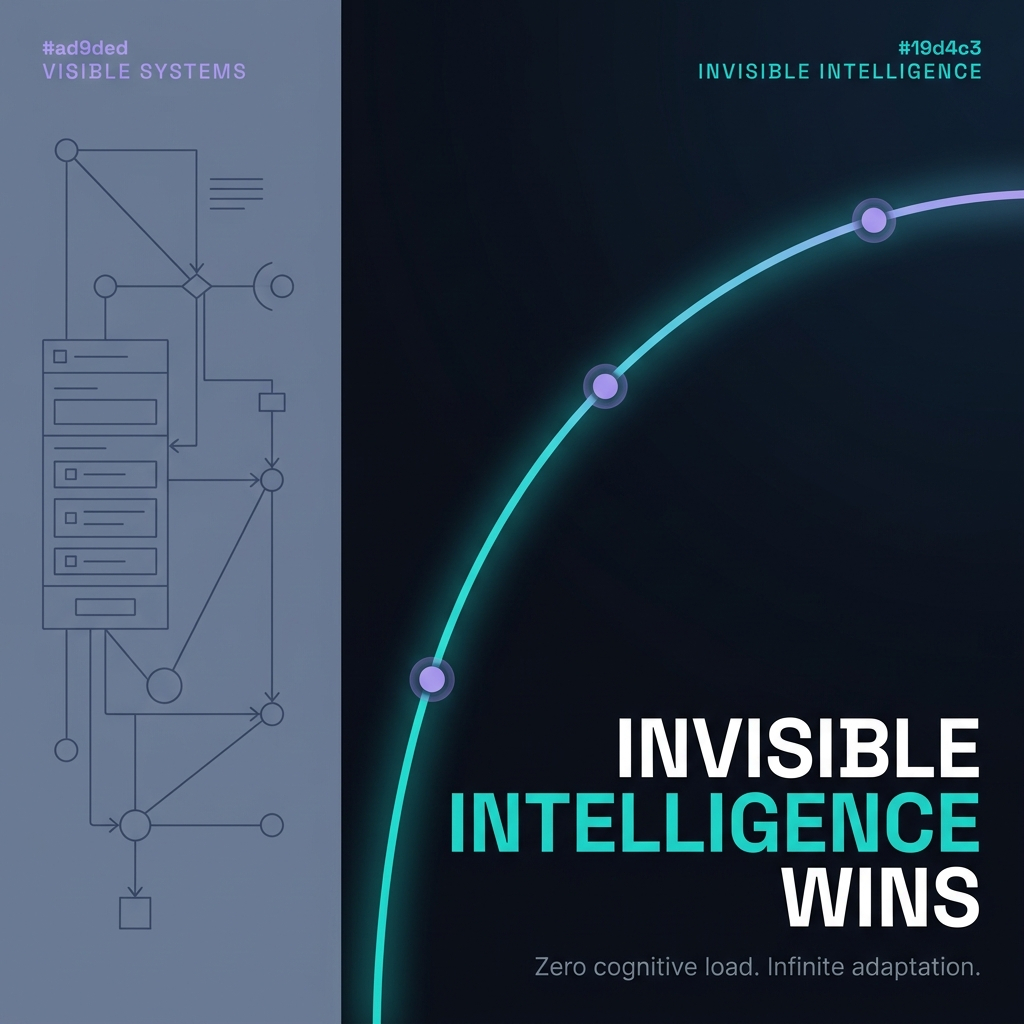
TL;DR: Most fitness apps fail not because users lack discipline, but because the systems demand a life users don't have. Invisible intelligence — technology that absorbs complexity without requiring user input — is the architectural solution. The data backs it up, and the design principles are transferable across any product that depends on sustained behavior change.
Fitness app failure is a system design problem, not a motivation problem.
Invisible intelligence means the system absorbs complexity so the user never has to process it.
Zero cognitive load is the real benchmark for intelligent technology.
Adaptive systems outperform rule-based systems by 20–30% in engagement.
If a product demands more decisions than it absorbs, users delete it — silently.
The Evidence Starts With a Failure Pattern
Every industry investigation should start with its biggest unsolved problem. In fitness technology, that problem is adherence.
Research confirms it plainly. Despite their potential, fitness apps face high attrition rates and inconsistent long-term adherence. People download, engage for two weeks, then disappear.
The common diagnosis blames motivation. That diagnosis is lazy.
When millions of people fail at the same task in the same way, the cause sits inside the system, above any individual. Infrastructure failures look like motivation failures from the outside. From the inside, they look like a Tuesday where the schedule collapsed and the app kept demanding the original plan.
If something requires willpower to maintain, the system is broken. That principle guides every architectural decision at FitPocket.
Key Point: Adherence failure in fitness technology is a structural problem — not a personal one. The system is failing the user, not the other way around.
What "Invisible" Actually Means
Invisible intelligence means the system absorbs complexity so the user never has to process it. The user experiences outcomes. The machinery stays out of view.
Researcher Amber Case describes the direction of the entire field:
"We're moving into an era where the best interface is no interface. Ambient systems must be designed to require the least attention, integrating so well that users forget they're there."
That observation from her work on ambient computing matches what user behavior confirms every day.
The moment a person has to think about the tool, the tool starts consuming the same limited attention it was supposed to protect. Zero cognitive load is the real benchmark. Users want systems that understand context without explanation.
The best sign that intelligence is working: nobody mentions it.
How to Recognize Invisible Intelligence
Context arrives before the user does. Weather, location, available equipment, and schedule already shape the plan before the plan is opened.
Adjustments happen without negotiation. A rainy day produces an indoor session automatically. Nobody files a request.
Progress reads across dimensions. Photos, body scans, measurements, and trends replace a single vanity number.
Key Point: Invisible intelligence isn't a UX pattern — it's an architectural commitment to keeping complexity on the system's side of the equation.
The Data Behind the Thesis
The ambient computing market is projected to reach $85.35 billion in 2026, growing at 26.3% annually. Capital flows toward technology that operates in the background.
Performance data points the same direction. AI-driven adaptive systems achieved a 20 to 30 percent improvement in engagement compared to rule-based systems. Real-time adaptation outperforms static programming, measurably and consistently.
Personalization research adds another layer. When systems adapt to individual context, conversion rates increase by up to 30 percent. Context is the active ingredient — above preferences and settings.
Salesforce AI Research frames the trust dimension well: the AI earns the right to be present by demonstrating it knows when to surface relevant insights and when to stay quiet.
Restraint is a feature. It is designed for deliberately.
Key Point: Market growth, engagement data, and personalization research all converge on the same conclusion — systems that operate quietly in the background consistently outperform those that demand attention.
Why Visible Intelligence Keeps Losing
Most products treat intelligence as something to display. Dashboards multiply. Notifications stack. Every algorithm announces itself with a badge or a graph.
Each announcement extracts a small tax from the user's attention.
Modern life already overwhelms people. Cognitive load research shows the increasing flow of stimuli makes it harder to filter information and focus on what matters. Technology that adds decisions to a person's day works against them, whatever its underlying quality.
The math is simple. A person managing a job, a family, and a body has a fixed budget of daily decisions. Every decision a product demands comes out of that budget. Products that demand too many decisions get deleted — quietly, without complaint.
This is commonly overlooked because deletion generates no feedback. Users rarely explain why they left. They just stop showing up, and the product team blames engagement tactics instead of architecture.
Key Point: Visible intelligence is a liability. Every notification, badge, or decision a system pushes back to the user is a small withdrawal from a fixed attention budget — and budgets run out.
How to Build for Invisibility
At FitPocket, this thesis translates into four concrete architectural rules. They apply well beyond fitness.
1. Treat Variance as the Terrain
Weather changes. Schedules collapse. Bodies respond differently than charts predict. These are first-class design constraints from day one — not edge cases handled later.
Ambient AI systems continuously interpret sensors, location data, behavioral patterns, and environmental factors to understand a user's state. Using that capability as the foundation — above decoration — separates adaptive systems from rigid ones.
2. Design for Conversation
Commands demand precision from the user. Conversation demands understanding from the system.
Voice and text access sit in FitPocket's core infrastructure because typing exact parameters into a form is a hidden tax. Saying "I only have 20 minutes and no equipment" and receiving a correct session back removes that tax entirely.
3. Make Adaptation the Default State
Every feature answers one question: does this reduce what the user has to manage? Weather adjustments, meal flexibility across vegetarian, vegan, pescatarian, and omnivore preferences, and multidimensional tracking through scans and photos — each one exists to absorb a decision the user used to make manually.
4. Let Outcomes Carry the Message
The product never explains its own cleverness. Users compare the experience to having a coach who knows them and adjusts for them. That comparison emerges from results — and it means the intelligence disappeared correctly.
Key Point: Building for invisibility requires treating real-world variance as the expected condition, not the exception. Adaptive systems are designed for that terrain from the start.
The Bigger Implication
This investigation started inside fitness. The conclusion extends further.
Any goal that requires sustained behavior change faces the same structural problem: the gap between what a person intends and what their life allows. Ambient computing research describes the solution as eliminating the friction between human intention and digital response.
That gap is the next layer of software. An intelligent layer that sits between intention and execution, closing it through design instead of demanding more effort from the person.
Fitness is the wedge into that layer. The endpoint is an operating system for adaptive personal development — one that meets people where they are.
Key Point: Invisible intelligence isn't a fitness concept — it's the architecture for any system that needs to sustain human behavior across real-world variance.
What This Means for Builders and Users
If you build products, audit your intelligence for visibility. Count the decisions your system pushes back onto the user. Each one is a leak.
If you evaluate technology for your own life, apply one test: after two weeks, notice whether the tool asks more of you than it absorbs for you. Tools that absorb more than they ask survive. The rest get deleted.
The evidence, the market, and a decade of adherence data all converge on the same finding.
Invisible intelligence wins every time.
Build accordingly.
Frequently Asked Questions
What is invisible intelligence in technology?
Invisible intelligence refers to systems that absorb complexity and adapt to user context without requiring explicit input or attention. The user experiences outcomes; the mechanism stays out of view.
Why do fitness apps have such high dropout rates?
Because most fitness apps are built around static plans that assume ideal conditions. When real life intervenes — schedule changes, weather, fatigue — the app demands the original plan anyway. That friction causes dropout, not lack of motivation.
How does ambient computing relate to fitness technology?
Ambient computing describes systems that operate in the background, interpreting environmental and behavioral signals without requiring direct interaction. Applied to fitness, it means workouts adjust automatically based on weather, location, and schedule — before the user has to ask.
What is cognitive load, and why does it matter for app design?
Cognitive load is the mental effort required to process information and make decisions. Every decision an app pushes onto the user consumes a portion of a fixed daily budget. Products that exceed that budget get deleted. Invisible intelligence minimizes cognitive load by keeping decisions on the system's side.
What makes adaptive AI systems better than rule-based systems?
Adaptive AI systems interpret real-time signals — location, behavior, environment — and adjust outputs accordingly. Rule-based systems follow fixed logic regardless of context. Research shows adaptive systems achieve 20–30% better engagement because they respond to how people actually live, not how plans assume they live.
How does FitPocket implement invisible intelligence?
FitPocket builds invisible intelligence through four architectural principles: treating variance as the terrain, designing for conversation (voice and text access), making adaptation the default state, and letting outcomes carry the message rather than surfacing the system's own logic to users.
Is invisible intelligence only relevant to fitness apps?
No. The same principle applies to any product that depends on sustained behavior change. The gap between intention and execution is a structural problem that appears across health, productivity, finance, and learning — any domain where real-world variance disrupts planned behavior.
How can a user tell if an app uses invisible intelligence well?
Apply a two-week test: if the tool asks more of you than it absorbs for you, the intelligence is visible — and the product will likely be deleted. If the tool consistently adjusts to your life without requiring explanation, the intelligence is doing its job.
Key Takeaways
Fitness app dropout is an infrastructure failure, not a motivation failure.
Invisible intelligence means the system absorbs complexity — the user only experiences outcomes.
Zero cognitive load is the real benchmark: if the user has to think about the tool, the tool is failing.
Adaptive AI systems outperform rule-based systems by 20–30% in engagement because they respond to real context, not ideal conditions.
Every decision a product pushes back to the user is a withdrawal from a fixed attention budget. Exceed that budget and the product gets deleted.
Restraint is a feature. Systems that know when to stay quiet earn user trust.
The principle extends beyond fitness — invisible intelligence is the architecture for any system built to sustain human behavior across real-world variance.