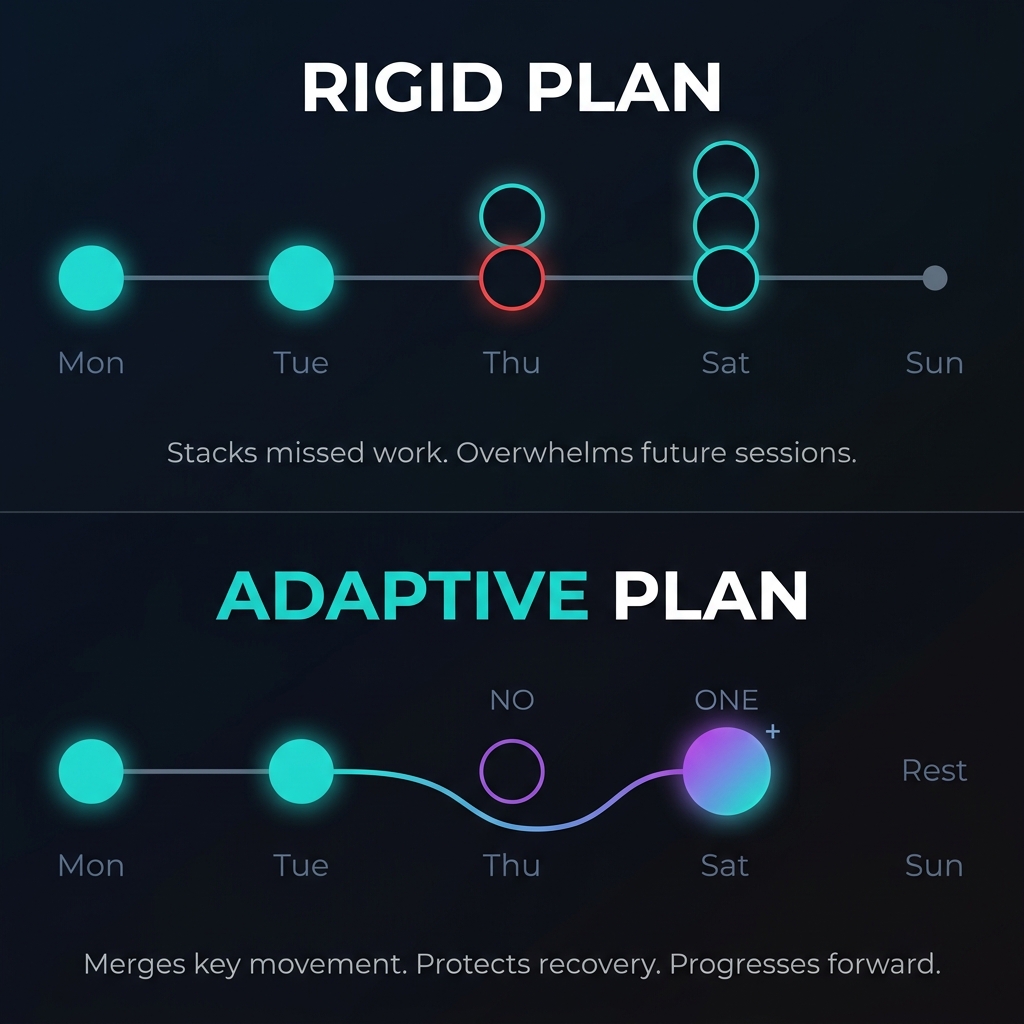
TL;DR: Missing a workout does not break an adaptive plan. FitPocket detects the absence, ranks the missed session's movements by priority, merges the highest-value work into your next available slot, drops accessory volume, and adjusts your progression timeline by days. Your goal, recovery spacing, and training split structure stay exactly where they were.
At a Glance
Adaptive plans recalculate the week — they do not stack missed sessions on top of remaining ones.
The primary movement pattern from the missed session merges into the next available slot.
Weekly volume drops slightly rather than doubling up, because cramming volume creates fatigue, not progress.
Rest days and recovery spacing are protected constraints — never flexible ones.
Progression timelines shift by days after one miss. They do not reset.
I built FitPocket because I kept seeing the same failure. The workout was fine. The plan around the workout was brittle.
This article walks through one real missed-session scenario, step by step, so you can see what moves, what stays fixed, and the reasoning behind both.
Why Missed Sessions Break Rigid Plans
Most fitness plans treat a missed workout as an error state. The plan assumes you will make it up, and when you cannot, guilt accumulates faster than fatigue.
The data shows how badly this ends. A study of 389,481 fitness app users found that only 10.1% of beginners remained adherent at 12 months, with a median dropout time of 19 weeks.
Intention is rarely the problem. Roughly 46% of adults with strong intentions to exercise fail to turn them into action. Researchers point to the same gap I saw as a founder: interventions leave out contextual changes over time.
Schedules collapse. Weather shifts. Kids get sick. A plan that treats these as edge cases has designed itself for a person who does not exist.
💡 Tip: If your current plan requires willpower to maintain after a disruption, the plan is the problem. Design absorbs variance. Discipline burns out trying to.
Bottom line: Rigid plans fail because they assume a stable life. Adaptive plans are built for the life that actually happens.
The Scenario: You Missed Thursday's Lower Body Session
Here is a concrete case, the same one shown in the demonstration screenshots inside the app.
Your week as planned:
Monday: Upper body strength (completed)
Tuesday: 30-minute zone 2 run (completed)
Thursday: Lower body strength (missed)
Saturday: Full body + conditioning (upcoming)
Sunday: Rest
Thursday evening, a work deadline ate your training window. Friday morning, you open FitPocket. There is nothing to confess and no red warning banner. The plan has already recalculated.
What the Recalculated Week Looks Like
Saturday's session changed. It now leads with a heavy squat pattern pulled from the missed Thursday session, followed by a compressed version of the original full body work. Total session time stays within your stated 60-minute window.
Weekly lower body volume dropped by roughly 25% instead of being fully recovered. The system prioritized the highest-value movement and let accessory work go.
Sunday stays a rest day. Recovery spacing is a protected constraint, never a flexible one.
Next week is untouched. Your progression targets shift forward by the actual training stimulus you received, measured in completed work rather than calendar days.
Key Point: One missed session produces a measured, surgical adjustment — not a cascade of disruption through the rest of your plan.
How It Works: The Recalculation Logic Step by Step
The logic runs the same way every time. Here is the sequence.
1. Detect the miss.
The session window closes without a logged workout. No user action required. The system reads absence as a signal, the same way it reads weather or location.
2. Rank what the missed session contained.
Every session has a primary stimulus and secondary work. Thursday's primary stimulus was the squat pattern. Accessory calf and core work ranked lower.
3. Check remaining capacity in the week.
The system looks at your open slots, your stated time limits, and your recovery spacing. Saturday had room for one added compound movement. It did not have room for two extra hours.
4. Merge, reduce, and protect.
The primary stimulus merges into Saturday. Secondary work is dropped for the week. Rest days and your maximum session length stay locked.
5. Adjust the progression timeline.
Load targets for next week recalculate from completed work. One missed session shifts progression by days. It never triggers a restart.
💡 You can override any of this. Ask the coach by voice or text to restore the full session, swap it to a different day, or skip it entirely. The recalculation is a default, and you remain the decision-maker.
Key Point: The system handles five distinct steps automatically — detection, ranking, capacity check, merging, and timeline adjustment — without requiring any input from the user.
What Stays Fixed, and Why
Adaptive means responsive to reality. It does not mean everything is negotiable. Three things never move after a single missed session.
Your goal. One missed workout carries almost no information about your long-term trajectory. The research backs this up: consistency in the first 28 days was the strongest predictor of adherence, and consistency means returning, never means perfection.
Recovery spacing. Cramming missed volume into recovery windows trades a missed session for accumulated fatigue. Coaches structure planned deloads precisely because fatigue management drives progression, with athletes typically deloading every 5.6 weeks on average. A system that erases rest days to "catch up" works against the same principle.
Your training split logic. The structure of your week reflects your equipment, your schedule, and your preferences across 175+ supported countries and contexts. A single disruption changes the contents of a slot. It leaves the architecture alone.
Fixed structure plus flexible contents. That combination is what lets a plan survive a real life.
Key Point: Adaptive flexibility and structural stability are not opposites. Goal, recovery spacing, and training split stay locked so that the adjustments around them can be trusted.
What FitPocket Does Not Claim
Transparency matters more in fitness than in most categories, because the industry has trained people to expect exaggeration. So, plainly:
FitPocket does not claim that adaptive scheduling guarantees results. Long-term exercise adherence drops to 30% to 50% in the first year for the general population, and no software eliminates that reality on its own.
FitPocket does not diagnose injuries, treat medical conditions, or replace clinical guidance. If you have a health condition, talk to a physician before changing your training.
FitPocket does not claim its recalculation logic is superior to a qualified human coach observing you in person.
FitPocket does not claim that one algorithm fits every athlete. Advanced lifters with competition timelines have constraints the default logic will not fully capture, and manual overrides exist for exactly that reason.
⚠️ If you miss multiple weeks due to illness or injury, the correct move is a structured ramp-up, never a merged mega-session. FitPocket flags extended absences and rebuilds from reduced volume.
Key Point: Clear limits build credibility. Knowing what the system will not do helps set accurate expectations for what it will.
How to Set This Up in FitPocket
1. Set your real constraints. Enter your true available days and maximum session length. The recalculation is only as honest as the inputs.
2. Mark protected days. Days you flag as rest or unavailable stay locked during any recalculation.
3. Let missed sessions pass without logging excuses. The system needs no explanation to adapt.
4. Review the recalculated week each Friday. Adjust by voice or text if the defaults miss something the system cannot see.
Full details on the scheduling logic live on the adaptive scheduling feature page, and the underlying decision model is documented on the AI coaching mechanics page.
Key Point: Four inputs — real constraints, protected days, passive absence detection, and a weekly review — are all the setup the system requires.
FAQs
Does the missed workout just get deleted?
No. Its primary movement pattern merges into your next available session. Lower-priority accessory work is dropped for that week only, and next week's plan restores the full structure.
What happens if I miss two or three sessions in a row?
The system stops merging and starts reducing. After multiple misses, the plan lowers the coming week's total volume and rebuilds toward your baseline over one to two weeks, following the same volume-reduction logic coaches use in structured deloads.
Can I force the app to schedule a makeup session instead?
Yes. Tell the coach by voice or text to restore the full session on any open day. Your stated preferences override the default recalculation.
Does missing a workout reset my progression?
No. Progression targets recalculate from completed work. One miss shifts your timeline by days. Resets only happen after extended absences, and even then the ramp-up starts from your last verified level, never from zero.
Does this work for cardio and running plans too?
Yes. Missed runs follow the same logic: the key stimulus of the week is protected, junk volume is dropped, and synced data from Strava and Apple Health informs the recalculation.
Will the system notify me when it recalculates?
The recalculated plan appears automatically when you open the app after a missed session. No notification is required because the updated plan is what you see by default.
What if I missed a session because of an injury?
Flag the affected day as unavailable and note the limitation to the coach by voice or text. The system will route around the injury pattern and reduce load accordingly. Extended injury periods trigger the structured ramp-up protocol rather than standard recalculation.
Can I still see what the original plan looked like?
Yes. The session history shows completed, skipped, and recalculated sessions so you can track what actually happened versus what was originally scheduled.
Author and Review
Author: Written by the founder of FitPocket, who designed the adaptive scheduling architecture described in this article and has spent his career building systems that adjust to real-world constraints rather than demanding compliance with fixed programs.
Expert review: The training and recovery claims in this article were reviewed by a certified strength and conditioning specialist (CSCS). Statements about adherence rates and deloading cite peer-reviewed research, linked inline.
Key Takeaways
Adaptive plans recalculate — they do not punish. A missed session triggers a measured redistribution, not a cascade of disruption.
Primary movement patterns are protected. Accessory and lower-priority work is what gets cut when volume has to give.
Rest days are non-negotiable. Cramming volume into recovery windows creates fatigue debt, not makeup gains.
One missed session shifts your progression timeline by days, not weeks. It never resets it.
The system requires no explanation or user action to adapt. Absence is a signal it reads automatically.
Manual overrides exist for every default. The recalculation is a starting point, not a mandate.
Multiple consecutive misses trigger a volume reduction and structured ramp-up — the same protocol coaches use after deloads.
Try It on Your Own Schedule
The next time your week falls apart, watch what your plan does about it. If the answer is nothing, you now know what to look for.
→ Download FitPocket on the App Store and let the plan adapt to the week you actually have.
Primary Sources
Frontiers in Sports and Active Living: 12-month adherence study of 389,481 fitness app users — https://www.frontiersin.org/journals/sports-and-active-living/articles/10.3389/fspor.2026.1855668/full
Clinical Interventions in Aging: intention-behavior gap in exercise — https://www.dovepress.com/revolution-or-empty-promise-a-6--and-12-month-follow-up-to-an-rct-of-t-peer-reviewed-fulltext-article-CIA
JMIR Research Protocols: adaptive interventions and contextual personalization — https://www.researchprotocols.org/2025/1/e73766
Sports Medicine Open: deloading practices in strength sports — https://link.springer.com/article/10.1186/s40798-024-00691-y
PMC: coach perspectives on deload structure — https://pmc.ncbi.nlm.nih.gov/articles/PMC9811819/