Almost every fitness app on the market claims to be personalized. It greets you by name. It asks your goal, your starting weight, your preferred training days. Then it hands you a plan and expects your life to hold still for twelve weeks.
Your life does not hold still. Weather changes. Schedules collapse. Your body responds differently than the chart predicted.
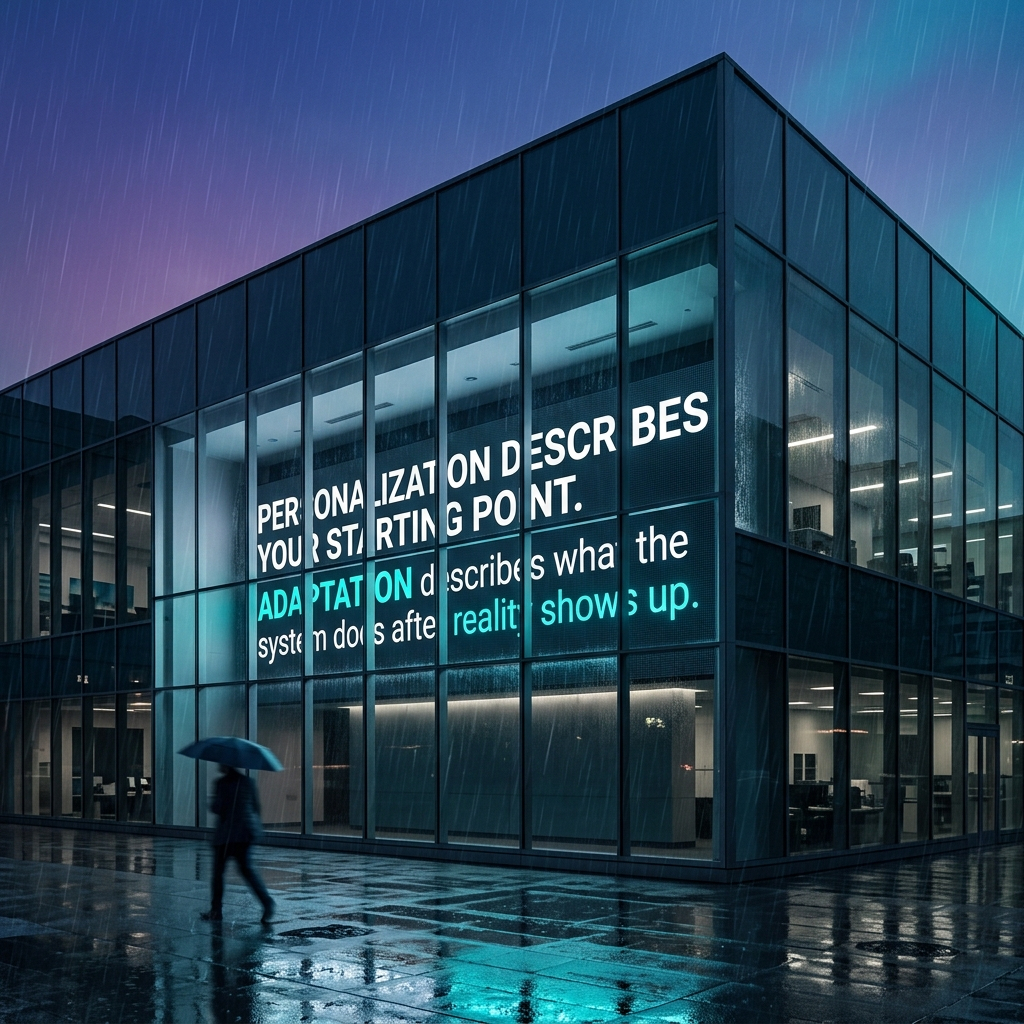
I have spent years building in this space, and I keep returning to one distinction that the industry blurs on purpose. Personalization describes your starting point. Adaptation describes what the system does after reality shows up. Most products deliver the first and market it as the second.
THE DEFINITIONS THE INDUSTRY AVOIDS
Here is how I draw the line in practice.
Personalization is configuration. The system stores facts about you at signup and uses them to select a template. Your name appears in the header. Your calorie target reflects your bodyweight. The plan says "for you" because a form filled in the variables.
Adaptation is response. The system changes what you do next based on what just happened to you. You skipped Tuesday because a meeting ran long. It rained, and your outdoor run needs an indoor equivalent. Your recovery lagged, and tomorrow's load has to drop.
Configuration happens once. Response happens continuously.
The technical literature is precise about this. Adaptive AI describes intelligent systems that adjust their behavior in real time based on new information, shifting environments, and evolving user needs. Static training data and fixed rules sit outside that definition. Most fitness apps run on fixed rules with your name attached.
THE EVIDENCE IS IN THE RETENTION DATA
If personalization solved the problem, retention numbers would show it. They show the opposite.
Health and fitness apps held a 3% retention rate by day 30 in 2023. Ninety-seven out of a hundred people who downloaded a "personalized" fitness app in January were gone by February.
The steepest churn hits apps that rely on manual logging, where the friction of data entry outweighs the perceived benefit within the first month. Analysts now point to choice paralysis from oversized workout libraries as another primary driver of abandonment.
Read those two findings together and a pattern emerges. Users leave when the system demands work from them. Manual logging demands work. Choosing from 800 workouts demands work. A plan that ignores a schedule collapse demands the hardest work of all, which is rebuilding the plan yourself.
These are infrastructure failures. The industry has spent two decades labeling them motivation failures, and users have absorbed that blame as personal shame.
💡 A useful test: if a product requires willpower to maintain, the system is broken. Willpower is the tax users pay for engineering that stopped at configuration.
WHY THE GAP EXISTS
The gap between the personalization claim and the adaptive reality is well documented far beyond fitness.
Research shows that 89% of companies invest in personalization while 96% struggle to execute it. They stall in pilot programs because they treat personalization as a feature to bolt on rather than a capability that requires deep engineering.
Gartner research goes further. Personalized marketing generates negative experiences for 53% of customers, and 76% of consumers report frustration when companies claim tailored interactions and fail to deliver them. The word has been spent faster than the capability has been built.
The reason is structural. Personalization is cheap to ship. You add a form, a template selector, and a first name field, and the marketing page writes itself.
Adaptation is expensive to ship. Consider what a genuinely adaptive fitness system has to do:
- Ingest context as first-class input. Weather, schedule, available equipment, and location are constraints the plan must resolve before it renders, rather than edge cases to handle later.
- Separate signal from noise. One bad night of sleep means something different than three declining weeks of strength. The system needs models that distinguish variance from trend.
- Recompute the plan continuously. Every completed, modified, or skipped session updates what comes next. The plan is a living output, recalculated against current reality.
- Track progress across multiple dimensions. Body scans, measurements, photos, and trend lines together describe what is actually happening. A single scale weight describes almost nothing.
- Accept input as conversation. Voice and text access lowers the reporting cost to near zero. Manual logging forms raise it until people quit.
Each of those items is an architecture decision. None of them can be retrofitted onto a template engine. This is why so few companies build them, and why the retention curve keeps punishing everyone who skips them.
WHAT I LEARNED BUILDING FOR THE MESSY WEEK
When I started building FitPocket, I made a decision that shaped everything downstream. I designed for the messy week as the default condition.
Most fitness software is designed and tested against a clean week. Four planned sessions, completed as written, in good weather, with full equipment. That week exists mainly in demo environments.
The real week contains a canceled gym visit, a rainstorm, a work trip, and a Thursday where you had twenty minutes instead of sixty. A system built for the clean week treats each of those events as user error. A system built for the messy week treats them as inputs.
The difference shows up in how people talk about their own history. When the system flexes around a schedule collapse instead of penalizing it, people stop defending their past failures. They start recognizing those failures as system failures. The shame leaves the room through architecture rather than through pep talks.
Nearly half of the people who begin an exercise program drop out within six months, and researchers point to the absence of systems that adapt to life events, stress, and competing priorities as a core factor. The behavior science and the engineering requirement point at the same target. Sustainable behavior emerges from reduced friction. Discipline was never the missing ingredient.
THE DISTINCTION MATTERS BEYOND FITNESS
Fitness happens to be where I work, and it makes the pattern unusually visible because the feedback loop is fast and physical. The same distinction applies anywhere software claims to be tailored.
An education platform that stores your grade level has been configured. One that changes tomorrow's lesson based on today's mistakes has been engineered to adapt. A financial tool that knows your income has been configured. One that restructures your plan when your expenses spike has been engineered to adapt.
Gartner named adaptive AI a top strategic technology trend, and analysts project that businesses implementing it will outperform competitors by 25% by 2026. In fitness specifically, apps with AI-driven adaptive capabilities already show 50% higher retention than those without them. The market is beginning to price the difference, even before most users have the vocabulary for it.
HOW TO TELL WHICH ONE YOU ARE HOLDING
You can run this test on any app in about a week. Three checks:
- Skip a session. Watch what happens to the rest of the plan. A configured system shows you the same schedule with a red mark. An adaptive system redistributes the work.
- Change your context. Report an injury, a travel day, or missing equipment. Count how many taps it takes and whether the next session actually differs.
- Look at week six. If the plan for week six was fully written on day one, the system finished thinking about you at signup.
Most products fail all three checks while advertising personalization on their landing page.
My position, after building this for years, is straightforward. Personalization is a marketing word because it describes a moment. Adaptation is an engineering commitment because it describes a relationship. The system either recomputes against your reality every day, or it hands you a template and grades you against it.
People compare genuinely adaptive systems to having a coach who knows them, adjusts for them, and withholds judgment. Nobody compares a template to that.
The next time an app promises it was built for you, skip a workout and watch what it does. The response tells you everything the landing page left out.