Monday morning. Your app says leg day.
It said leg day last week. It will say leg day next week. It says leg day whether you slept four hours, landed from an overnight flight at 2am, or woke up with a fever.
I have spent years building fitness technology, and this is the design decision I keep coming back to: almost every fitness app treats the calendar as ground truth. The schedule sits at the center of the architecture. The human orbits around it.
Once you see this, you see it everywhere. I want to walk you through why this happens, what it costs, and what a system looks like when it takes the human signal seriously.
The Evidence: People Leave, and the Timing Tells the Story
Start with the numbers, because they are brutal.
Fitness apps lose roughly 80% of users within the first 30 days. The steepest drop hits apps that rely on manual logging. Friction compounds faster than motivation, and by day 30 the compounding wins.
Zoom out further. Among beginners, only 18.1% remain adherent at six months, with a median dropout time of 14 weeks. Health and fitness apps carry roughly 67% annual churn, the steepest churn category of any consumer subscription.
💡 Read the timing, then read the pattern. Fourteen weeks is long enough to prove intent. Nobody uses an app for three and a half months without wanting the result. Something else breaks.
The industry's standard explanation is that users lose motivation. I find that explanation convenient and incomplete. It places the failure inside the user, which means the software never has to change.
What Actually Breaks at Week 14
Here is my reconstruction of the dropout, based on everything I have seen building FitPocket.
Week one through four, life cooperates. The schedule and reality happen to align, so the rigid system looks like it works.
Then variance arrives. It always arrives.
- A work trip lands on push day, and the hotel has two dumbbells and a broken treadmill.
- A kid gets sick, and the Tuesday session evaporates.
- Rain cancels the outdoor run the plan assumed.
- A rough night of sleep turns the prescribed intensity into a genuinely bad idea.
The app registers each of these events the same way: a missed workout. A red mark. A broken streak. The system had one model of the week, reality delivered a different one, and the software assigned the error to the human.
Miss enough sessions and the plan drifts out of sync with your actual body. The app is now programming for a person who trained consistently for six weeks. That person does not exist. You are the person who trained four out of six weeks because life happened, and the plan has no representation of you at all.
Quitting at that point is a rational response to software that stopped describing your situation.
The Absurdity Nobody Names
Consider what "Monday leg day" actually encodes.
It encodes an assumption that your recovery, sleep, stress, travel, equipment access, and health status are constants. Every one of those is a variable. The schedule flattens all of them into a single static instruction and then measures you against it.
In any other domain of software, we would call this a modeling error. A logistics system that ignored weather would get rewritten. A navigation app that ignored traffic would get deleted. Fitness software ignores the equivalent signals from the human body and calls the resulting failure a discipline problem.
The data to do better already exists. Research on context-aware computing shows systems can interpret user activity, location, and environmental conditions in real time and adapt to fluctuating demands. AI-driven training systems already adjust workout intensity based on wearable data like elevated heart rate and signs of fatigue. The technical foundation is proven.
The calendar-centric design persists because it is easy to build, easy to sell, and easy to blame the user when it fails.
What "Ground Truth" Should Actually Mean
Here is the core of my argument.
Ground truth is the human signal. The calendar is a hypothesis.
A schedule is a prediction made days or weeks in advance about conditions nobody can predict days or weeks in advance. Treating that prediction as authoritative, and treating live information about the actual human as noise, inverts the correct hierarchy.
A system built on the correct hierarchy behaves differently at every layer:
Signal collection. Sleep, recovery markers, location, available equipment, weather, and stated preferences enter the system as first-class inputs. Weather stops being an edge case. Travel stops being an edge case. These are the normal operating conditions of a human life.
Interpretation. A skipped session on four hours of sleep reads as sound judgment, and the system logs it that way. The plan updates to reflect the body that showed up today.
Response. The overnight flight triggers a session built for a hotel room with two dumbbells. The fever triggers rest and a recalibrated week. The rain triggers an indoor substitution. No red marks. No broken streaks. No penalty for living.
⚠️ One caution: adaptation without judgment matters. A system that responds to every signal, including the weak ones, becomes chaotic. Intelligence means separating signal from noise, then adjusting quietly. When it works, you never think about it.
Why This Removes Shame From the Architecture
There is a second effect of this design shift, and I consider it the more important one.
When the schedule is ground truth, every deviation becomes a personal failure. The app quantifies it, color codes it, and shows it back to you. Years of this trains people to narrate their fitness history as a character defect.
I have watched that narration reverse in real time. When I explain adaptive architecture to someone, they stop defending their past attempts. They start recognizing those attempts as system failures. The rigid program failed to model their life, and the failure was assigned to the wrong party.
The research backs this up. Studies on behavior change techniques show that goal setting, self-monitoring, and feedback work best when simplified and personalized, and lose effectiveness when they add friction through complex compliance demands. Perceived value and personalization drive long-term engagement with digital health tools. Tailored systems reduce dropout.
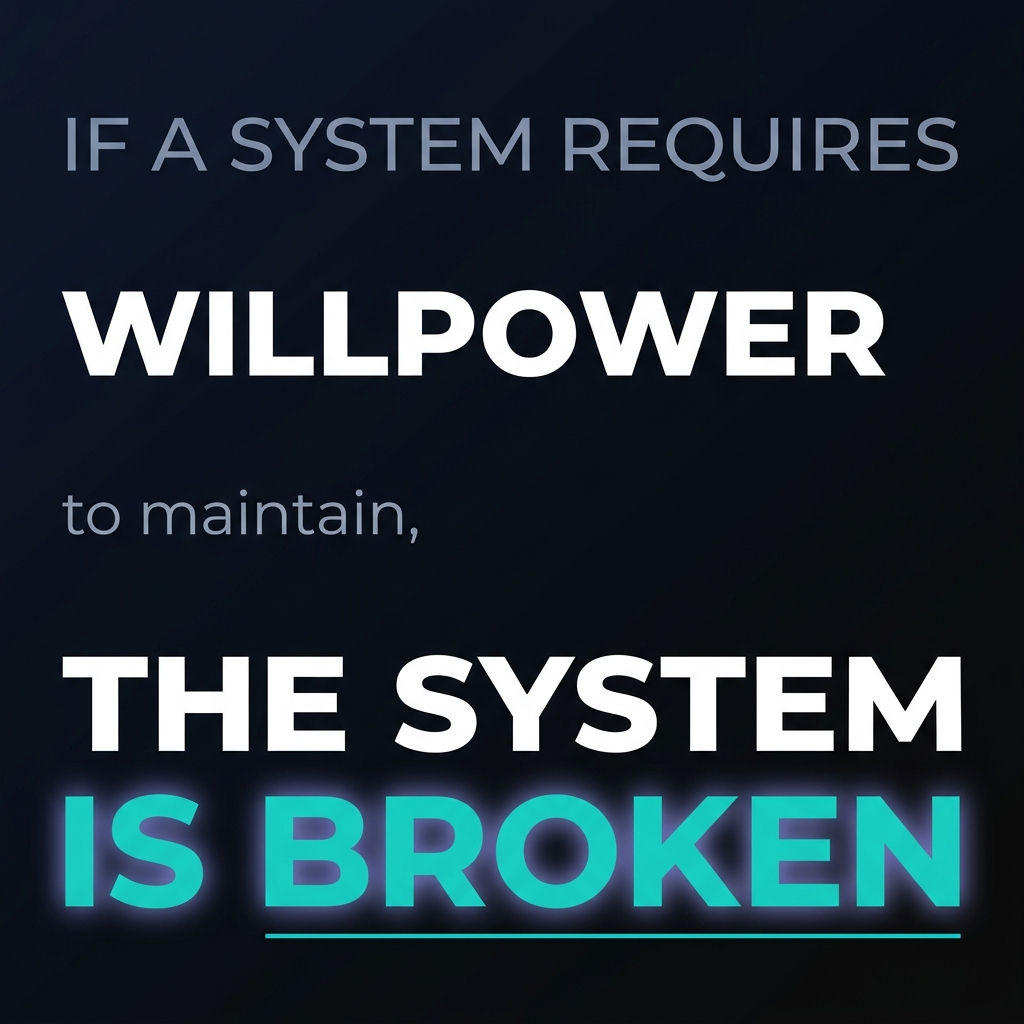
Sustainable behavior emerges from reduced friction. A plan that flexes around your real constraints requires no willpower to maintain, because it never asks you to do the impossible. My working rule is simple: if a system requires willpower to maintain, the system is broken.
The Question I'd Ask Any Fitness Product Team
If I could audit any fitness app, I would ask one thing: show me what happens in your system when the user's life diverges from the plan.
Most products answer with a notification, a guilt mechanic, or a streak reset. Each of those is the software insisting its prediction was correct and reality was wrong.
The better answer is a recalculation. Navigation software solved this years ago. You miss a turn, and the system computes a new route from where you actually are. It never scolds you for missing the turn. It never makes you drive back to the start.
Fitness deserves the same architecture. Meet the person where they are today, with the sleep they got, the equipment they have, and the weather outside their door. Build the plan from that position.
Where This Goes Next
I believe adaptive architecture extends past fitness. Any goal that requires sustained behavior over months, whether health, learning, or finances, runs into the same collision between static plans and variable lives. The intelligent layer that closes that gap becomes valuable everywhere the gap exists.
Fitness happens to be the sharpest test case, because the human signals are measurable and the churn data makes the failure undeniable.
So here is where I land.
The 67% annual churn in fitness apps is a verdict on an architecture. The industry has spent a decade optimizing rigid programs, adding features to rigid programs, and gamifying rigid programs. The rigidity itself is the defect.
The next generation of fitness software will treat the human as ground truth and the calendar as a working draft. The teams that build this way will keep their users past week 14. The teams that keep shipping Monday leg day to a person running a fever will keep watching them leave.
Take a look at your own fitness app tonight. Check what it has planned for you tomorrow. Then ask yourself whether it knows anything about the day you actually had. If the answer is no, you have found the reason it will eventually stop working for you, and you will know it was never your fault.