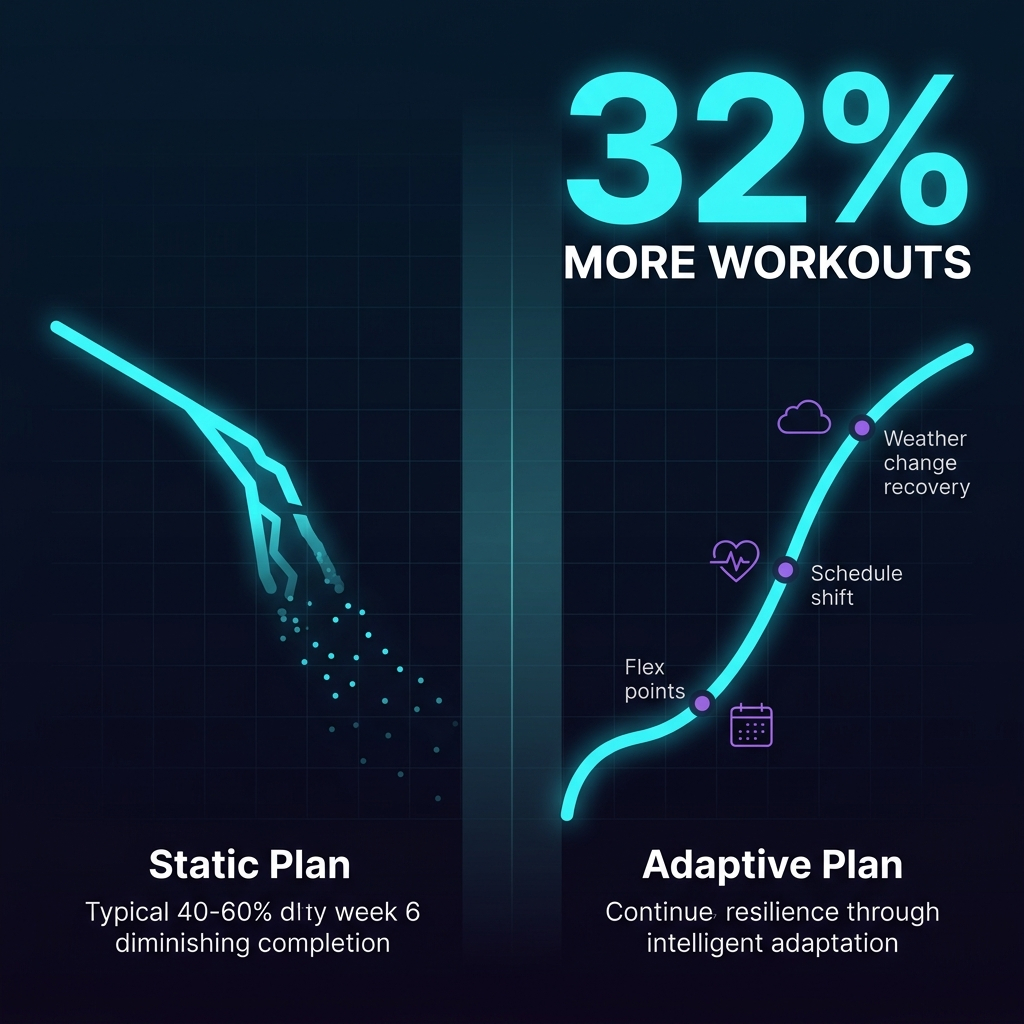
TL;DR: Around half of new gym members quit within six months. The founder of FitPocket reads that number as an infrastructure failure. Static plans stay frozen while real life keeps moving, and the gap between the two produces drift. FitPocket Pro regenerates training around three live inputs, weather, recovery, and schedule, and treats adaptation as core architecture. The result shows up in the data: adaptive plans produce 32% more completed workouts per month.
Around 50% of new gym members quit within six months — not from lack of motivation, but because static plans fail to adapt to changing conditions.
FitPocket Pro's regeneration engine rewrites training plans around three live inputs: weather, recovery, and schedule.
Adaptive plan users complete 32% more workouts per month than users on static templates.
Weather is a measurable training variable: runners slow 1.7–4.5% for every 9°F rise above 41°F.
A free 4-week trial lets the system prove its value before any payment decision.
The Dropout Problem, Examined Again
Roughly half of new members quit the gym within their first six months. The fitness industry has explained this for decades with a single word: motivation.
The founder of FitPocket examined the same evidence and reached a different diagnosis.
People quit when their plan stops matching their week. A schedule collapses. Weather turns. Recovery lags behind what the chart predicted. The plan stays frozen, and the person slowly moves away from it.
He calls this drift. He treats it as an infrastructure failure.
This article traces how that diagnosis shaped FitPocket Pro, what the numbers show, and what the case teaches anyone who builds systems that depend on sustained human behavior.
What the Churn Data Actually Says
The drift is measurable across the entire category.
Fitness apps average 9.2% monthly churn. Lost motivation drives 38% of cancellations. January cohorts sign up in massive volume, then 40 to 60% cancel by February.
The founder reads those numbers as a design signal.
February brings disrupted schedules, cold snaps, and missed sessions. A static plan absorbs none of it. Each missed workout compounds. The plan grows further from reality every week. Abandonment becomes the rational choice.
You have likely experienced this yourself. The plan assumed a version of your life that lasted exactly eleven days.
Key Point: The 38% who cite "lost motivation" are describing a symptom. The structural cause is a plan that stopped reflecting their actual week.
Weather Is a Training Variable, and Most Plans Ignore It
The environment carries hard numbers too.
Runners slow 1.7 to 4.5% for every 9°F increase above 41°F. In a machine learning analysis of running performance, air temperature earned a feature importance score of 40 percent, ahead of humidity, solar radiation, and wind.
Weather is a first-class training variable. This is commonly overlooked. Most plans treat it as an inconvenience the user should push through.
The founder treats it as a required input. A plan that prescribes an outdoor tempo run during a heat wave is prescribing a worse workout and calling it discipline.
Inside the Regeneration Engine
FitPocket Pro was built around one operating principle.
If your training plan does not change when your week does, you will drift.
The system regenerates training around three live inputs:
Weather. Outdoor sessions shift indoors. Intensity adjusts to heat and cold.
Recovery. The plan responds to how your body actually performed, beyond what the chart predicted.
Schedule. A collapsed Tuesday redistributes across the remaining week instead of registering as failure.
The founder is explicit that regeneration sits in the core architecture. In his framing, intelligence in a system means adapting to signal. A missed workout is signal. A heat wave is signal. A plan that reads those signals and rewrites itself removes the friction between intention and execution.
💡 The design test he applies to every feature: if maintaining the behavior requires willpower, the system is broken.
Key Point: Regeneration works as the operating system. The three live inputs replace rigid planning with continuous responsiveness.
The Evidence for Adaptive Training
The adaptive approach has measurable support.
Users following adaptive workouts complete 32% more workouts per month than users on static templates, according to Fitbod's anonymized workout data. Estimated one-rep maxes on core lifts improve 15 to 20% faster when workouts adjust dynamically.
The people abandoning fitness plans have plenty of desire. Their systems fail to adapt when life changes, and the drift begins there.
This reframes the retention conversation entirely. You stopped following your last plan because the plan stopped following you. The completion data supports that claim.
Key Point: A 32% increase in completion is an architectural outcome. Adaptation drives follow-through because the plan stays relevant to actual conditions.
A Business Model That Matches the Architecture
The conversion design mirrors the product philosophy.
FitPocket Pro starts with a free 4-week plan. The upgrade happens after the system demonstrates that it adapts to your actual life. No urgency mechanics. No countdown timers.
Four weeks gives the regeneration engine enough disrupted Tuesdays and rained-out sessions to show its value on real terrain, including the imperfect weeks.
The founder treats this as consistent architecture. A system built on earned adaptation should also earn its revenue. Payment follows proof.
Key Point: Performance-based conversion is the revenue model because it is also the product model. Trust builds across four real weeks.
Lessons From the Case
Three takeaways travel well beyond fitness.
1. Diagnose Infrastructure Before Diagnosing People
High dropout rates are commonly read as a discipline problem. Reading them as a design problem opens solutions that motivation rhetoric never reaches. The 38% "lost motivation" figure looks completely different once you ask what the system did when life changed.
2. Treat Variance as the Terrain
Weather, schedules, and recovery are the actual operating conditions of any sustained behavior. Systems designed for those conditions from day one outperform systems that handle them as exceptions. The founder builds for the person with a real life, and the completion data rewards that choice.
3. Let the Product Earn the Commitment
A trial that survives real-world disruption builds durable trust. Feature lists communicate intent. Four weeks of adaptive performance communicates proof. Consumers increasingly expect the second one.
The FitPocket case shows what happens when a founder takes the failure data seriously and rebuilds the foundation. Plans that rewrite themselves keep people in the system. The drift stops where the adaptation starts.
→ The free 4-week plan comes first. The upgrade follows after the plan earns it.
Frequently Asked Questions
What is an adaptive training plan?
An adaptive training plan regenerates its workouts based on live inputs such as weather, recovery status, and schedule changes. It rewrites itself as conditions change, because static plans cannot absorb real-world variance.
Why do people quit fitness apps?
Data shows 38% of cancellations cite lost motivation. The structural cause runs deeper: static plans stop reflecting the user\'s actual week, drift accumulates, and abandonment becomes the rational outcome.
How does FitPocket Pro handle a missed workout?
A missed session registers as a signal. The system redistributes the workload across the remaining week instead of leaving a compounding gap in the plan.
Does weather actually affect training performance?
Measurably. Runners slow 1.7 to 4.5% for every 9°F increase above 41°F. In machine learning analyses of running performance, air temperature carries a feature importance score of 40%, ahead of humidity, wind, and solar radiation. FitPocket Pro adjusts session intensity and location accordingly.
What does the free 4-week plan include?
The full regeneration engine: weather-adjusted sessions, recovery-responsive programming, and schedule flexibility. The free period runs long enough to encounter disrupted weeks, which is where the system\'s value becomes visible.
What completion difference does adaptation produce?
Users on adaptive plans complete 32% more workouts per month than users on static templates, and estimated one-rep maxes on core lifts improve 15 to 20% faster when workouts adjust dynamically.
What does "drift" mean in this context?
Drift is the compounding distance between a static plan and a user\'s actual week. A missed session, a schedule change, or a weather disruption widens that gap. Once the plan stops reflecting real life, most users disengage rather than catch up.
Why does FitPocket Pro offer a free trial instead of a discount?
The product philosophy holds that a system built on earned adaptation should also earn its revenue. A free 4-week trial lets the regeneration engine demonstrate value across real disruptions before any payment decision is required.
Key Takeaways
Fitness dropout is an infrastructure failure. Static plans cannot absorb real-world variance.
FitPocket Pro regenerates training around three live inputs: weather, recovery, and schedule.
Adaptive training users complete 32% more workouts per month than users on static templates.
Weather counts as a first-class training variable: runners slow 1.7 to 4.5% per 9°F above 41°F.
The free 4-week trial serves as the proof mechanism. The upgrade decision follows real-world performance.
Systems that treat variance as terrain from day one outperform systems that treat it as an edge case.