TL;DR: 82% of people fail at fitness apps within six months — not because they lack discipline, but because the systems were never built to absorb real life. Adaptive software that reads weather, schedule, equipment, and body signals retains users at dramatically higher rates. The failure is infrastructure, not motivation.
Only 18.1% of fitness app beginners remain adherent at six months; median dropout hits at 14 weeks.
Women on nonstandard work schedules are 11.2% less likely to exercise — Black women on those schedules, 54.1% less likely.
AI-powered adaptive platforms average 72%+ annual retention versus 40–50% for static apps.
Apps that normalize rest days see 20% higher adherence — because removing shame keeps people longer than adding pressure.
The gap between aspiration and daily execution is a design problem. Design problems have design solutions.
THE EVIDENCE POINTS AWAY FROM MOTIVATION
Follow the churn data.
I spent years watching people quit fitness programs and blame themselves.
Then I looked at the data, and the story fell apart. Only 18.1% of beginners using fitness apps remain adherent at six months. Median dropout time: 14 weeks.
That number stopped me.
When 82% of people fail at the same thing, in the same window, in the same way, the explanation sits inside the system. Individual willpower cannot produce a failure pattern that consistent.
Most fitness failures are infrastructure failures. That single reframe drives everything I build at FitPocket, and it deserves a closer investigation.
What the churn data actually reveals.
The fitness app industry loses 68.4% of its users every year. Companies file this under "lost motivation," and 38% of cancellations cite exactly that.
I read those exit surveys differently. "Lost motivation" describes the moment a person stopped fighting their own software.
Here is what actually happens. You download an app in January. It hands you a plan: four gym sessions per week, fixed exercises, fixed times. Week one goes fine. Week three, your schedule collapses on Tuesday, it rains on Thursday, and the plan marks you as noncompliant.
The plan stayed rigid. Your life stayed real. Something had to break, and it was never going to be reality.
Women on nonstandard work schedules were 11.2% less likely to exercise. Black women on nonstandard schedules were 54.1% less likely.
That research finding matters because it isolates the variable. The people failing at fitness in the largest numbers are the people whose schedules vary the most.
Same bodies. Same intentions. Different calendars.
The calendar is the failure point, and almost every fitness system treats the calendar as the user's problem to solve.
Core Signal: When a failure pattern is this consistent across this many different people, the system is the variable — not the user.
VARIANCE IS THE TERRAIN
Design for the life people actually have.
Traditional fitness software makes a quiet assumption: your week repeats. Same free hours, same energy, same access to equipment, same weather.
I have never met that person.
Real weeks contain a sick kid, a delayed flight, a gym that closed early, a knee that feels wrong, and a thunderstorm during your only free hour. Studies on exercise adherence consistently identify unforeseen events, time constraints, and financial limits as the critical environmental barriers.
Those barriers show up in nearly every study, for nearly every population. Researchers keep labeling them "barriers." I label them the terrain.
Rain is a Tuesday. A canceled meeting is a Tuesday. A skipped workout after a night shift is a Tuesday.
Once you accept that variance is the default condition of human life, the design question changes completely. You stop asking how to make people more consistent. You start asking how to make the system absorb inconsistency.
How adaptive systems process real-world variance.
A few concrete translations of that principle:
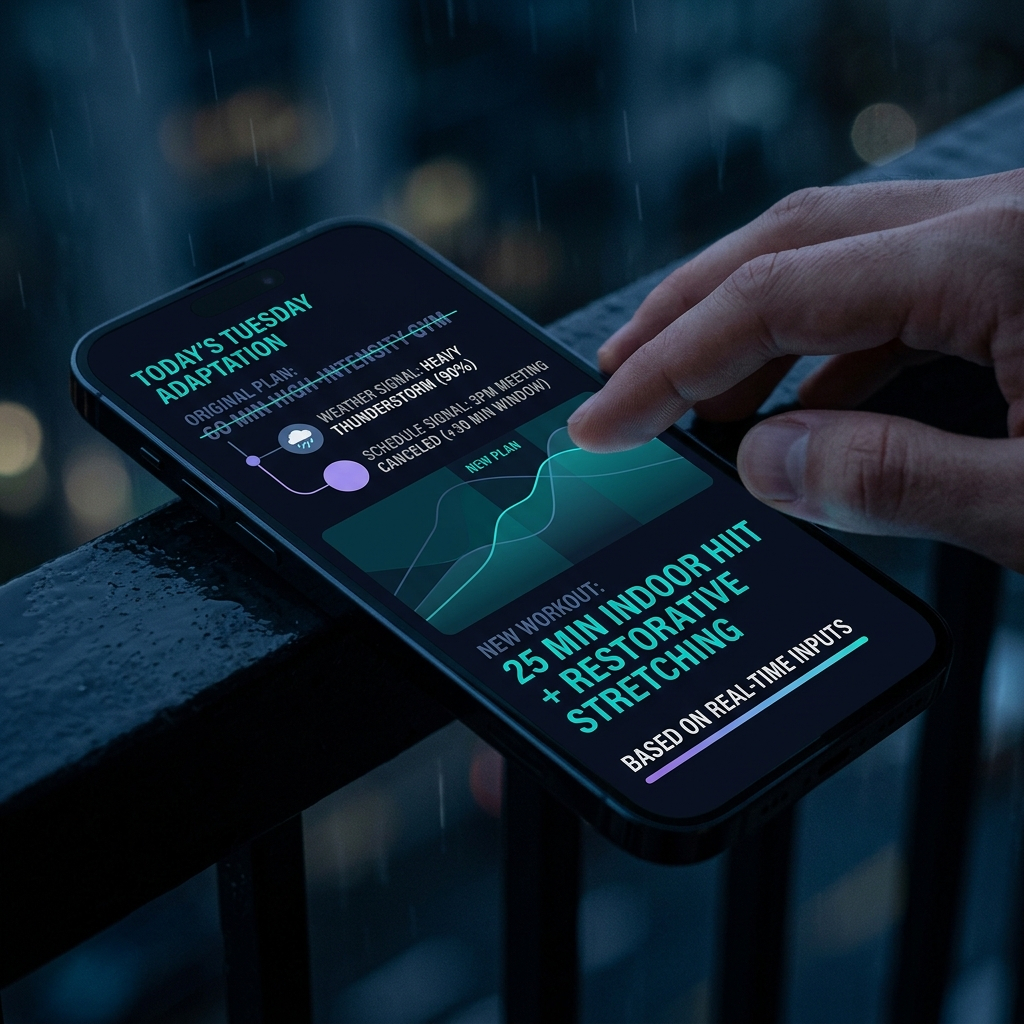
Weather as input. The forecast shifts, the workout shifts to an indoor equivalent before you open the app.
Schedule as input. A 60-minute session becomes a 25-minute session when 25 minutes is what the day allows.
Equipment as input. Hotel room, home floor, full gym. The plan reads the environment and adjusts the exercises.
Body signal as input. Soreness and fatigue reroute the plan the way traffic reroutes a navigation system.
Each of these looks like a feature. Together they form an operating assumption: if the tool requires you to change your life to fit it, the tool has failed.
Core Signal: Adaptive design treats real-world disruptions as inputs to process, not errors to penalize.
WHAT THE ADAPTATION DATA SHOWS
Intelligence in software means responding to signal.
The strongest evidence for this thesis comes from retention numbers, because retention is where theory meets behavior.
AI-powered adaptive fitness platforms report average annual retention above 72%. The industry norm for static digital fitness apps sits at 40 to 50%. Platforms using AI-driven personalization see 35 to 50% higher retention than platforms delivering fixed content.
The users on both sides of that gap have the same average willpower. The systems differ.
Why rest days improve retention.
One detail in the research stands out more than any market figure. Apps that teach users about recovery and explicitly recommend rest days see 20% higher adherence. Users feel validated when the system tells them to stop.
The feature that improves adherence is the one that removes shame from a missed or skipped session. When software acknowledges that your body needed rest, you stay. When software marks the rest day as failure, you leave.
Sustainable behavior emerges from reduced friction. Every retention statistic in this industry confirms it. Discipline gets you through week one. Architecture gets you through year one.
I want to be careful here, because "AI" has become a label people attach to everything. Intelligence in a system has a specific, testable meaning: the system reads real signals from your life — weather, schedule, equipment, body data, food preferences — and produces a different, better plan than it produced yesterday. Complexity that ignores those signals is decoration.
Core Signal: Retention data makes the case clearly — users stay when systems adapt, and leave when systems judge.
THE COACH TEST
Measure software against a human who knows you.
Here is the standard I hold my own product to. Imagine a competent human coach who knows you well.
You text them: "Rough week, only have 20 minutes today, and my shoulder is tight." A good coach replies with a 20-minute session that avoids the shoulder. No lecture. No guilt. No reference to the plan you missed.
That interaction is the bar. Most fitness software fails it on every dimension, because it was built as a broadcast medium: one plan, pushed outward, compliance measured against it.
What passing the coach test requires.
Building software that passes the coach test requires a few structural commitments:
Conversation as infrastructure. Voice and text access to the system, so adjusting a plan takes one sentence instead of six menu screens.
Multidimensional tracking. Body scans, measurements, photos, and trends — because scale weight alone tells you almost nothing about progress.
Context as first-class data. Location, weather, equipment, and available time enter the plan before the plan reaches you.
Global assumptions from day one. A system designed across 175+ countries has to handle variance in climate, food, and daily rhythm as its baseline condition.
People who use systems like this stop comparing them to other apps. They compare them to having a coach who knows them, adjusts for them, and skips the judgment.
That comparison tells me the category itself is shifting.
Core Signal: Software that passes the coach test isn't a better app — it's a different category of tool entirely.
WHERE THIS LEADS
Fitness is the first application, and the smallest one.
Step back from fitness for a moment and the pattern generalizes.
Every goal that requires sustained behavior change — sleep, nutrition, learning, finances — runs into the same wall: rigid plans meet variable lives, and the plans lose. The gap between your aspirational identity and your operational reality is a design problem, and design problems have design solutions.
I believe the next decade of personal software gets built on that recognition. An intelligent layer that sits between what you intend and what your day allows, and closes the gap through adaptation.
What the market data signals.
The market already signals this direction. AI in fitness reached $6.9 billion in 2025, growing at 29.7% annually, and 68% of fitness app users prefer AI-personalized plans over generic programs. Platforms deploying continuously adapting AI agents report 30 to 45% churn reduction and 2 to 3x improvement in workout adherence.
Those numbers describe an industry discovering, one retention report at a time, that the user was fine all along. The systems needed the redesign.
Review your own history of abandoned plans, fitness or otherwise. Look at each one and ask a diagnostic question: did the plan have any mechanism for absorbing a bad week.
In my experience, almost none did. You brought real effort to systems that treated your real life as an error state, and then you inherited the blame when the math played out.
You deserve tools that read your life as input. When you evaluate any system that asks for sustained behavior change, apply the coach test — check whether rest counts as data instead of failure, and check whether a chaotic Tuesday reshapes the plan or breaks it.
The systems that meet people where they are will keep them. The retention data has already settled that question. The remaining work is building enough of them.
That is the work I get up for.
Core Signal: Adaptive intelligence is not a fitness trend — it is the next infrastructure layer for any goal requiring sustained human behavior.
FREQUENTLY ASKED QUESTIONS
Why do most people quit fitness apps within six months?
Because most fitness apps deliver fixed plans that cannot absorb real-life disruptions. When a schedule collapses or weather intervenes, the plan marks the user noncompliant rather than adjusting. The failure is structural, not motivational.
What is adaptive fitness software?
Adaptive fitness software reads real-time inputs — weather, available time, equipment access, body signals, food preferences — and adjusts the plan accordingly. The goal is a system that changes to fit the user's day, not the other way around.
How does AI improve fitness app retention?
AI-powered adaptive platforms average 72%+ annual retention compared to 40–50% for static apps. Because the system responds to user context instead of enforcing a fixed schedule, users encounter fewer friction points and fewer reasons to abandon the plan.
Do rest days actually help with fitness adherence?
Yes. Apps that educate users on recovery and explicitly recommend rest days see 20% higher adherence. When software validates rest as a legitimate training input rather than a failure, users remain engaged longer.
What is the coach test for fitness software?
The coach test asks whether software can respond the way a knowledgeable human coach would — absorbing real-life context, adjusting the session, and skipping the judgment. Most static fitness apps fail this test because they were built as broadcast tools, not responsive ones.
Why does schedule variance predict fitness dropout?
Research shows women on nonstandard work schedules are 11.2% less likely to exercise, and Black women on those schedules are 54.1% less likely. Variable schedules create frequent collisions with rigid plans — and rigid plans always lose to reality.
Is adaptive fitness software only for fitness?
No. The same infrastructure problem — rigid plans meeting variable lives — applies to sleep, nutrition, learning, and financial behavior. Adaptive intelligence that closes the gap between intention and execution is a general-purpose design principle, not a fitness-specific feature.
What makes AI in fitness apps genuinely intelligent versus just labeled as AI?
Genuine intelligence means the system reads specific real-world signals — weather, schedule, body data, food preferences, location — and produces a meaningfully different plan based on them. Systems that apply the label without processing those signals add complexity without adapting to the user.
KEY TAKEAWAYS
Only 18.1% of fitness app users stay adherent at six months. A failure rate that consistent is a system problem, not a motivation problem.
Schedule variance is the most reliable predictor of dropout. The calendar is the failure point most fitness software ignores.
Adaptive AI platforms retain users at 72%+ annually — nearly double the industry baseline — because they absorb disruption instead of penalizing it.
Rest days validated by the system produce 20% higher adherence. Removing shame is a retention mechanism.
The coach test is the right benchmark: software should respond to real context the way a knowledgeable human coach would, without judgment or lecture.
The design principle generalizes beyond fitness. Any goal requiring sustained behavior change runs into the same wall — rigid systems meeting variable lives.
The remaining work is building enough systems that meet people where they are, not where a plan assumed they would be.