TL;DR: Writing a training program is a solved problem. Keeping a person on that program for six months is not. Adherence fails because systems refuse to adapt to real life — not because users lack willpower. The fix is architecture: adaptive check-ins, physiological decision-making, and infrastructure that treats variance as the default condition.
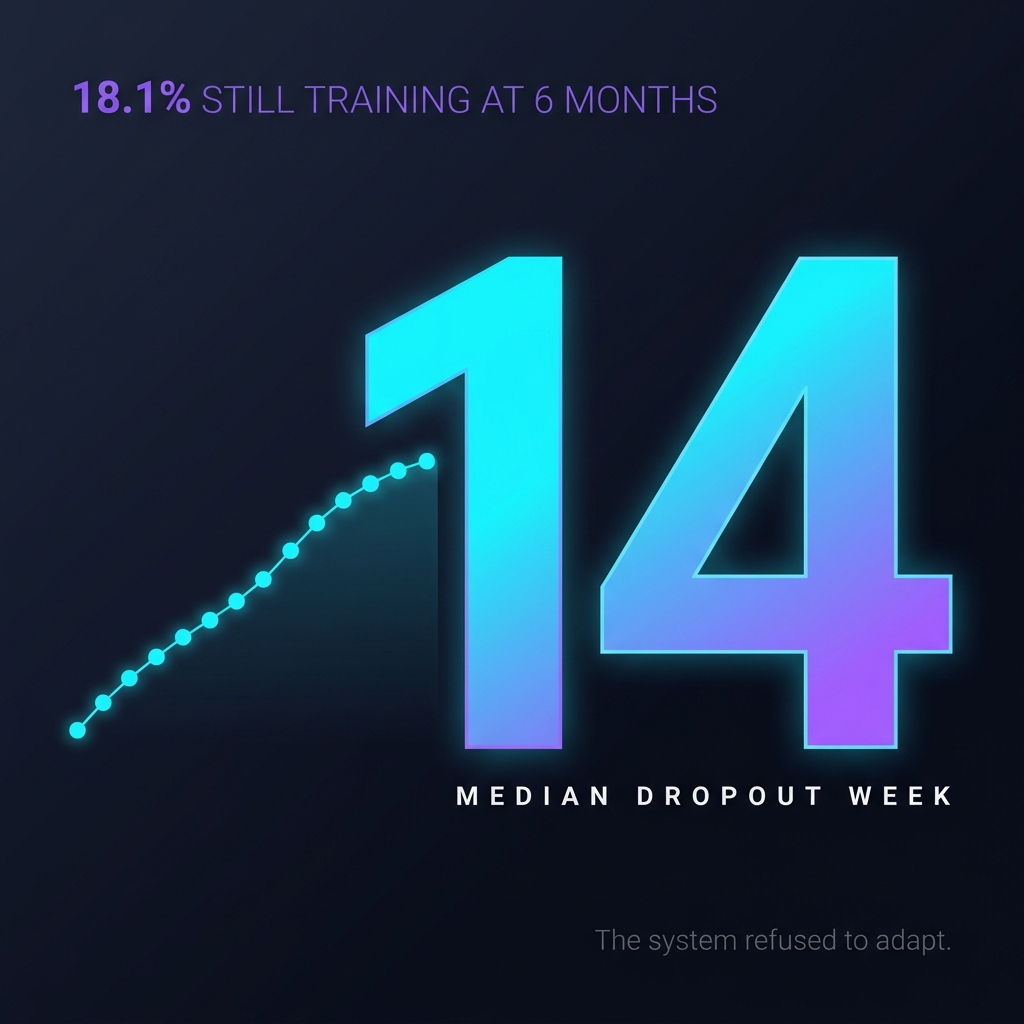
Only 18.1% of beginner fitness app users remain adherent at six months. The median dropout is week 14.
Adherence fails because rigid systems don't adapt to schedule changes, travel, illness, or poor sleep — not because users lack discipline.
Wearable data (HRV, sleep, training load) becomes useful only when translated into automatic decisions, not left as a score on a screen.
Accountability is a structural problem, not a motivational one. Evidence-based check-in frameworks outperform guilt notifications.
Fitness failures are infrastructure failures. The system, not the user, is broken when variance breaks the plan.
Why Most People Quit Fitness Apps by Week 14
I have read hundreds of threads where people debate fitness apps. One theme keeps surfacing. Writing a training program is a solved problem. Keeping a person on that program for six months remains unsolved.
The data backs this up. Research shows only 18.1% of beginner fitness app users stayed adherent at six months, with the median dropout happening at 14 weeks.
Fourteen weeks. That is where most fitness journeys end, quietly, without anyone noticing.
I build FitPocket around this exact failure point. Here is what I learned investigating why people quit, and why the answer sits in how systems handle real life.
Key Signal: The adherence crisis is measurable and predictable. The median dropout is week 14 — and most software does nothing about it.
How Adherence Fails: It's Not Willpower
The common explanation blames willpower. I find that explanation lazy.
When I trace individual dropouts, I see a consistent sequence. A schedule collapsed. A work trip removed gym access. Sleep fell apart for two weeks. The program kept demanding the same thing anyway.
The person adapted to reality. The system refused to.
If maintaining a program requires willpower, the system is broken. That principle drives every architectural decision I make. Sustainable behavior emerges from reduced friction. Discipline is a finite resource, and any design that spends it daily will run out of it by week fourteen.
Users describe what they actually need with clarity:
Check-ins when adherence starts slipping
Reminders that account for their actual schedule
Encouragement tied to real progress signals
Intervention before a missed week becomes a missed month
These are accountability functions. They are the core of coaching, and most software treats them as an afterthought.
Key Signal: Dropouts follow a structural pattern — not a motivational one. The system failed to adapt; the user didn't fail to comply.
The Readiness Score Problem: Why Data Without Action Is Noise
Wearables made this gap visible. Your watch now produces heart rate variability, sleep stages, training load, and resting heart rate every single day.
Producing numbers is easy. As one analysis puts it, the real value of a fitness dashboard lies in helping you make better training decisions today, and a graph by itself does none of that.
Consider the difference between these two messages.
Message one: "Your readiness score is 54."
Message two: "Your HRV is down, your sleep was poor, and yesterday's training load was high, so I reduced today's volume by 20%."
The first message hands you a number and walks away. The second one made a decision on your behalf, explained the reasoning, and adjusted the plan. Wearable users complain about this exact disconnect constantly, and they are right to.
Data without context is noise. Context without action is theater.
A readiness score sitting on a screen asks you to become your own exercise physiologist. Almost nobody signed up for that job.
Key Signal: The problem isn't the data — it's the absence of a decision layer that acts on it.
What Actionable Wearable Intelligence Actually Looks Like
The translation layer already exists in good human coaching. Practitioners describe the logic clearly:
Low sleep or HRV dip? We pivot to mobility, zone 2, and technique work. Great recovery streak? We layer in progressive overload and skill reps.
That framing comes from coaches who turn daily data into decisions, and it maps directly to what software should do automatically.
The evidence supports this approach. Research on HRV-guided training shows it is more effective than predefined programming for maintaining and improving performance, with a lower likelihood of negative responses. The framework enables real-time training adjustments based on physiological response, which reduces injury and overtraining risk while preserving gains.
Three rules make physiological data useful in practice.
1. Read patterns, not single readings
One bad HRV morning means nothing. A seven to fourteen day trend means something. Systems that react to daily noise train users to distrust the signal.
2. Compare against the individual baseline
Population averages tell you about populations. Your HRV of 45 is meaningless without knowing your normal range. Intelligent systems build the baseline first, then interpret deviations from it.
3. Cross-reference physiology with lived experience
HRV interpreted alongside perceived exertion, mood, soreness, sleep, and life stress becomes a coaching tool. HRV treated as a standalone verdict becomes a source of anxiety. The metric works when you stop treating it like a magical score.
Key Signal: The gap between raw wearable data and useful coaching output is closed by a decision layer — not more metrics.
How Accountability Architecture Works: The Check-In Model
Motivation feels mysterious. Accountability structure is well documented.
Education solved a version of this problem years ago. Check In, Check Out is an evidence-based behavior intervention that combines frequent feedback, self-monitoring, goal setting with a mentor, and a daily review of progress. The routine builds self-management through consistency rather than intensity.
The model translates directly to fitness. The components are:
A morning check-in that sets the day's expectation based on current state
Feedback during execution tied to what actually happened
An evening review that closes the loop and adjusts tomorrow
A consistent rhythm that survives imperfect weeks
This structure assumes variance. It assumes some days go badly. It builds the response to bad days into the routine itself, so a poor Tuesday adjusts Wednesday instead of ending the program.
Most fitness software assumes the opposite. It assumes compliance, then punishes deviation with red streaks and guilt notifications. By week fourteen, the guilt wins and the app gets deleted.
Key Signal: Accountability is not a motivational feature — it is a structural one. Systems that survive imperfect weeks outlast systems that demand perfect ones.
Why Fitness Failures Are Infrastructure Failures
Here is the reframe I offer everyone who tells me they "failed" at a fitness program.
Weather changed. Your schedule collapsed. Your body responded differently than the chart predicted. You brought normal human variance to a system designed for a controlled environment, and the system had no answer for it.
That is an infrastructure failure.
This is why I treat context as a first-class input at FitPocket. Weather, schedule, available equipment, location, sleep quality, and recovery signals all shape what the system asks of you today. Voice and text access exist because accountability has to be reachable in the moments life actually happens — in the car, in a hotel room, at 6 a.m. before a flight.
Tracking works the same way. Body scans, measurements, photos, and trends replace a single vanity number, because real progress is multidimensional and a scale reading captures almost none of it.
Every one of these decisions serves the same goal: remove the moments where the plan and your reality disagree, because those moments are where adherence dies.
Key Signal: Fitness failures are system design problems. Context-aware infrastructure — not motivational content — is what keeps plans alive.
What to Demand From Your Fitness Technology
You now have a clear standard to apply. When you evaluate any coaching tool, app, or wearable ecosystem, ask three things of it.
First, it must decide — and explain the decision. "I reduced today's volume 20% because your HRV dropped and your sleep was short" respects your intelligence and saves your energy. A dashboard full of scores outsources the hardest work back to you.
Second, it must adapt before you quit. Adherence data shows the median dropout at week fourteen. A system that notices declining adherence at week ten and adjusts the plan downward keeps you in the game. Waiting for you to return is a design choice, and it is the wrong one.
Third, it must treat your bad weeks as expected input. Travel, illness, deadlines, and disrupted sleep are the terrain. Any system that handles them gracefully will outlast any system that handles them with a guilt notification.
The fitness industry spent a decade perfecting the workout. The next decade belongs to whoever perfects the part between workouts — the check-in, the adjustment, the quiet recalibration that keeps a plan alive through an imperfect life.
I am building for that decade. The technology that wins will be the technology that feels like it is finally on your side.
Key Signal: The evaluation standard for fitness technology is simple: does it decide, adapt, and survive your bad weeks? If not, it will not outlast week fourteen.
Frequently Asked Questions
Why do most people quit fitness apps?
Research shows the median dropout occurs at 14 weeks. The primary cause is not lack of motivation — it is a mismatch between a rigid system and real-life variance. Schedule changes, travel, and poor sleep break programs that were never designed to adapt.
What is the difference between a readiness score and actionable coaching?
A readiness score presents a number. Actionable coaching interprets that number, explains the reasoning, and automatically adjusts the plan. The former asks you to make the decision; the latter makes it for you.
How does HRV-guided training work?
HRV-guided training uses heart rate variability trends — typically measured over 7 to 14 days — to determine whether to increase training load or reduce volume. Research shows this approach outperforms predefined programs because it responds to individual physiological state rather than a fixed calendar.
Is willpower the real reason people fail at fitness?
No. Willpower is a finite resource, and systems that require daily expenditure of it will exhaust it. The evidence points to infrastructure failure: programs that do not adapt to real-life conditions, not users who lack discipline.
What does accountability look like in a fitness app?
Effective accountability follows a check-in model: a morning session that sets expectations based on current state, feedback during execution, and an evening review that adjusts the next day's plan. The structure must survive imperfect weeks — not punish them.
Why does wearable data often feel useless?
Because most platforms present data without acting on it. HRV, sleep scores, and readiness metrics require a decision layer to become useful. Without that layer, users are left to interpret complex physiological signals themselves — a job they did not sign up for.
What should I look for when evaluating a fitness app?
Three criteria: it must make decisions and explain them, it must detect declining adherence and adapt before you quit, and it must treat schedule disruptions and bad weeks as expected input rather than failures.
How is FitPocket different from standard fitness tracking apps?
FitPocket uses context — weather, schedule, location, equipment availability, sleep quality, and recovery signals — as first-class inputs. The system adjusts what it asks of you based on what your life currently allows, rather than assuming conditions will always be ideal.
Key Takeaways
Only 18.1% of beginner fitness app users stay adherent at six months. The median dropout is week 14 — a predictable, addressable problem.
Adherence fails because systems are rigid, not because users lack discipline. The system, not the user, needs to adapt.
Wearable data is only as useful as the decision layer acting on it. A score with no action attached is noise.
HRV-guided training, built on 7 to 14 day trends and individual baselines, outperforms predefined programming because it responds to physiological reality.
Accountability is structural. Evidence-based check-in frameworks — morning, execution, evening review — build resilience into the routine itself.
Fitness failures are infrastructure failures. Context-aware systems that adapt to variance survive; compliance-demanding systems do not.
The next competitive frontier in fitness technology is not the workout — it is the adaptive infrastructure between workouts.