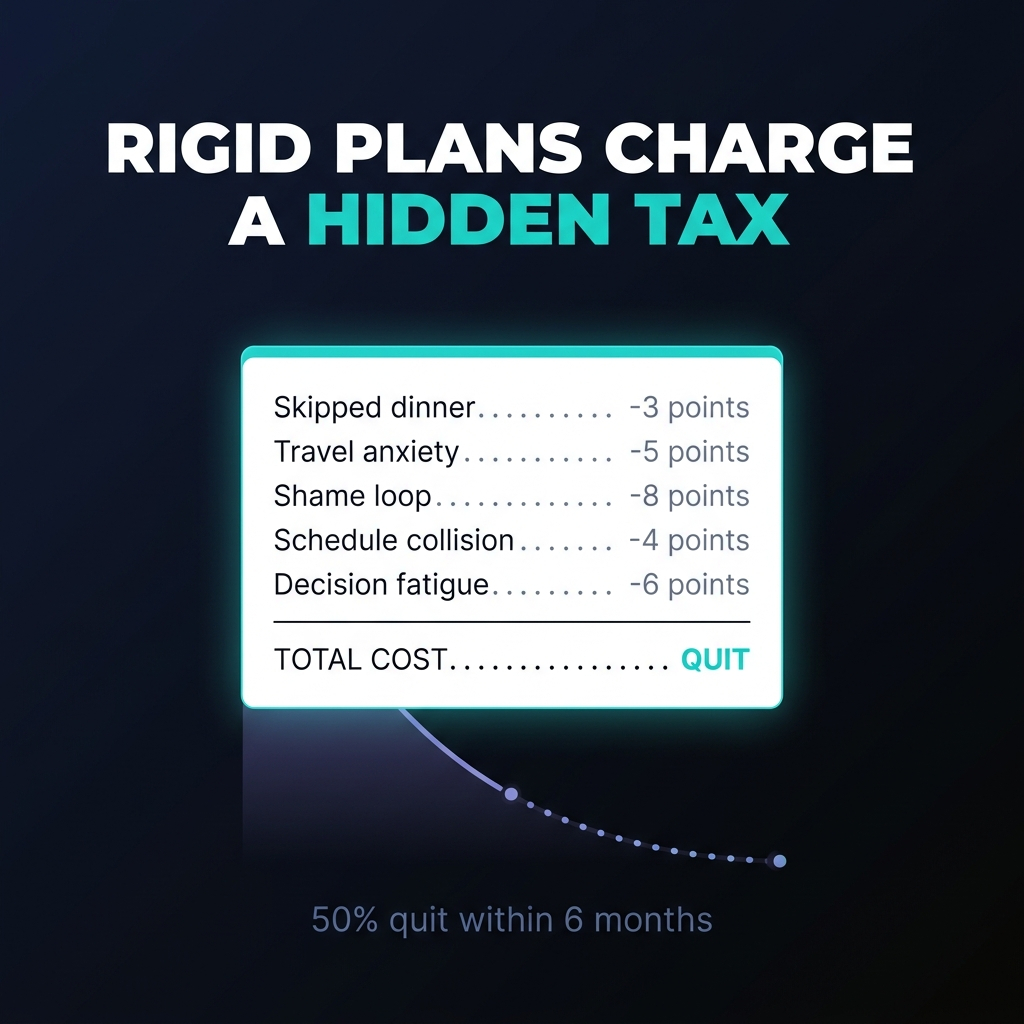
TL;DR: Rigid fitness plans fail most people not because of poor discipline, but because they impose a compounding "hidden tax" of mental overhead — guilt, anxiety, and decision fatigue — that makes quitting rational. Adaptive systems reduce that tax and improve retention.
50% of new gym members quit within six months; supervised programs lose half their participants within a year.
Rigid plans charge a "hidden tax": guilt, anxiety, social costs, and decision fatigue that compound over time.
Low schedule control predicts psychological distress and burnout — in workplaces and fitness programs alike.
People internalize plan failures as personal flaws, which lets flawed system designs escape scrutiny.
Adaptive systems — ones that flex around weather, travel, and energy — reduce cognitive load and improve long-term retention.
I spent years watching people quit fitness programs. The same pattern kept repeating, and the standard explanation kept failing to account for it.
The standard explanation says people quit because they lack discipline. I examined the data and the lived reality underneath it, and I reached a different conclusion.
Every rigid plan charges a hidden tax. The tax is the mental overhead of forcing your life to fit a schedule that was written without knowing your life.
This article itemizes that tax, week by week, until the bill grows too large and people walk away. Once you see the ledger, the dropout numbers stop looking like a character problem.
What Does the Data Actually Show?
Start with the evidence. Industry research from 2024 shows that 50% of new gym members quit within their first six months. The annual retention rate sits at 66.4%, which means roughly one in three members leaves every year.
When half of all users abandon a system within six months, the design carries the responsibility. Character explains outliers. It fails to explain a failure rate at that scale.
The evidence extends beyond commercial gyms. A 7-year retrospective study of supervised small-group exercise programs found a 12-month survival rate of 51.7%, with mean participation lasting just 13.8 months. Structured, supervised, professionally designed programs still lose half their participants within a year.
Tip: when a system blames its users at scale, audit the system first.
Bottom line: Dropout rates this high — across both commercial and supervised programs — indicate a design failure, not a motivation failure.
What Is the Hidden Tax of Rigid Plans?
The mental overhead tax rarely arrives as one dramatic moment. It arrives as small, recurring charges that most people never itemize.
The skipped dinner. Your friend suggests Thursday. Your plan says Thursday is leg day. You decline, and a small resentment gets logged against the plan.
The travel week spiral. A work trip appears on your calendar. Days before you leave, you already feel anxious about the sessions you will miss. The plan turns a normal week into a threat.
The shame loop. You miss Monday. Tuesday now carries double weight. You miss Tuesday, the week feels lost, and you write off everything until the next clean start.
Each event costs a little willpower, a little mood, a little identity. The charges compound quietly.
Bottom line: The hidden tax is invisible precisely because it accumulates in small increments — guilt, anxiety, social costs — rather than arriving as a single breaking point.
How Does Willpower Depletion Make This Worse?
The psychology here is well documented. According to the strength model of self-control, willpower operates as a finite resource. Once expended, it impairs performance on the next self-control task — a state researchers call ego depletion. The theory has since been refined to emphasize conservation, and it now extends to decision making, planning, and initiative.
Those are exactly the resources a rigid plan consumes before you ever lift a weight. Reconciling a fixed schedule with an unpredictable week is administrative work, and your brain bills it against the same account that funds the workout itself.
Decision fatigue research shows the downstream effect. As cognitive resources deplete, people make more impulsive decisions or avoid decisions entirely. Researchers are careful to note that cognitive overload reflects finite bandwidth in the nervous system — capacity limits, not character limits.
Data without context is noise. A plan without context is a liability that charges interest.
Bottom line: A rigid plan spends willpower on schedule administration — the exact resource needed for the workout itself.
Why Does Low Schedule Control Predict Distress?
The workplace research on this mechanism is direct, and underused by anyone building behavior-change products.
Regression analysis of healthcare workers found that job autonomy and schedule flexibility were negatively associated with burnout. Greater control reduced burnout significantly. A separate study found that flexible working arrangements reduced the risk of occupational stress in employees with high job autonomy. Control over your own schedule protects your psychology.
A rigid fitness plan is a low-control environment you volunteered for.
It preassigns your hours. It ignores your calendar, your weather, your equipment, your energy. It defines success as compliance with a document written before your week existed.
Here is the part worth noting. People inside these systems internalize the failure. They say "I fell off" instead of "the plan broke on contact with my life." The shame lands on the person, and the plan escapes the audit entirely. This misattribution keeps flawed systems in business.
Bottom line: Low schedule control is a known psychological stressor — and rigid fitness plans replicate that stressor by design.
Why Does the Tax Compound Over Months?
A single missed session costs almost nothing physiologically. The body recovers. The training effect survives.
The psychological ledger works differently.
Each collision between plan and life adds a small entry: guilt, anxiety, a social cost, a story about who you are. Month one, the entries feel manageable. Month three, the plan has become a source of dread.
By month six, quitting feels like relief. That relief confirms the tax existed all along.
Warning: if you feel lighter after abandoning a plan, the plan was extracting more than it returned.
This explains the dropout curve far better than any laziness theory. Parents, caregivers, and shift workers sustain hard things for decades when the structure fits their reality. They quit systems that demand a life they do not have.
Bottom line: Psychological compounding — not physical deconditioning — is why most people quit at months three to six, not week one.
How Do Adaptive Systems Solve What Optimized Plans Cannot?
The fix lives at the level of architecture.
An optimized plan asks for the perfect sequence of sessions toward a goal. An adaptive system asks for the best available move given what this person's week actually allows.
The market data already confirms the direction. Flexible membership options like pay-per-visit and hybrid models reduce cancellations by 18%. When systems flex around user reality, retention improves. Research on choice architecture points the same way: curating options, using smart defaults, and breaking complex decisions into smaller steps directly reduces cognitive load.
Concretely, an adaptive system treats context as a first-class input:
Weather changes. The outdoor run becomes an indoor session, automatically.
Schedule collapses. The 60-minute workout compresses to 25 minutes that still count.
Travel week. The plan rebuilds around hotel constraints before you land.
Low energy day. Intensity adjusts to signal from recent data, and the session survives.
Every adjustment the system makes is a tax you stop paying. That is the entire economic argument for adaptive intelligence.
Bottom line: Adaptive systems don't lower standards — they remove the administrative friction that prevents people from meeting them.
The Operating Principle Behind FitPocket
I run FitPocket on one operating rule: if something requires willpower to maintain, the system is broken.
Willpower is a finite, expensive resource. Spending it on schedule reconciliation wastes it on administration when it belongs to the actual work. Sustainable behavior emerges from reduced friction. Every friction point the system removes returns capacity to the person.
The intelligence works best when it stays invisible. The user thinks about the session. The machinery adjusts underneath, unnoticed.
This principle extends past fitness. Any organization enforcing rigid structures on people with variable lives collects the same tax and produces the same dropout curve — whether it appears as gym cancellations or employee burnout.
Bottom line: Invisible adaptive intelligence — not motivational pressure — is the architecture that makes sustainable behavior possible.
How to Audit Your Own Systems
You can test this on any plan currently in your life. Ask three questions.
1. Count the collisions. In the last month, tally how many times the plan conflicted with something real — a trip, an invitation, a sick kid, a deadline.
2. Price each collision. Note what each one cost you. Guilt counts. Anxiety counts. The dinner you skipped counts.
3. Check who absorbed the cost. If you adjusted every single time and the plan adjusted zero times, you found the tax.
A plan worth keeping shares the burden of change. It flexes around your variance instead of demanding you eliminate it.
The people who quit were paying attention to their own accounting. Quitting was a rational response to a bad deal.
Stop auditing your character. Start auditing your systems. The next time you fall off a plan, itemize the tax it charged you first. Then find, or build, structure that meets you where you are.
Frequently Asked Questions
Why do most people quit fitness programs?
Industry data shows 50% of new gym members quit within six months. The primary driver is not lack of discipline — it is the compounding mental overhead imposed by rigid, inflexible schedules that conflict with real-life variance.
What is the "hidden tax" of rigid fitness plans?
The hidden tax is the accumulated psychological cost of forcing your life to fit a fixed plan: guilt from missed sessions, anxiety before travel weeks, social costs from declined invitations, and the decision fatigue of constant schedule reconciliation.
What is ego depletion, and why does it matter for fitness?
Ego depletion is a state of reduced self-control capacity after willpower has been expended. Rigid plans consume willpower on administrative tasks — reconciling a fixed schedule with a variable week — before the workout even begins, leaving fewer resources for the actual effort.
How does low schedule control affect mental health?
Research on healthcare workers found that low job autonomy and schedule flexibility are significantly associated with burnout. A rigid fitness plan replicates this low-control environment voluntarily, producing the same psychological distress.
Why do people blame themselves instead of the plan?
People internalize failure language — "I fell off" — rather than attributing the breakdown to a plan that could not accommodate real-life disruption. This misattribution protects flawed system designs from scrutiny and perpetuates the cycle.
What is an adaptive fitness system?
An adaptive fitness system treats context — weather, schedule, energy, equipment, location — as first-class inputs rather than edge cases. It adjusts the session to fit the available conditions rather than demanding compliance with a fixed document.
Do flexible fitness structures actually improve retention?
Yes. Market data shows flexible membership options like pay-per-visit and hybrid models reduce cancellations by 18%. When systems flex around user reality, measured retention improves.
How do I know if my current plan is charging me a hidden tax?
Count the plan-life collisions in the last month. Price each one in guilt, anxiety, or social cost. If you absorbed every adjustment and the plan absorbed none, the tax is real. A plan worth keeping shares the burden of variance.
Key Takeaways
50% of gym members quit within six months — at that scale, the design is responsible, not the individual.
Rigid plans charge a hidden tax: recurring psychological costs that compound into dropout over months, not days.
Willpower spent reconciling a fixed plan with a variable week is willpower unavailable for the workout itself.
Low schedule control is a known predictor of burnout. Rigid fitness plans create that condition voluntarily.
People misattribute plan failures as personal flaws, which lets poor system design escape accountability.
Adaptive systems — ones that adjust to weather, travel, schedule, and energy — reduce cognitive load and improve retention by design.
If quitting a plan feels like relief, the plan was extracting more than it returned. Audit the system, not the character.