I want to describe one specific person. The description will feel narrow, and that narrowness is deliberate.
Most fitness products describe their user in the widest possible terms. Anyone with a body. Anyone with a goal. That framing produces software that works beautifully in a demo and quietly falls apart in a real week.
I took the opposite approach. I spent my time studying the person the industry has already written off, and I built FitPocket around the exact shape of their life.
The specificity is the point.
Who This Person Is
She has a starting folder of abandoned apps on her phone. He signed up for a gym in January and stopped going in March, three separate years in a row.
This person travels for work. Some weeks the hotel has a gym, some weeks it has a hallway. Every third week, the schedule collapses entirely. A client call runs long, a flight gets delayed, a kid gets sick.
The intention never disappeared. I want to be clear about that, because it matters. This person genuinely wants consistency. The desire is intact. The life keeps intervening.
💡 Here is the observation that shaped everything I built: the people who quit are usually the people who tried the hardest to comply with a system that never accounted for them.
Who This Person Is Absent From the Design
The competition athlete already has structure. Their calendar bends around training. They have a coach, a program, and a life engineered for adherence.
The person with a dedicated home gym and a Sunday meal prep routine has already solved the environment problem. Their surroundings do the heavy lifting.
I respect both of those people. They simply have a different problem, and plenty of products serve them well.
The person I designed for has none of that scaffolding. Their environment changes weekly. Their equipment changes daily. Their available time changes hourly.
When you design for the person with scaffolding, you get a program. When you design for the person without it, you have to build an adaptive system.
Why "Tried and Quit" Is a Design Brief, Not a Character Report
The fitness industry has a standard explanation for quitting. It calls the problem motivation, discipline, or commitment. Then it sells more motivation.
I read the same evidence differently.
When I looked closely at how people actually abandon a fitness program, the pattern was consistent. The failure almost never happened on a normal day. It happened on the disrupted day. The rainy morning that killed the outdoor run. The work trip that removed the barbell. The week where dinner had to come from whatever the airport offered.
Every quit I studied traced back to a moment where the plan demanded conditions the person's life could not supply.
The person did nothing wrong. The plan assumed a stable world, and the world declined to cooperate.
That reframing changed how I built. If disruption is the actual failure point, then disruption is the actual design target. Weather, travel, equipment gaps, and schedule collapse stopped being edge cases in my architecture. They became the primary inputs.
⚠️ If a system requires willpower to maintain, the system is broken. Willpower is a backup generator. It was never meant to run the building.
What Building for This Person Actually Requires
Designing around this user forced concrete engineering decisions. I will name them, because vague "personalization" claims are exactly what this person has learned to distrust.
Context as a first-class input
The system reads the conditions before it prescribes the work. Weather shifts an outdoor session indoors. A hotel room with no equipment generates a bodyweight session instead of a barbell session. Location, schedule, and available gear feed the plan the same way a route app feeds on traffic.
Most software treats these signals as exceptions to handle later. FitPocket treats them as the terrain.
Conversation instead of configuration
This person will not maintain a settings dashboard. They will say "I only have twenty minutes and I'm in a hotel" the same way they would tell a coach. Voice and text access sit in the core infrastructure, because the fastest way to lose a disrupted person is to make them fill out forms during the disruption.
Tracking that survives imperfect weeks
Step counts and streaks punish exactly the person I built for. Real progress is multidimensional, so the system tracks it that way: photos, body scans, measurements, and trends over time. A collapsed week shows up as a data point inside a longer signal. It stops functioning as a verdict.
Food that flexes with reality
Meal guidance covers vegetarian, vegan, pescatarian, and omnivore preferences, with substitutions built in. The person eating at an airport needs a workable answer for that meal, in that terminal, at that hour.
Built for wherever the schedule sends them
Availability across 175+ countries was a day-one requirement, because the target user's defining trait is that their location changes. Integrations with Strava and Apple Health pull existing data in, so the system learns from signals the person already generates.
The Shame Problem Nobody Prices In
There is a quieter reason this person keeps quitting, and I think it deserves honest treatment.
Every abandoned program leaves a residue. After three or four cycles, the person starts to internalize the failure. They stop saying "the plan didn't fit my life" and start saying "I can't stick to anything."
That conclusion is wrong, and it is also the single biggest barrier to trying again.
I found that the most effective response to this is architectural. When the system visibly adapts, when a rained-out run becomes an indoor session without penalty, when a chaotic week gets absorbed instead of punished, the person's own history starts to look different to them.
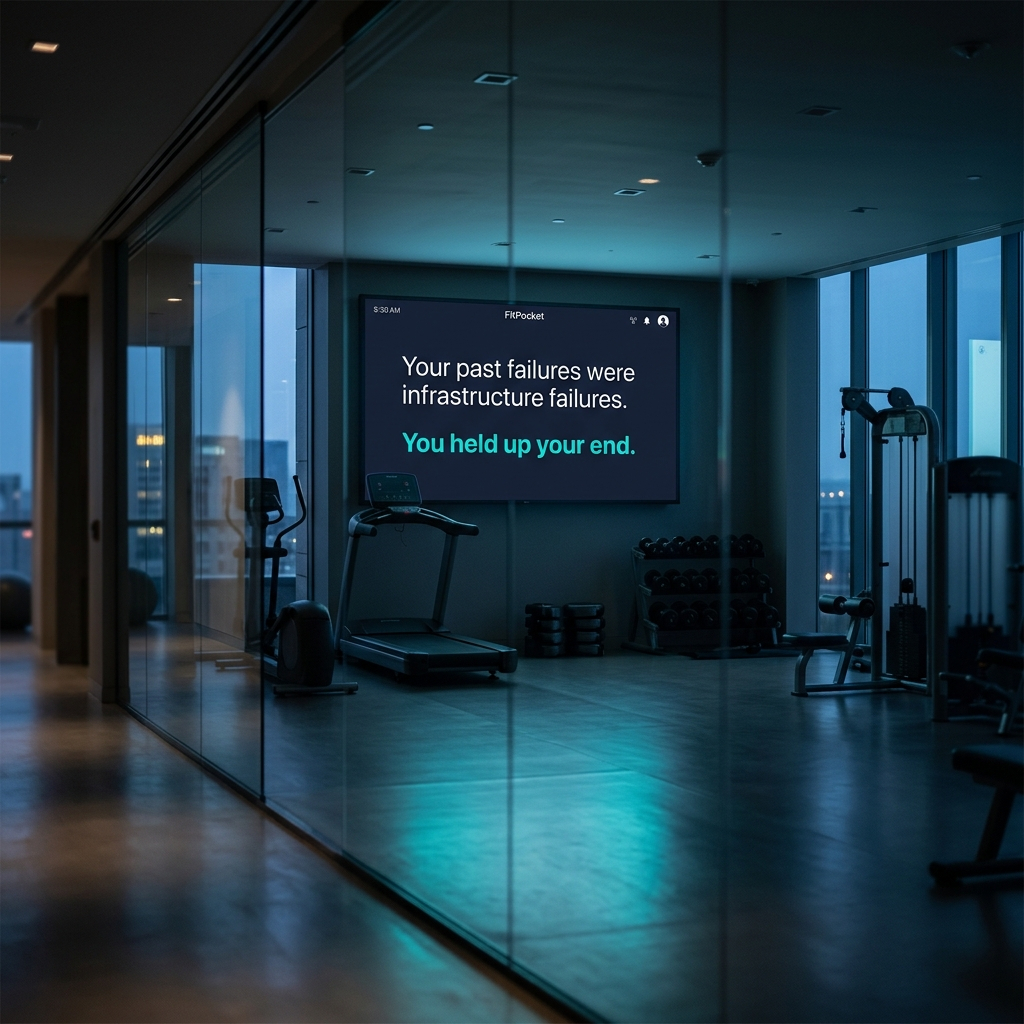
Their past failures reclassify themselves as infrastructure failures. The evidence was there all along. The tools just kept assigning the blame to the user.
Once that shame lifts, consistency stops feeling like a personality trait this person lacks. It starts looking like an engineering outcome they were never given access to.
Why Narrow Beats Broad
Some founders worry that a specific target user shrinks the market. My experience points the other way.
The person I described, the traveler with the collapsing calendar and the folder of quit apps, represents an enormous population. The industry has simply trained itself to see them as churn instead of as a design brief.
Serving them precisely produces a strange side effect: the product stops getting compared to other apps. Users compare it to having a coach who knows their schedule, adjusts for their week, and skips the judgment. That comparison is worth more than any feature list.
Precision also compounds. Adaptation beats optimization, because a system built to flex around one person's variance flexes around everyone's. The dedicated athlete with the perfect setup can use FitPocket without friction. The reverse was never true.
What I Want You to Take From This
If you build products, define your user by their real conditions, including the ugly ones. The disrupted week, the missing equipment, the collapsed schedule. Design for the worst realistic Tuesday, and the ideal Tuesday takes care of itself.
If you are the person I described, the one who has tried and quit and quietly concluded the problem is you, I will offer one honest correction.
You held up your end. The systems you used assumed a life you were never going to have.
Intelligence in software means adapting to the life you actually live. I built FitPocket as proof that this is an engineering problem, and engineering problems get solved.
The right system meets you where you are. Everything else follows from that.