TL;DR: Most AI fitness apps collect your data but never truly act on it. Real personalization means the system makes materially different decisions for you — based on your goals, history, equipment, schedule, and context — and keeps adapting as your life changes. Here is how to tell the difference, and why it matters.
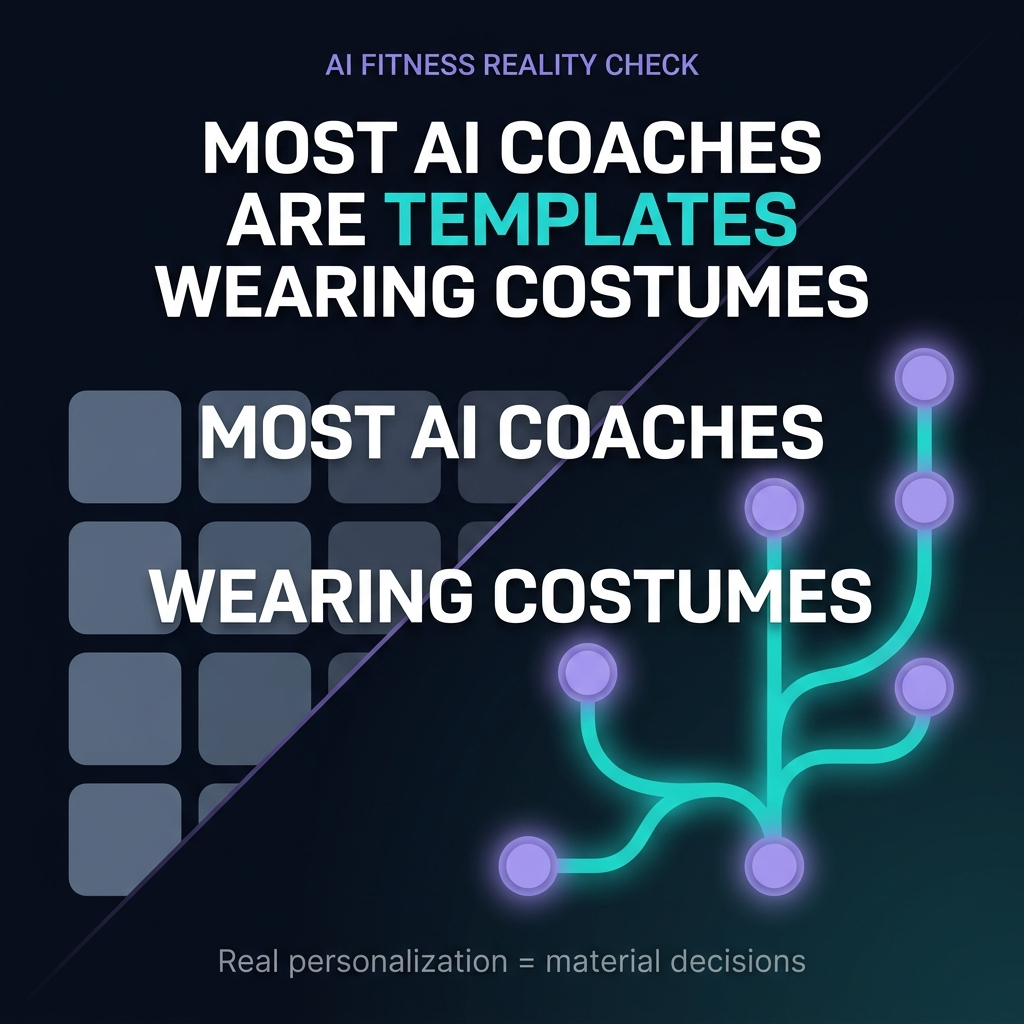
Real personalization produces materially different decisions for each user — not template swaps.
Most apps map onboarding answers to pre-built templates and call it personalization.
Personalized training produces 30–40% better results than generic plans, and lifts retention by up to 30%.
Context — schedule, weather, equipment, recovery — must be a first-class input, not an afterthought.
Four audit tests can reveal whether any AI coach is genuinely adaptive or just a template with a chat window.
People ask me one question more than any other: "Will it actually personalize my training, or just hand me a generic AI workout with my name on it?"
It is the right question. I want to answer it honestly, because I have spent years inside this problem, and most of the industry answers it with marketing instead of architecture.
Here is my starting position: if a system needs your willpower to keep working, the system is broken. Personalization is the test of whether the system was ever built for you at all.
What Does "Personalized" Actually Mean to Users?
When you ask whether an AI coach personalizes, you are asking something specific. You want the system to understand seven things:
Your goals, stated in your words
Your experience level, real, current
Your previous workouts, what you actually did
Your equipment, what sits in your home or gym today
Your schedule, including the weeks it falls apart
Your weaknesses, the joints, patterns, and gaps that hold you back
Your progress, measured across more than one dimension
Then you want one more thing, and this is the part most systems fail: you want the AI to make materially different decisions because of all that data.
Different from the plan it gives someone else. Different from the plan it gave you last month. Different tomorrow if your context changes tonight.
That bar is high. It should be.
Key Point: Personalization is not about collecting data — it is about the system acting on that data to produce decisions that are genuinely unique to each user and each moment.
Why Most "Personalization" Is a Template Wearing a Costume
The pattern is common enough to describe plainly.
The system asks you ten onboarding questions. It maps your answers to one of a few dozen pre-built templates. It swaps a machine exercise for a dumbbell exercise if you said "home gym." Then it presents the result as a plan built for you.
That process collects data. It never comprehends it.
Users can tell. Research on AI coaching interfaces found that people perceive AI feedback as impersonal when the system overlooks effort, fatigue, injury, or training intent. The market has grown sophisticated enough to spot the difference between an algorithm that stores your inputs and one that acts on them.
Surface-level personalization has become a liability. A generic plan with your name on it insults your intelligence twice: once by being generic, and again by pretending it is anything else.
Key Point: Collecting inputs at onboarding is not personalization. Personalization requires the system to comprehend and act on those inputs continuously — not just once.
Why the Failures You Blamed Yourself For Were Infrastructure Failures
This is the reframe that matters most, and it is commonly overlooked.
When someone abandons a fitness program in week three, the industry calls it a motivation problem. The more accurate diagnosis is a design problem. The plan assumed a stable schedule, consistent weather, unchanging energy, and a body that responds exactly as the chart predicts.
Real life offers none of those things. Your Tuesday session collides with a work deadline. Rain kills the outdoor run. Your shoulder complains during pressing. That happens in real life, on a regular basis, to everyone.
A rigid plan treats each of these as your failure. An adaptive system treats each one as a signal to redesign the next decision.
💡 The core principle: context — weather, schedule, equipment, and location — belongs in the system as a first-class constraint from day one. Handling it later means handling it never.
Key Point: Most fitness program failures are infrastructure failures, not motivation failures — because the plan was rigid, not because the user was weak.
What the Evidence Says About Adaptive Training
This position rests on data, and the data is consistent.
Studies show that personalized training programs produce 30 to 40 percent better results than generic plans. Apps that adapt to user ability and progress generate larger effects than one-size-fits-all programs.
The retention picture points the same direction. AI-driven personalization can lift user retention by up to 30% compared to standard apps. Data-driven programs improve adherence by 45 percent over traditional plans.
Read those numbers carefully. Adherence is the whole game in fitness. A perfect program you quit produces nothing. A responsive program you sustain produces everything.
The evidence confirms what users feel in their own experience: sustainable behavior emerges from reduced friction, and adaptive systems reduce friction by design.
One concrete example of what "materially different decisions" looks like in practice: Fitbod reports that users training four times per week hit strength goals 23% faster than template followers, because the system adjusts load per person. Small decision differences compound into large outcome differences.
Key Point: The data is unambiguous — adaptive, personalized training outperforms generic programs on every relevant metric: results, retention, and adherence.
How to Audit Any AI Coach, Including Mine
You deserve a way to test the personalization claim yourself. Here is the audit to run on any product, including the one I build.
1. Change one constraint. Watch the response.
Tell the system you lost access to a barbell this week. A real adaptive system rebuilds the affected sessions immediately, preserving the training intent with different tools. A template system swaps one exercise and leaves the structure untouched.
2. Report a weakness. Check for structural change.
Mention a cranky knee or a weak upper back. The plan should shift load, exercise selection, and volume around that signal. Acknowledgment without action is theater.
3. Miss a week. See what happens next.
Imperfect weeks are expected conditions, so the system should treat them that way. The follow-up plan should account for the gap, recalibrate intensity, and continue. A system that resumes exactly where it left off never understood you in the first place.
4. Ask why.
Ask the coach why it programmed today's session. A system making genuine decisions can explain them in terms of your goals, your history, and your current context. A template cannot explain itself, because there was no decision to explain.
⚠️ Warning sign: any system that responds to all four tests with the same plan, lightly reshuffled, is running templates. The AI label on the front does nothing to change what runs in the back.
Key Point: Four tests — constraint change, weakness report, missed week, and explanation request — reliably distinguish a genuinely adaptive system from a template engine wearing an AI label.
What Real Personalization Looks Like in the Architecture
Vague claims created this trust problem. Specifics are the correction.
Multidimensional tracking. Progress lives in body scans, measurements, photos, and trends over time. A single scale number tells you almost nothing about whether the system is working. The tracking layer needs to see the whole picture the way you experience it.
Conversation as infrastructure. The richest signal you produce is what you say. Voice and text input let the system hear "my shoulder felt off during presses" and convert it into a programming decision. Leading systems already work this way. Zing's AI coach checks in daily on sleep, energy, and mood and recalibrates the plan in real time based on the conversation.
Prediction, going beyond reaction. The frontier here is real. Machine learning models can now calculate injury risk with 78 percent accuracy up to three weeks in advance, and motion-capture feedback systems reduce injury risk by 60 percent according to studies by the American College of Sports Medicine. Understanding your weaknesses means preventing the failure before it arrives.
Invisible intelligence. The system works best when you never think about it. The plan simply fits your Tuesday, your equipment, your weather, and your recovery state. Complexity belongs in the architecture. Simplicity belongs in your experience.
Key Point: Genuine personalization is built on four layers — multidimensional tracking, conversational input, predictive intelligence, and invisible execution. Systems missing any one of these are operating below the standard users now expect.
Where This Goes Next
The market for AI-based fitness apps is projected to reach 4.22 billion dollars by 2032. That number is a verdict. People are paying for systems that flex around human variance, and they are abandoning systems that demand humans eliminate it.
My conviction runs deeper than fitness. The gap between what you intend to do and what your life allows you to sustain is a design problem, and design problems have design solutions. Fitness is where that thesis proves itself first, because fitness is where rigid systems have failed the most people for the longest time.
So when you ask "will it actually personalize my training," you are asking the question that will sort this entire industry over the next decade.
Keep asking it. Run the audit. Demand decisions, explanations, and adaptation.
The systems worth your time meet you where you are. Everything else is a template with a chat window attached, and you already know how those end.
Key Point: The AI fitness market is growing because users are choosing adaptability. The next decade will favor systems that treat human variance as design terrain, not as a problem to be eliminated.
Frequently Asked Questions
What is the difference between a personalized AI workout and a generic one?
A personalized AI workout makes materially different decisions for each user based on goals, history, equipment, schedule, and real-time context. A generic workout maps onboarding answers to a pre-built template and swaps superficial details like exercise names.
How can I tell if an AI fitness app is truly adaptive?
Run four tests: change a constraint (such as equipment access), report a physical weakness, miss a week, and ask the system to explain its programming decisions. A genuinely adaptive system will respond differently to each signal. A template system will not.
Why do people quit fitness programs in the first few weeks?
Most early dropout is a design failure, not a motivation failure. Rigid programs assume stable schedules, consistent energy, and unchanging equipment access. When real life disrupts those assumptions — and it always does — the plan breaks down instead of adapting.
Do personalized training programs actually produce better results?
Yes. Studies show personalized training programs produce 30 to 40 percent better results than generic plans. AI-driven personalization also improves user retention by up to 30 percent and adherence by 45 percent compared to traditional programs.
What data should an AI fitness coach use to personalize a plan?
At minimum: stated goals, current experience level, previous workout history, available equipment, schedule constraints, physical weaknesses or injury history, and multidimensional progress data including body measurements, photos, and performance trends.
What does "invisible intelligence" mean in a fitness app?
Invisible intelligence means the system handles complexity in its architecture so the user experiences simplicity. The plan fits your available time, equipment, recovery state, and context automatically — without requiring you to manage or configure it manually.
Is AI fitness personalization proven by research?
Yes. Research on AI coaching interfaces confirms users perceive impersonal feedback when systems ignore effort, fatigue, injury, and training intent. Fitbod data shows users training with adaptive load adjustments hit strength goals 23 percent faster than those following static templates.
What is the biggest red flag when evaluating an AI fitness coach?
The clearest red flag: the system responds to constraint changes, reported weaknesses, and missed weeks with the same plan, lightly reshuffled. That behavior indicates template logic, regardless of how the product is marketed.
Key Takeaways
Real AI personalization produces materially different decisions per user — not surface swaps on a shared template.
Most fitness app "personalization" is data collection without comprehension. The system stores inputs; it does not act on them.
Personalized training outperforms generic plans by 30–40% on results, 30% on retention, and 45% on adherence.
Context — schedule disruptions, weather, equipment changes, recovery state — must be treated as a first-class system input from the start.
Four audit tests (constraint change, weakness report, missed week, explanation request) reliably identify whether a system is adaptive or template-based.
The architecture of genuine personalization requires multidimensional tracking, conversational input, predictive modeling, and invisible execution.
Fitness program failures are mostly infrastructure failures. When a system adapts instead of demanding compliance, adherence follows.