TL;DR: Fitness apps collect recovery data and deliver workout plans — but almost none connect the two. The next generation of fitness technology will synthesize multi-signal recovery data into daily training decisions, then layer camera-based form coaching on top. This article explains the evidence behind that shift and where the market goes next.
Most fitness apps keep recovery metrics and workout programming in separate silos — users are left to reconcile them manually.
HRV-guided training is backed by research: it improves VO2max and increases long-term adherence because it removes guilt from the recovery decision.
No single readiness score is reliable on its own; multi-signal reasoning (sleep, HRV, resting heart rate, soreness, motivation) is more accurate.
Vision-based form coaching is the next hard problem — and the clearest coming differentiator between commodity chat interfaces and genuine AI trainers.
The winning architecture treats sensing, decision-making, and movement observation as one integrated system, not three separate features.
The Disconnect Nobody Designed On Purpose
I keep hearing the same complaint from people who use fitness technology.
Their watch says recovery is low. Their app says today is leg day. Neither system talks to the other, and the person in the middle gets stuck making a judgment call the technology promised to make for them.
That gap is the story of fitness tech right now.
Modern wearables measure a lot: sleep quality, heart rate variability, resting heart rate, training load, soreness self-reports. The data collection layer is mature.
The decision layer is missing.
Researchers reviewing consumer recovery tools found that these systems typically provide HRV values without specific exercise recommendations based on those metrics. You get a readiness score. You get a workout plan. The two never meet.
I see this as an infrastructure failure. The user wakes up tired, sees a green checkmark next to "Heavy Squats," and has to decide alone whether the plan or the body wins today.
💡 A plan that ignores your current state is a document. A plan that reads your current state and adjusts is a coach.
When I started building FitPocket, this was the first principle: if the user has to reconcile the data themselves, the system has already failed. Weather, schedule, fatigue, and equipment are first-class constraints. Recovery state belongs on that list.
Key Point: The problem is not missing data — it is a missing decision layer that acts on that data.
What the Evidence Actually Supports
Skeptics ask whether readiness-based training is real science or wellness theater. The research gives a clear answer.
A 2020 meta-analysis by Granero-Gallegos and colleagues found that HRV-guided training produced a positive effect on VO2max improvement with an effect size of 0.402 compared to controls. More recent work with the Selftraining UMH app confirmed that HRV-based training enhances fitness in sedentary adults, with strong adherence even without professional supervision.
The adherence finding matters most to me. One study described the mechanism plainly:
Using daily HRV to guide training decisions offered an objective "green-light/amber-light" cue that replaced in-person supervision. Trainees could skip a session without guilt when HRV indicated incomplete recovery, yet they also had clear permission to train once their autonomic status improved.
Skip a session without guilt.
Sustainable behavior change happens when the system removes shame from the equation through architecture. A readiness signal turns "I failed to train" into "the system scheduled recovery." Same outcome, completely different psychology — and the second version keeps people in the game for years.
Key Point: HRV-guided training improves both fitness outcomes and long-term adherence because it replaces guilt-based decisions with objective signals.
Why One Score Is Never Enough
The current trend is the single readiness score: one number, zero to a hundred, decides your day. It feels intelligent. The science says it is fragile.
Sports scientist Meeusen and colleagues note that no single biomarker diagnoses overtraining risk on its own. Individual variability is large enough that population-level trends can actively mislead. The strongest recovery decisions come from agreement between several signals:
Poor sleep
Elevated resting heart rate
Suppressed HRV
Unusual soreness
Low motivation
Together, these form a persuasive pattern. Alone, each one is noise.
Training load enters here as well. Dr. Tim Gabbett's work shows that performance and injury risk are shaped by how load is managed over time, with acute-to-chronic workload ratios between 0.8 and 1.3 commonly treated as a safer zone, while ratios above 1.5 associate with higher injury risk.
⚠️ The practical takeaway: the isolated hard session rarely hurts you. The unmanaged trend does. A system that only sees today misses the pattern that predicts the injury.
My prediction: within two to three years, single-score readiness will look as dated as step counting looks now. Multi-signal reasoning, cross-referenced against training history and real life context, becomes the baseline expectation.
Key Point: Single readiness scores are a starting point, not an endpoint — accurate recovery decisions require multiple signals in agreement, not one number in isolation.
The Next Frontier: The Camera Becomes the Coach
Recovery intelligence solves the "should I train today" question. It leaves the harder question open: am I doing this movement correctly right now?
This is where the clearest dividing line is forming between two categories of product. Language models made it easy to wrap a chat interface around fitness advice. Text-based coaching is now a commodity. Anyone can build it in a weekend.
Vision-based form coaching is a different problem entirely.
The honest state of the field: no consumer app in 2026 reliably detects and corrects movement faults the way a qualified trainer can while standing next to you. Real-time accuracy, robustness across exercise variations, and personalized feedback remain unsolved at consumer scale.
The research direction is promising. Teams from Drexel and Michigan State built BioCoach, a prototype that integrates biomechanical modeling with computer vision and a vision-language model to provide live, personalized feedback and explain the guidance it gives. Explanation is the key detail. A system that says "raise your hips" earns some trust. A system that says "raise your hips because your lower back is rounding under load" earns adoption.
The engagement data explains why this matters commercially. Without the presence of a real coach, 50% of people abandon their programs within the first six months. Computer vision addresses the exact absence that drives churn: accurate, immediate, data-driven feedback that makes training interactive instead of solitary.
Key Point: Vision-based form coaching is the hardest unsolved problem in consumer fitness tech — and therefore the strongest coming competitive moat for whoever solves it first.
What the Converged System Looks Like
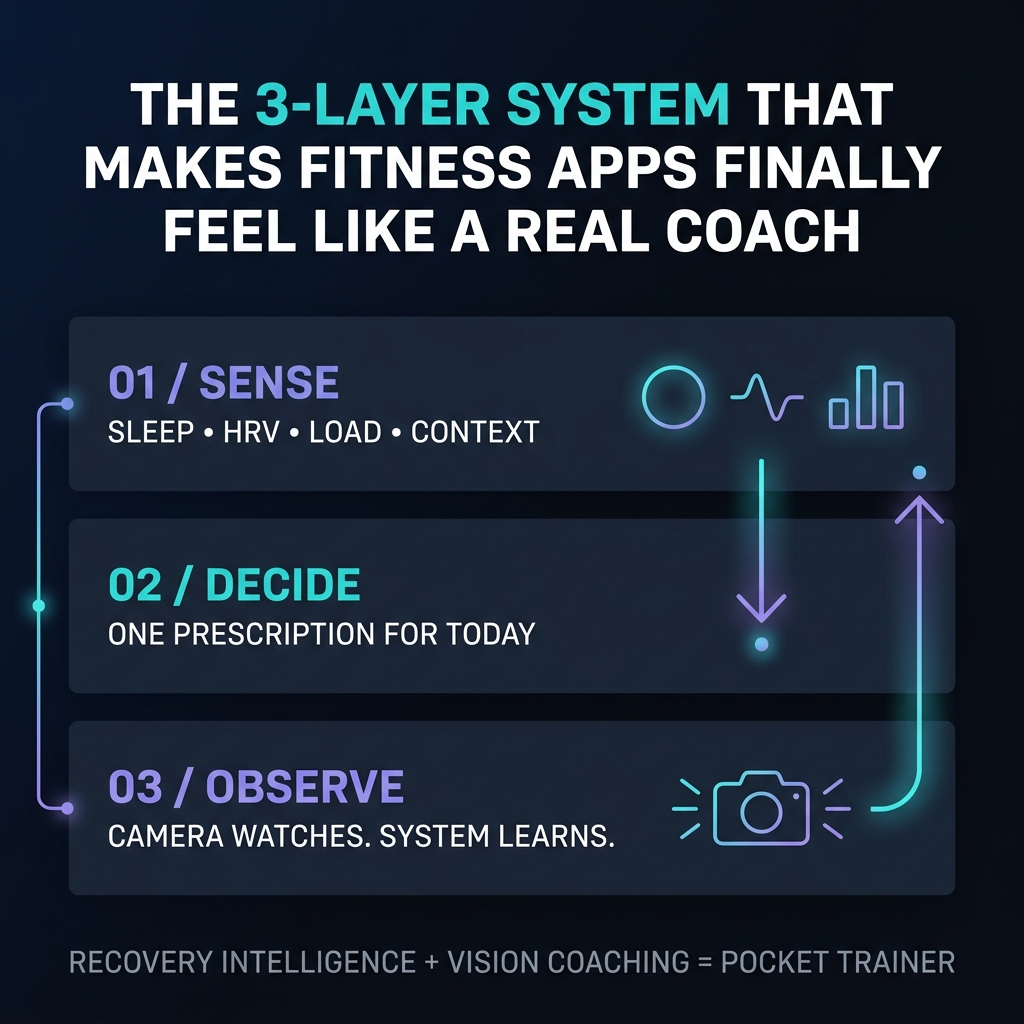
Put the pieces together and you can see the shape of the next generation. Three layers, one architecture:
1. Sense. The system reads sleep, HRV, resting heart rate, soreness, recent load, plus real-world context like schedule and location. Multiple signals, weighted by your personal baseline.
2. Decide. It reconciles those signals into a single prescription for today — harder, lighter, different, or rest. No dashboard for you to interpret. The intelligence stays invisible.
3. Observe. During the session, the camera watches execution, catches breakdowns as fatigue accumulates, and feeds that information back into tomorrow's decision.
The third layer closes the loop. Form degradation under load is itself a fatigue signal — arguably a better one than any morning metric. A system that sees your squat depth collapse on set four learns something no wearable can measure.
This is the difference between data aggregation and coaching. A coach standing next to you performs all three layers without thinking about it. Software is finally close to doing the same.
Key Point: The converged system does not add features — it closes the feedback loop between how you feel, what you do, and how you move.
My Predictions, Stated Plainly
I build in this space daily, so let me put specific claims on the record.
Prediction one: by 2027, recovery-aware programming becomes table stakes. Apps that prescribe workouts without reading readiness signals will feel broken, the way an app without offline mode feels broken today.
Prediction two: multi-signal reasoning replaces the single readiness score as the credibility marker. Users learn to distrust one-number systems the same way they learned to distrust calorie estimates.
Prediction three: vision-based form coaching becomes the defining differentiator between conversational fitness interfaces and genuine pocket trainers. The technology gap is real today, which is exactly why it becomes the moat. Whoever solves robust, explainable, real-time form feedback at consumer scale owns a category of one.
Prediction four: the winners will treat all of this as one operating system rather than a feature list. Recovery intelligence, load management, and vision coaching only create value when they inform each other.
Key Point: The competitive advantage in fitness tech will belong to systems that integrate recovery, load, and movement data into one architecture — not to platforms that treat them as separate features.
The Standard You Should Hold Your Tools To
If you use fitness technology, here is the test I suggest you apply.
Ask whether the system changes today's session based on how you slept, how sore you are, and what you did this week. If the answer is no, you are holding a data logger with a workout library attached.
If you build in this space, the roadmap writes itself: synthesize recovery signals into training decisions first, then earn the right to watch and correct movement. Both problems reward the same design philosophy. Adaptation beats optimization. Systems that flex around human variance outlast systems that demand humans eliminate it.
The most powerful version of this technology will feel simple from the outside. You wake up, it already knows, and today's session fits the body you actually have this morning.
That is the future I am building toward. The technology that finally feels like it is on your side.
Frequently Asked Questions
What does "recovery-aware programming" mean?
It means the app adjusts your workout prescription based on real-time recovery signals — sleep quality, HRV, resting heart rate, and soreness — rather than following a fixed calendar schedule regardless of how you feel.
Is HRV-guided training backed by research?
Yes. A 2020 meta-analysis by Granero-Gallegos and colleagues found HRV-guided training produced a measurable improvement in VO2max (effect size 0.402). Separate research confirmed improved adherence in sedentary adults training without professional supervision.
Why is a single readiness score not reliable enough?
Because no single biomarker diagnoses overtraining risk on its own (Meeusen et al.). Individual variability is too large. Accurate recovery decisions require agreement across multiple signals — sleep, HRV, heart rate, soreness, and motivation — not one composite number.
What is vision-based form coaching and why does it matter?
Vision-based form coaching uses a device camera and computer vision to detect movement errors in real time and provide corrective feedback. It matters because text-based coaching is now a commodity, and camera-based feedback addresses the primary reason people quit: the absence of accurate, immediate feedback that a real trainer would provide.
What is the acute-to-chronic workload ratio?
It is a measure developed by Dr. Tim Gabbett that compares recent training load (acute) to long-term training load (chronic). A ratio between 0.8 and 1.3 is associated with lower injury risk. Ratios above 1.5 are associated with elevated injury risk.
How is this different from what fitness apps already do?
Most current apps track recovery metrics separately from workout delivery. The next generation connects them directly — so recovery data changes what the app prescribes today, and movement data during the session feeds back into tomorrow's recovery assessment.
What is BioCoach?
BioCoach is a research prototype developed by teams at Drexel and Michigan State that combines computer vision, biomechanical modeling, and a vision-language model to deliver live, explainable form corrections. It represents the current state of the art in academic exercise form coaching technology.
When will these technologies become standard in consumer fitness apps?
Recovery-aware programming is already emerging in early products and is likely to become table stakes by 2027. Vision-based form coaching at consumer scale remains an unsolved problem as of 2026, but active research (including BioCoach) suggests meaningful progress within the next two to three years.
Key Takeaways
Fitness apps have a mature data collection layer and a missing decision layer — the gap between recovery metrics and workout prescriptions is an infrastructure failure, not a user failure.
HRV-guided training is research-supported: it improves VO2max and long-term adherence by replacing guilt-driven decisions with objective recovery signals.
Single readiness scores are fragile; accurate recovery decisions require multi-signal reasoning across sleep, HRV, heart rate, soreness, and training load history.
Text-based fitness coaching is now a commodity. Vision-based form coaching — real-time, explainable, camera-driven — is the next hard problem and the next competitive moat.
The converged architecture has three layers: sense recovery signals, decide on today's prescription, observe movement quality and feed it back into tomorrow's decision.
50% of people abandon fitness programs within six months without coaching presence. Computer vision addresses the core absence driving that dropout rate.
Systems that adapt to human variance outperform systems that demand humans eliminate it. Adaptation beats optimization.