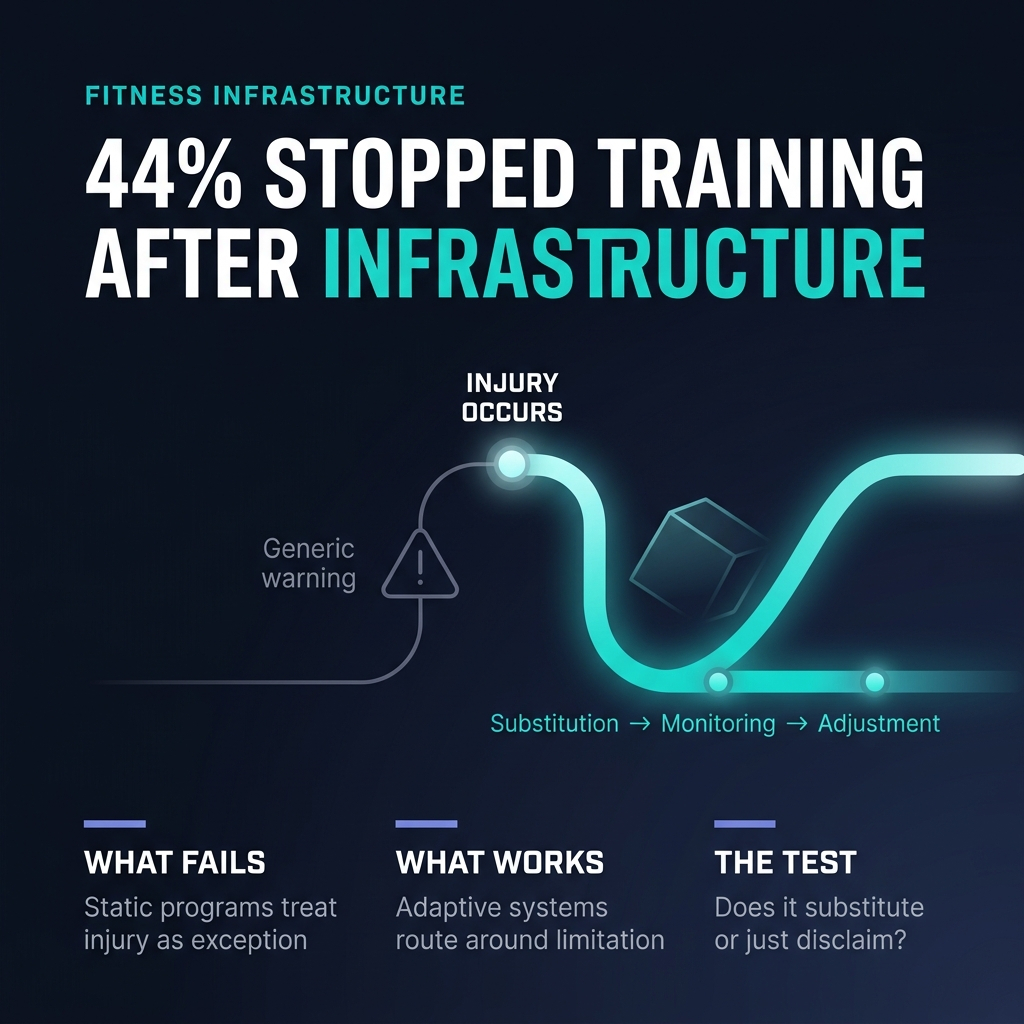
TL;DR: Most fitness systems respond to injury with disclaimers, not solutions. That design choice is why people quit. Adaptive fitness technology that accepts physical limitation as a core input — not an edge case — keeps users training through the exact moments when rigid systems lose them.
44% of people stop exercising entirely after an exercise-related injury.
Most fitness apps respond to injury with generic warnings, not safe substitutions.
Expert practitioners abandoned one-size-fits-all guidance long ago; mass-market software has not caught up.
Adaptive systems that treat pain and limitation as real-time inputs outperform static programs on engagement and satisfaction.
The moment a fitness plan fails to flex around a real body is the moment the user gets blamed for a design failure.
Injury Is Where Fitness Systems Quietly Lose People
A user asked me a simple question last month. "Can it work around my shoulder injury, or will it just tell me to consult a doctor and move on?"
That question exposed the biggest design failure in fitness technology.
Most systems handle injury, pain, and physical limitation the same way: a generic warning, a liability disclaimer, and silence. The user is left holding a program built for a body they do not currently have.
I build fitness systems for a living, and I want to walk you through why this failure happens, what it costs, and what an honest alternative looks like.
The Dropout Data
Research on older adults found that 44% stopped exercising entirely after an exercise-related injury, with return times ranging from 1 to 182 days.
Nearly half. Gone.
The standard industry interpretation blames the user. They lost motivation. They gave up. I read that data differently.
Those people hit a moment where their body changed and their program refused to change with it. The system offered them two options: do the workout as written or do nothing. They chose nothing, because nothing was the only safe option available.
That is an infrastructure failure. The dropout happened at the exact moment the system stopped matching reality.
This pattern extends far beyond older adults, and it explains something important about what users actually ask for.
Key Point: Exercise dropout after injury is not a motivation problem — it is a design problem. The system failed before the user did.
Users Want Substitutions, Systems Offer Disclaimers
Listen to how people with injuries actually talk about training. They say things like:
"My knee can't handle lunges. What can I do instead?"
"I have a herniated disc. Which of these movements are safe for me?"
"My mobility is limited on the left side. Adjust the plan, please."
Every one of these is a request for a specific, safe substitution. The person wants to keep training. They are asking the system to route around an obstacle.
Now look at what most systems return: "Consult a physician before beginning any exercise program."
Legally sound. Practically useless.
The professionals already know this. Qualified exercise professionals seldom use generic guidelines when prescribing activity to clients, because applying generic guidance arbitrarily conflicts with evidence-based practice. The people with the deepest expertise abandoned the one-size-fits-all approach a long time ago.
The gap sits between what professionals know works and what mass-market software actually delivers. Closing that gap is a design problem, and design problems have solutions.
Key Point: Injured users ask for specific alternatives. Generic disclaimers answer a liability question, not the user's question.
Why Generic Programs Break at the Edges
A static program makes a hidden assumption: your body today matches your body on day one, and both match the template the program was built on.
Real bodies violate that assumption constantly.
A shoulder tweaks during week three. A hip that felt fine in the gym feels different after a long drive. An old injury flares in cold weather. For people with chronic conditions or disabilities, research shows generic workout options become ineffective or risky because they overlook medical history, functional ability, and rehabilitation needs.
💡 The key insight: injury and limitation are normal operating conditions, and any system that treats them as rare exceptions will fail the majority of its users eventually.
When I designed FitPocket, I treated context — including pain, mobility restrictions, and physical constraints — as first-class inputs to the system. Weather gets that treatment. Schedule gets that treatment. A sore knee deserves the same architectural respect as a rainy forecast.
If a system only works when your body cooperates perfectly, the system carries a structural flaw. The user carries none of the blame.
Key Point: Static programs assume a stable body. Real bodies change constantly — therefore systems must change with them.
What Adaptive Actually Means When Pain Enters the Picture
The word "adaptive" gets used loosely in fitness marketing. Here is what it actually requires when injury is involved.
1. The System Accepts Limitation as Data
You tell it your knee hurts — through voice or text, in plain language. The system logs that as a constraint that shapes every downstream decision, the same way it handles equipment availability or location.
2. The System Substitutes Instead of Subtracting
Removing the barbell squat and leaving a hole in the program helps no one. An adaptive system replaces the movement with one that trains a similar pattern within your current capacity. You keep momentum. The injured area gets protection.
3. The System Reads Recovery Signals Over Time
Modern AI systems already adjust plans using real-time data such as sleep quality, energy levels, and biometrics, reducing intensity when recovery markers look poor. Emerging research goes further, integrating movement analysis and pain detection through computer vision, vocal fatigue cues, and heart rate data to build interventions that evolve with the user. The same research shows adaptive systems outperform static baseline programs on enjoyment and satisfaction.
People engage more with systems that meet them where they are. The evidence now backs the intuition.
Key Point: True adaptability means accepting limitation as data, substituting movements rather than removing them, and adjusting intensity based on real-time recovery signals.
The Shame Layer Nobody Talks About
There is a quieter cost to generic warnings, and it deserves attention.
When a program tells you to "modify as needed" without telling you how, it transfers the expert's job onto you. Most people lack the training to design safe substitutions. So they guess, they get hurt again, or they quit. Then they internalize the failure as personal weakness.
I hear it in almost every user conversation: "I always fall off eventually. I guess I'm just not disciplined."
That belief is commonly held and almost always wrong. The person fell off at a moment when their body needed the plan to bend, and the plan stayed rigid.
Good architecture removes that shame. When the system openly expects imperfect weeks, flare-ups, and physical variance, the user stops interpreting adaptation as failure. Adjusting a workout around a bad shoulder becomes routine maintenance, like rerouting around traffic.
This shift in framing does more for long-term consistency than any motivational feature I have ever tested.
Key Point: "Modify as needed" without guidance transfers expert responsibility to the user — and when they fail, they blame themselves instead of the system.
Where the Industry Goes From Here
The market signal is loud. The fitness app market is projected to reach $40.26 billion by 2034, growing 13.5% annually, driven largely by AI integration. Users now expect personalization as a baseline.
Expectation will keep rising, and injury handling is where the honest test happens. Anyone can personalize a plan for a healthy 28-year-old with a full gym and unlimited time. The real measure of intelligence in a fitness system is what it does for the person with a bad back, one dumbbell, and twenty minutes.
How to Evaluate Any Fitness Product on This Standard
Tell it about a specific limitation. Watch whether it responds with a substitution or a disclaimer.
Change your situation mid-program. Report pain in week two. See whether the plan actually restructures.
Check the input channels. A system you can address in plain language will capture constraints a form-based system misses.
⚠️ A disclaimer in response to a limitation tells you the system was designed for liability protection first and your body second.
Key Point: Injury handling is the clearest test of intelligence in a fitness system. How a product responds to a specific limitation reveals who it was actually designed for.
The Standard I Hold Myself To
I build for the person whose body changed last Tuesday. The one managing a chronic condition. The one coming back after six months away and unsure what is safe.
For them, adaptation is the entire product. A plan that flexes around a real injury keeps a person training through the exact moment when 44% of their peers walk away for good.
My conviction after years of building in this space comes down to one sentence.
Sustainable behavior change emerges from systems that flex around human variance, and injury is the moment that flexibility gets tested.
If you build fitness products, treat pain and limitation as core inputs from day one. If you use fitness products, hold them to that standard. Your consistency depends less on your willpower and more on whether your tools were designed for the body you actually have.
Frequently Asked Questions
Why do most fitness apps fail users with injuries?
Most apps rely on static programs built for an idealized user body. When an injury changes that body, the program has no mechanism to adapt — because limitation was never treated as a design input, only a legal liability.
What is the difference between a disclaimer and an adaptive response?
A disclaimer tells you to consult a professional and ends the interaction. An adaptive response accepts the limitation as data, identifies safe movement alternatives, and restructures the plan around the current constraint.
How much does injury actually affect exercise adherence?
Research on older adults found that 44% stopped exercising entirely after an exercise-related injury. Return times ranged from 1 to 182 days, meaning the dropout is not always permanent — but the gap it creates is long and costly.
What makes an AI fitness system genuinely adaptive versus just claiming to be?
A genuinely adaptive system accepts plain-language limitation inputs, substitutes movements rather than deleting them, and adjusts future sessions based on recovery signals like sleep, energy, and reported pain — not just a preset schedule.
Is fitness personalization only relevant for people with injuries?
No. Personalization matters at every stage, but injury is the moment the gap between generic and adaptive becomes visible. For people with chronic conditions or disabilities, generic programs are not just ineffective — they can be risky.
What inputs should an adaptive fitness system accept?
At minimum: equipment availability, schedule constraints, location, current pain or mobility limitations, recovery markers (sleep, energy, biometrics), and historical response to specific movement patterns.
How does framing affect long-term fitness consistency?
When a system expects and accommodates imperfect weeks and physical variance, users stop reading adaptation as personal failure. That reframe — from discipline problem to infrastructure response — is one of the most powerful drivers of long-term consistency.
How can I test whether a fitness product handles injury well before committing to it?
Tell it about a specific limitation during onboarding. Note whether it returns a disclaimer or a substitution. Then report new pain mid-program and observe whether the plan restructures. Those two tests reveal the system's actual design priorities.
Key Takeaways
44% of people stop exercising after an injury — because the system failed them, not the other way around.
Injured users ask for specific substitutions; most fitness apps return generic disclaimers instead.
Expert practitioners abandoned one-size-fits-all guidance long ago; mass-market software has not.
Adaptive systems must accept limitation as data, substitute movements rather than remove them, and adjust based on real-time recovery signals.
Generic "modify as needed" language transfers expert responsibility to the user — and produces shame when they cannot execute it.
How a fitness product responds to a specific injury is the clearest test of its actual intelligence.
Sustainable behavior change requires systems that flex around human variance. Injury is the moment that flexibility gets tested.