TL;DR: Most fitness apps that claim to use AI are running static plans with a marketing label. A genuinely adaptive system reads your sleep, soreness, missed sessions, and biometric data every morning — then modifies that day's workout accordingly. The research is clear: adaptation prevents injury, improves readiness, and eliminates the self-blame that rigid plans produce.
True AI adaptation adjusts sets, reps, load, and exercise selection based on daily physiological state — not a plan built weeks ago.
Sleep quality, soreness, prior-session performance, and HealthKit signals are the four inputs that should drive every session modification.
Research shows adaptive training keeps athletes at significantly higher readiness than fixed programs, even at identical training volumes.
High-intensity training during incomplete recovery actively reduces performance — static plans cannot detect or respond to this.
If sustaining a fitness program requires willpower, the system's architecture is broken, not the user's discipline.
What Is the Problem With "AI" Fitness Apps?
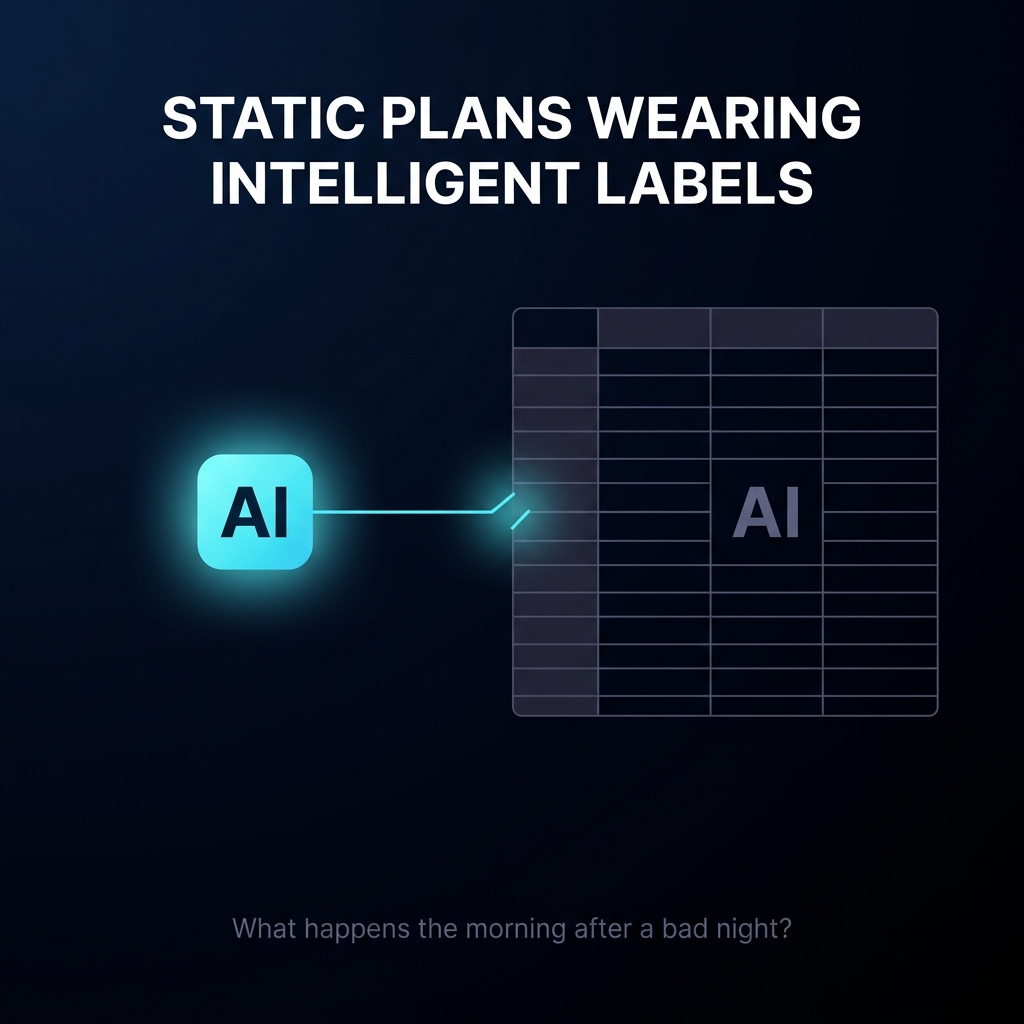
Static plans wearing intelligent labels.
I started asking one question when I evaluate any training system that calls itself intelligent.
What happens the morning after a bad night.
You slept four hours. Your legs are still sore from Tuesday. You skipped Wednesday entirely because work collapsed on you. Your watch logged all of it. The data sits right there in HealthKit.
Then you open the app, and it hands you the exact session it planned three weeks ago.
That moment tells you everything about the system you are using. The label on the box says AI. The behavior says spreadsheet.
When I dug into how most fitness apps actually work, I found the same architecture repeated everywhere. A questionnaire generates a plan. The plan runs for weeks. The app tracks whether you completed it.
Tracking compliance to a fixed plan is bookkeeping. It records your failure to match a prediction made before your life happened.
The market rewards this shortcut. The fitness app industry is projected to reach $40.26 billion by 2034, growing 13.5% annually, and a large share of that growth rides on apps that claim adaptive intelligence without delivering it. A static plan with a regenerate button is still a static plan.
Even traditional personal trainers update plans weekly at most, working largely from memory. A genuinely adaptive system refines programming session by session and adjusts mid-workout based on real performance data.
The gap between the label and the behavior is where users get hurt. They blame themselves for falling off a plan that never accounted for their reality. That is an infrastructure failure, and the evidence backs it up.
Key Point: The majority of "AI" fitness apps run fixed templates. Adaptive intelligence requires session-by-session modification based on real physiological inputs — not a questionnaire run once at setup.
What Does the Research Show About Adaptive vs. Static Training?
Adaptation produces measurable results. Rigidity produces measurable damage.
Three findings shaped how I think about daily decision-making in training.
First: adaptive systems keep athletes readier. A study on runners found the adaptive group maintained significantly better readiness scores than athletes on fixed programs, spending more time above baseline readiness even with similar training volumes. The difference came from how intelligently the system responded to daily state, since volume was held constant.
Second: recovery status determines whether training helps or harms. Research on youth soccer players showed prolonged, incomplete recovery of hamstring force 48 hours after a match. When high-intensity training landed at that 48-hour mark anyway, performance declined significantly compared to moderate sessions. The calendar said train hard. The body said absolutely do not. The systems that listened to the calendar made their athletes worse.
Third: fatigue is predictable before it is visible. AI models using sensor data forecast the onset of fatigue before physical symptoms appear, enabling individualized adjustments synchronized with each athlete's physiological thresholds. Waiting for the user to feel broken means waiting too long.
The exercise science on soreness reaches the same conclusion: the only strategy proven to reduce post-exercise muscle soreness and improve recovery is a progressive approach to training. Ice baths, supplements, and recovery gadgets lack that evidence base.
Persistent soreness after moderate workouts signals a program progressing too fast. A rigid plan misses that signal completely. An adaptive one reads it and pulls back before the damage compounds.
Key Point: The science is consistent — adaptive systems outperform static ones in readiness, recovery, and injury prevention. Ignoring daily physiological data doesn't just reduce effectiveness; it actively causes harm.
How Does Daily Adaptive Decision-Making Work?
Four inputs. Evaluated fresh. Every session.
I designed FitPocket around a decision loop that runs before every single workout. Four inputs, evaluated fresh each day.
1. Assess sleep. Last night's sleep duration and quality set today's capacity. In elite swimmers, sleep duration predicted 88% of performance variance. Slow-wave sleep percentage predicted the same share of outcomes. Sleep monitoring functions as a performance predictor, and any system ignoring it prescribes blind.
2. Assess soreness. Reported soreness and residual fatigue from prior sessions reshape today's load. The 48-hour recovery data makes this non-negotiable. Elevated soreness plus high prescribed intensity equals a session that sets you back.
3. Assess yesterday. Completed sessions, missed sessions, actual performance against prescribed performance. A missed workout changes the plan structurally. Pretending it happened and rolling forward corrupts every session that follows.
4. Read the signals. HealthKit consolidates heart rate, HRV, sleep stages, activity, and workout data from Apple Watch, Garmin, Oura, and manual inputs into one unified source. That consolidation enables coaching that suggests an easy day when HRV indicates poor recovery, regardless of which device captured the signal.
Then, and only then, the system modifies the prescribed session. Sets. Reps. Load. Exercise selection. Future sessions downstream.
The plan you see today was decided today.
Key Point: Four inputs — sleep, soreness, prior session performance, and biometric signals — feed a daily decision loop that modifies every workout in real time. No input from yesterday goes unread.
Why Is Adaptation an Architecture Decision, Not a Feature?
Adaptation belongs in the operating system, not bolted on afterward.
Here is what I learned building this: you cannot retrofit daily adaptation onto a static plan engine. The whole data model resists it.
A static engine treats the plan as the source of truth and your behavior as deviation. An adaptive engine treats your current physiological state as the source of truth and the plan as a hypothesis that gets revised every morning.
Those are different foundations. The choice happens on day one of building the product, which explains why so many apps fake it with a regenerate button instead.
Context earns first-class status in this architecture. Weather, schedule, equipment, location, sleep, soreness. Treating these as edge cases to handle later guarantees a system that breaks the moment real life shows up. Real life shows up daily.
The same principle governs progression. When soreness data says the program is moving too fast, the system slows it down and keeps easy days genuinely easy. Discipline stops being the load-bearing wall. The structure carries the weight instead.
A useful test emerges from this: if maintaining the program requires willpower, the system is broken.
Key Point: Static and adaptive systems are incompatible architectures. An app cannot deliver real adaptation by adding a regeneration button to a fixed-plan engine — the data model must be built for daily revision from the start.
What Does This Mean for the User?
The end of self-blame as a default outcome.
The deepest consequence of static plans is psychological. When the plan ignores your reality and you fail to execute it, you absorb the failure as personal. Years of that teaches people they lack discipline.
The readiness research, the recovery research, the sleep research all point the same direction. Those failures were misalignment between a fixed prescription and a variable human.
Daily adaptive decision-making removes that misalignment structurally. You wake up under-recovered, the session adjusts. You miss Wednesday, Thursday accounts for it. You crush a workout beyond expectations, future load reflects it.
People stop comparing this to other fitness apps. They compare it to having a coach who actually knows them, checks on them each morning, and adjusts without judgment.
Key Point: Adaptive systems remove the structural cause of self-blame. When the plan responds to your actual state, failure to comply becomes a system problem to solve — not a character flaw to overcome.
How to Evaluate Whether a Fitness App Is Truly Adaptive
A practical test. Run it before you trust the label.
When you evaluate any training product that claims intelligence, run this test. Sleep badly, skip a session, report soreness, then open the app.
Watch what changes.
Sets and reps adjusted? That is adaptation.
Load reduced after poor recovery signals? That is adaptation.
Exercise selection changed for your actual state? That is adaptation.
Future sessions restructured around the missed one? That is adaptation.
The same session, three weeks old, waiting for you? That is a spreadsheet with a marketing budget.
The evidence is settled. Adaptive systems keep people readier, prevent recovery-impairing sessions, and catch fatigue before it becomes injury. Static plans, whatever their label, ignore the one thing that changes daily: you.
I build systems that meet people where they are. Every morning. Fresh decision. Real data.
That standard is worth demanding from every product you let program your body.
Key Point: The simplest way to test a system's intelligence is to stress it with a bad week. A truly adaptive system responds with a different plan. A static one hands you the same session regardless.
Frequently Asked Questions
What is the difference between an adaptive fitness app and a static one?
A static fitness app generates a plan from an initial questionnaire and runs it unchanged regardless of how you perform, recover, or feel. An adaptive fitness app reads daily inputs — sleep, soreness, missed sessions, biometric signals — and modifies that day's session and future sessions accordingly.
What data does a truly adaptive fitness system use?
A genuine adaptive system processes sleep duration and quality, reported soreness, prior-session performance, heart rate variability (HRV), and consolidated biometric data from sources like Apple Watch, Garmin, and Oura — integrated through platforms like HealthKit.
Why does high-intensity training during recovery cause harm?
Research on youth soccer players found that hamstring force remains incompletely recovered 48 hours after a match. Scheduling high-intensity sessions during that window produced significantly worse performance outcomes compared to moderate sessions. The body's recovery state determines whether training produces improvement or damage.
How much does sleep affect athletic performance?
In elite swimmers, sleep duration predicted 88% of performance variance. Slow-wave sleep percentage predicted the same share. A fitness system that ignores sleep quality is making load prescriptions without access to one of its most predictive variables.
Why do most fitness apps fail to deliver real AI adaptation?
Because adaptation requires a different data architecture from the ground up. A static plan engine treats the original plan as the source of truth. Retrofitting daily adaptation onto that model is structurally incompatible — which is why most apps substitute a regenerate button instead of rebuilding the foundation.
Is self-blame a normal outcome of using rigid fitness plans?
It is a predictable one. When a fixed plan does not account for under-recovery, schedule disruptions, or physiological variance, the user experiences repeated failure to comply. Over time, that mismatch gets internalized as personal weakness rather than recognized as a system design flaw.
What is HRV and why does it matter in adaptive training?
Heart rate variability (HRV) measures the variation in time between heartbeats. Higher HRV generally indicates better recovery and readiness for high-intensity effort. Lower HRV signals accumulated fatigue. An adaptive system reads HRV as an input and adjusts session intensity accordingly — before the user consciously feels depleted.
How do I know if a fitness app is truly adaptive?
Sleep badly, skip a session, report soreness, and open the app. If the session that appears is the same one scheduled weeks ago, the system is static regardless of its marketing. If sets, reps, load, and exercise selection have changed in response to your inputs, the system is functioning adaptively.
Key Takeaways
Most "AI" fitness apps run static plans. Genuine adaptive intelligence modifies programming session by session based on real physiological data.
Sleep, soreness, prior-session performance, and biometric signals (HRV, heart rate, activity) are the core inputs that should drive daily session modifications.
Research confirms that adaptive training produces higher readiness scores than fixed programs at identical training volumes.
Training at high intensity during incomplete recovery actively decreases performance — a risk static plans cannot detect or prevent.
Fatigue is predictable before it becomes symptomatic. Adaptive systems act on early signals; static systems wait until the damage is visible.
Adaptation is an architectural decision, not a feature. It cannot be added to a static plan engine after the fact.
If a fitness program requires willpower to maintain, the system is broken. Sustainable behavior emerges from reduced friction — not increased discipline.