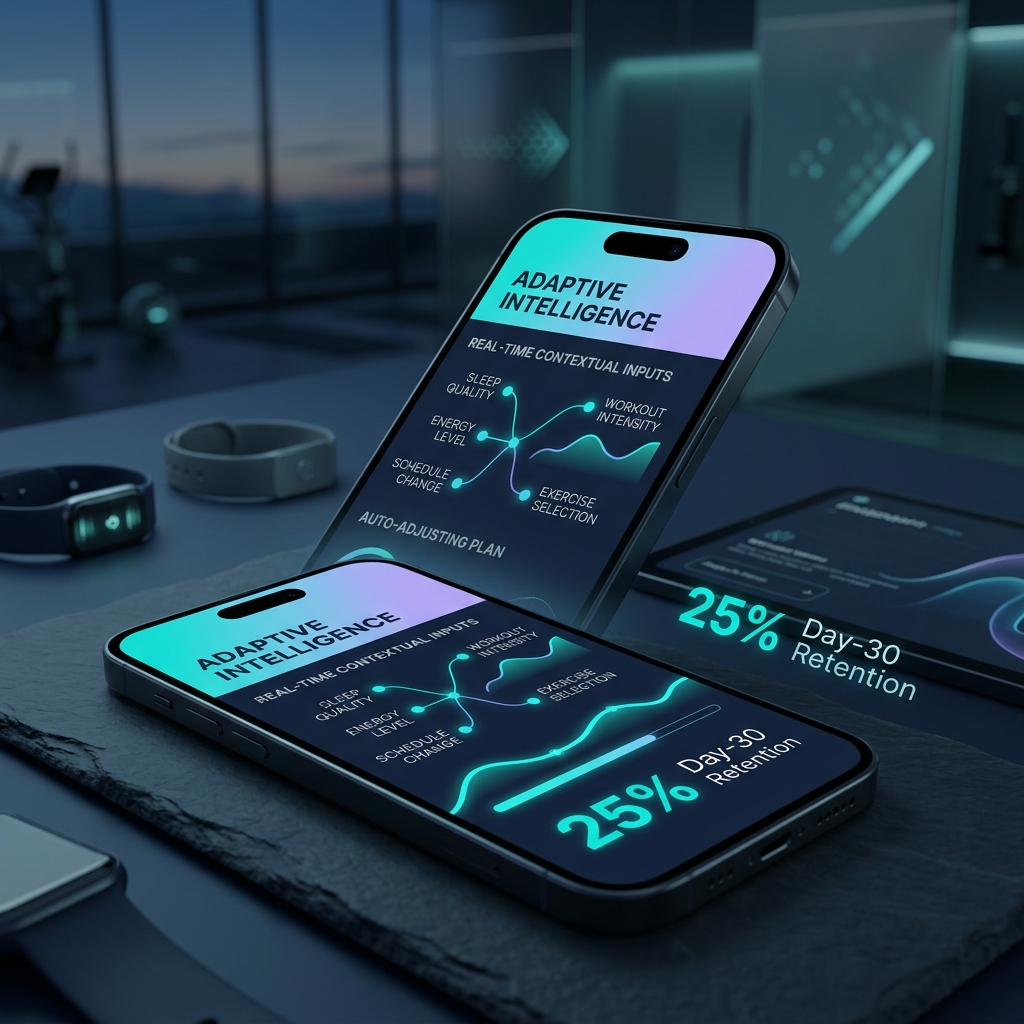
TL;DR: Fitness apps lose 96% of users within 30 days — not because users lack discipline, but because the systems are designed for controlled conditions that real life never provides. Adaptive AI architecture that adjusts to context, weather, schedule, and energy is the structural fix the industry refuses to build.
The average fitness app retains only 3–4% of users at day 30; 46.8% of premium subscribers churn within 90 days.
Abandonment is a design defect, not a discipline problem — rigid programs fail when real life deviates from the plan.
Adaptive systems that read real-time signals achieve up to 25% day-30 retention, a 6–8x improvement over the industry baseline.
Intelligence in software means adjusting to context (weather, schedule, equipment, energy) before the user has to ask.
Systems that flex around human variance outperform systems that demand conformity — in retention, in outcomes, and in trust.
Why Do Fitness Apps Fail So Fast?
I started with a question that bothered me for years.
Why do intelligent, capable adults quit fitness programs at rates that would sink any other product category?
The standard answer blames the user. Low discipline. Weak motivation. Poor consistency. I heard this explanation everywhere, and I stopped believing it the day I looked at the numbers seriously.
The average fitness app keeps 3 to 4 percent of its users at day 30. Roughly 80 percent of people abandon a new fitness app within the first month. Among premium subscribers, people who paid real money, 46.8 percent churn within 90 days.
Read that last figure again. These users invested. They committed financially. They still left.
When paying customers walk away at that scale, the diagnosis becomes obvious. The system failed the person. Building FitPocket forced me to treat that failure as an engineering problem, and this article is what I found when I investigated it.
📌 The data removes user blame from the equation. A 96% failure rate is a system indictment, not a character assessment.
THE EVIDENCE POINTS TO INFRASTRUCTURE
Every failed fitness attempt I studied followed the same pattern.
Someone starts a program built for controlled conditions. Fixed schedule. Fixed equipment. Fixed energy levels. Then reality arrives. Rain cancels the outdoor run. A meeting eats the lunch workout. Sleep collapses during a stressful week.
The program stays rigid. The person adapts alone. Within weeks, the gap between the plan and the life becomes too wide to bridge, and the person quits.
The industry calls this a compliance problem. I call it a design defect.
The research backs this up. Studies on mobile health apps show that abandonment stems from system complexity and the mismatch between design and user needs. The one month retention rate across all health apps sits at 4 percent.
💡 Key insight: if a system requires willpower to maintain, the system is broken. Willpower is a finite resource. Architecture is permanent.
This principle shapes everything I build. Weather changes. Schedules collapse. Bodies respond differently than charts predict. A program that treats these as user errors will lose the user every time.
📌 Infrastructure failure, not motivation failure, explains the dropout rate. The same real-life disruptions that programs treat as exceptions are actually the norm.
What Does Intelligence Actually Mean in Fitness Software?
The word "intelligent" gets attached to a lot of software that behaves like a filing cabinet.
Most fitness apps generate a plan from a static profile you filled out on day one. Age, weight, goal, done. The plan never learns anything after that. It executes the same logic in week twelve that it ran in week one, regardless of what happened in your life during those twelve weeks.
Real intelligence adapts to signal. It reads what is actually happening and adjusts.
The market already understands this. According to McKinsey research from 2025, 68 percent of fitness app users prefer platforms that learn and adapt to their performance. Adaptive systems can read real-time inputs like sleep quality, energy levels, and performance trends, then refine the plan on the go.
Context as a First-Class Constraint
Most systems treat context as an edge case — something to handle later, after the core product ships. In contrast, I treat context as the core product.
Weather. Schedule. Available equipment. Location. Energy that day. These are the actual conditions under which a human executes a plan. A system that ignores them produces recommendations for a person who does not exist.
In FitPocket, an indoor alternative appears when the forecast turns. A session compresses when the calendar tightens. A substitution surfaces when the equipment changes. The user never files a request. The system reads the signal and moves first.
Intelligence works when the user stops having to think about it.
📌 Static profiles produce static plans. Real intelligence adjusts to what is actually happening — sleep, schedule, weather, and equipment — not what was true on signup day.
The 6x Gap That Proves the Thesis
Skeptics tell me adaptation sounds nice in theory and makes no measurable difference. The data says otherwise.
The best fitness apps achieve 25 percent day-30 retention against the 3 to 4 percent industry average. That is a six to eight times difference, and it compounds into completely different economics.
The apps at the top share a specific architecture:
Passive data collection that reads signals without demanding manual input
Dynamic personalization that updates as the person changes
Context-aware timing that meets people when their life allows
Adaptive difficulty orchestrated by real health signals instead of static segments
Each element solves a friction point. Together they form an operating system for behavior change.
This finding matched my own product data. Users stayed engaged in direct proportion to how little the system demanded from their willpower. Every removed friction point extended retention. Every rigid requirement shortened it.
⚠️ A caution for builders: adding features increases complexity, and complexity drives abandonment. Depth of adaptation beats breadth of function.
📌 A 6–8x retention gap separates adaptive systems from rigid ones. That difference is architectural, not cosmetic.
How FitPocket Designs for Real-World Variance
I made a structural decision early. FitPocket would launch globally, across 175+ countries, from the start.
That decision was a forcing function. A product that serves someone in a fully equipped city gym and someone with resistance bands in a rural apartment has to be adaptive at the architectural level. Variance stops being an edge case when your first thousand users span dozens of climates, schedules, and cultures.
The same logic drove three other choices.
Conversation as Infrastructure
Voice and text access sit at the core of the system. People describe their constraints in natural language, the way they would tell a knowledgeable friend, and the system translates that into adjusted plans. Commands and menus create friction. Conversation removes it.
Multidimensional Tracking
The scale tells one thin story. Body scans, measurements, photos, and trend lines tell the full one. Real progress moves across multiple dimensions, and a system that tracks only weight will misjudge the person it serves.
Flexibility as a Default
Meal plans span vegetarian, vegan, pescatarian, and omnivore preferences with substitutions built in. Imperfect weeks are an expected condition, so the system plans for them instead of penalizing them.
📌 Designing for 175+ countries from day one forces adaptive architecture to be foundational, not a later-stage feature add.
How Rigid Systems Created Shame — and What Architecture Does Instead
One effect of this work surprised me.
When I explain adaptive architecture to people, something shifts in the conversation. They stop apologizing for the programs they quit. They start seeing those failures as system failures, because that is what the evidence shows they were.
The research confirms this reframing. Users leave because the experience fights against how habits naturally form. Generic plans fail because every person carries different goals, fitness levels, and routines, and a plan that ignores those differences leaves the person feeling unsupported.
Removing shame through architecture works better than removing it through encouragement. Encouragement asks people to feel differently about a broken system. Architecture fixes the system.
📌 Shame is a byproduct of bad system design. When the architecture accounts for human variance, past failures reframe as system failures — not personal ones.
Where This Leads
Fitness is the wedge. The pattern extends much further.
Every goal that requires sustained behavior change faces the same gap between aspirational identity and operational reality. The person you intend to be on Sunday night meets the life you actually live on Tuesday afternoon. Systems that flex around that collision succeed. Systems that demand conformity produce the 96 percent abandonment rate the industry has normalized.
I am building the intelligent layer between human intention and real-world execution. The adaptive value compounds as the system accumulates data about your specific patterns, learning what you sustain and what you abandon.
Three principles guide everything:
Adaptation beats optimization. A slightly worse plan you follow outperforms a perfect plan you quit.
Data without context is noise. Signals matter only when the system acts on them.
If the user has to change their life to fit the tool, the tool has failed.
The most powerful technology feels like it is finally on your side. That is the standard I hold my own product to, and it is the standard I believe you should hold every system in your life to.
The next time a program fails you, investigate the program before you indict yourself. The retention data says you will usually find the defect in the design.
Frequently Asked Questions
Why do most fitness apps fail to retain users?
Because they are designed for controlled conditions that real life rarely provides. Fixed schedules, fixed equipment, and static plans cannot adapt when reality changes. The result is a structural mismatch, not a user discipline problem.
What is the average day-30 retention rate for fitness apps?
The industry average is 3 to 4 percent. The best adaptive apps reach 25 percent — a 6 to 8 times improvement driven by context-aware design.
What does adaptive AI mean in a fitness context?
Adaptive AI reads real-time signals — sleep quality, schedule, weather, available equipment, energy levels — and adjusts the training plan automatically. The user describes their constraints in natural language; the system responds without requiring manual reconfiguration.
Why do premium subscribers still churn at high rates?
Financial commitment does not fix a design problem. When a rigid system cannot accommodate life's variance, paying users quit for the same reasons free users do. The architecture, not the price tier, determines retention.
How is multidimensional tracking different from standard fitness tracking?
Standard tracking records weight and workout completion. Multidimensional tracking adds body scans, measurements, photos, and trend lines — because real progress moves across multiple variables and a single metric misjudges the full picture.
What makes conversation-based fitness systems more effective?
Menus and commands create friction. Natural language removes it. When users describe constraints the way they would to a knowledgeable colleague, the system adjusts without requiring technical input from the user.
Does adaptive fitness design apply beyond fitness?
The same architecture applies to any goal requiring sustained behavior change. The gap between aspirational identity and operational reality exists across health, learning, and productivity — because real life disrupts all of them equally.
How does reduced friction extend retention?
Every friction point the system removes is a willpower demand it eliminates. Because willpower is finite, systems that rely on it fail at scale. Architecture that adapts to the user removes the reliance on willpower entirely, which is why retention improves proportionally to friction reduction.
Key Takeaways
The 96% abandonment rate is a system indictment. When almost every user quits, the design is the variable to investigate, not the user's motivation.
Rigid programs fail because they are built for controlled conditions. Real life — weather, schedule shifts, energy variance — is not an edge case; it is the terrain.
Adaptive systems outperform static ones by 6–8x at day-30 retention. That gap is structural, not incremental.
Real intelligence in software is invisible. It adjusts to context before the user has to ask.
Depth of adaptation beats breadth of features. Complexity drives abandonment; friction reduction drives retention.
Shame from past fitness failures is a design byproduct. When systems account for human variance, past failures reframe as system failures, not personal ones.
Adaptation beats optimization. A slightly worse plan followed consistently outperforms a perfect plan that gets abandoned.