You have probably filed yourself under a quiet label. Not disciplined enough. Not consistent enough. The kind of person who starts strong and fades by week two.
I want to take that label off the table.
I have signed up for the disciplined version of myself more times than I can count. The clean meal plan. The 6 a.m. workout. The program that promised results if I just showed up. And I watched each one collapse the first week real life walked in the door.
For years I read that collapse as a verdict about my character. It took me a long time to see it was a verdict about the plan.
Every fitness plan hides an ideal life it never mentions
Read the fine print of any program and you find a list of silent assumptions.
It assumes you slept eight hours. It assumes your morning is free. It assumes the weather cooperates, the gym is open, the kids are calm, and nothing at work ran late. It assumes a life with no interruptions.
Adherence does not measure how badly you want the result. It measures how closely your actual week matches that fiction.
Most weeks match it poorly. That is not because you are broken. It is because the fiction describes a life almost nobody lives.
When many people quit at the same place, the place is the problem
I trust patterns more than I trust guilt.
When one person abandons a plan, the story writes itself: they lacked willpower. When millions of people abandon the same kind of plan at the same predictable moment, that story stops holding.
A repeated failure pattern is data about design. If a bridge dropped every third car into the river, we would not lecture the drivers about focus. We would inspect the bridge.
💡 A simple audit: take any plan you abandoned and list the conditions it quietly required. Then count how many days last month actually met them. The gap you find is the plan's flaw, sitting where you assumed your own flaw was.
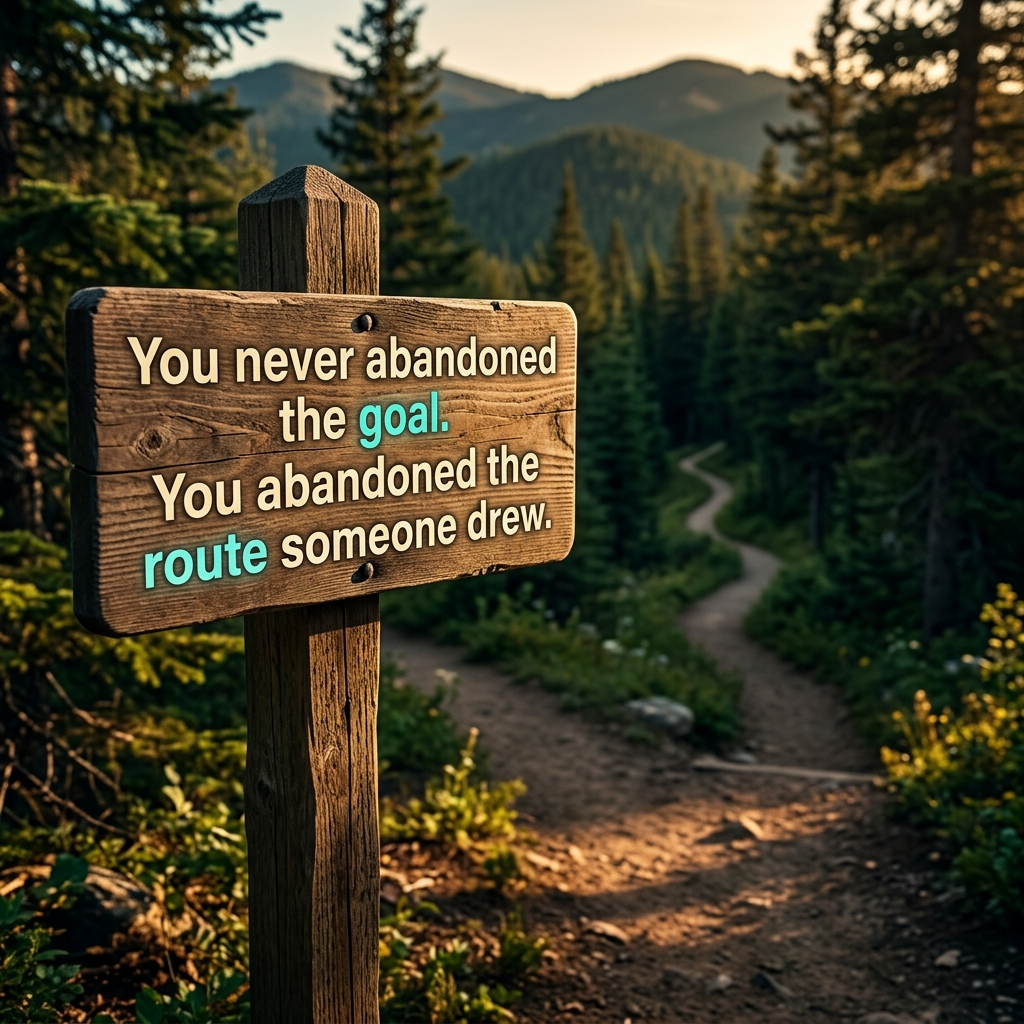
You never abandoned the goal. You abandoned the route someone drew
Here is the part that mattered most to me.
I never stopped wanting to be strong, healthy, and capable. What I stopped tolerating was a rigid path that shattered the moment my Tuesday went sideways.
People rarely walk away from what they want. They walk away from one specific, inflexible route to it. When that route assumes conditions you cannot reliably produce, walking away is the sane response, not the weak one.
What looked like a flaw in the person was a missing feature in the design.
Design for the disrupted week, because that is the normal week
Most programs treat the chaotic week as an exception to apologize for. I think that is backward.
The interrupted night, the stolen half hour, the trip that eats your routine, the storm that closes the outdoor run: these are not edge cases. They are the terrain. A system worth trusting treats disruption, fatigue, and unpredictability as its normal operating environment.
Build for that, and something quiet happens. The same person who kept failing starts succeeding without changing a single thing about their character.
They did not find more discipline. The system stopped demanding a life they were never living.
What a system built for real life actually does
This is the thinking behind FitPocket. The intelligence sits in the architecture, not on top of it as a feature you toggle on.
1. It reads context as a first-class input. Weather, schedule, available equipment, and location shape the session instead of getting handled as afterthoughts.
2. It adapts through conversation. Voice and text access are built in, so telling it your day changed is as simple as saying so.
3. It respects your food reality. Vegetarian, vegan, pescatarian, omnivore, with substitutions when the fridge does not match the plan.
4. It tracks progress in more than one dimension. Photos, body scans, measurements, and trends, because real change shows up in more than a single number.
5. It works across 175+ countries. Built for variance from day one, and it connects with tools you already use, including Strava and Apple Health.
The point of all of it is small and stubborn: if you have to change your life to fit the tool, the tool has failed.
Read your shame as a signal, then set it down
The quiet guilt you carry is worth listening to, once. Not as proof you fell short, but as a pointer to a false story you inherited about why you fell short.
You were handed a blueprint for a life you never had. You measured yourself against a fictional you who slept well, woke free, and met no resistance. Then you blamed the real you for the difference.
A system built for real, interrupted days makes that shame obsolete. Not through motivation. Through design that finally sits on your side of the table.
You were never the broken part. The plan was.