TL;DR: Most fitness and AI product failures are infrastructure failures, not user failures. Systems built on rigid assumptions break against real life. Adaptive AI, designed around human variance from the start, produces measurably better outcomes across satisfaction, trust, and sustained behavior change.
Users don't fail because they lack discipline; they fail because the system assumed a life they don't have.
Research confirms users want AI that understands them, not AI that explains itself better.
Contextually aware AI reduces clarifying questions by up to 47% and boosts first-response resolution by 39%.
Personalized, context-aware systems significantly outperform rigid ones on trust, satisfaction, engagement, and perceived intelligence.
Adaptive design is no longer a product philosophy. At scale, it becomes a survival requirement.
The Evidence Points at the System
When I dug into why AI products frustrate people, I expected to find a comprehension gap. Users confused by models, confused by outputs, confused by interfaces.
The research shows the opposite dynamic.
"Users in our study did not seem concerned about understanding AI but were often frustrated by a perceived lack of understanding on the part of AI, whether that was understanding them as a person, understanding what they wanted from the AI system, or understanding humans in general." (2022 study)
People weren't asking the machine to explain itself. They were asking the machine to understand them.
This matches what I see in fitness every day. Nobody quits a training plan because they can't comprehend sets and reps. They quit because the plan comprehends nothing about their Tuesday.
Key Point: The core frustration with AI is not confusion about how it works. It is frustration that the system fails to understand the user's context and needs.
Why Rigid Systems Keep Getting Built
The rigidity is a design choice, made upstream, long before any user touches the product.
Research from 2021 found that AI development is mainly driven by a technology-centered approach, with many AI professionals dedicated to studying algorithms rather than building systems that meet user needs. The result is documented widespread system failure.
Teams optimize for theoretical performance in controlled conditions. Then they ship into a world with none of those conditions.
In fitness, this produces the 12-week program that assumes:
Perfect weather for every outdoor session
A fully equipped gym within reach at all times
A schedule that never collapses
A body that responds exactly as the chart predicts
When reality deviates, the program treats the deviation as user error.
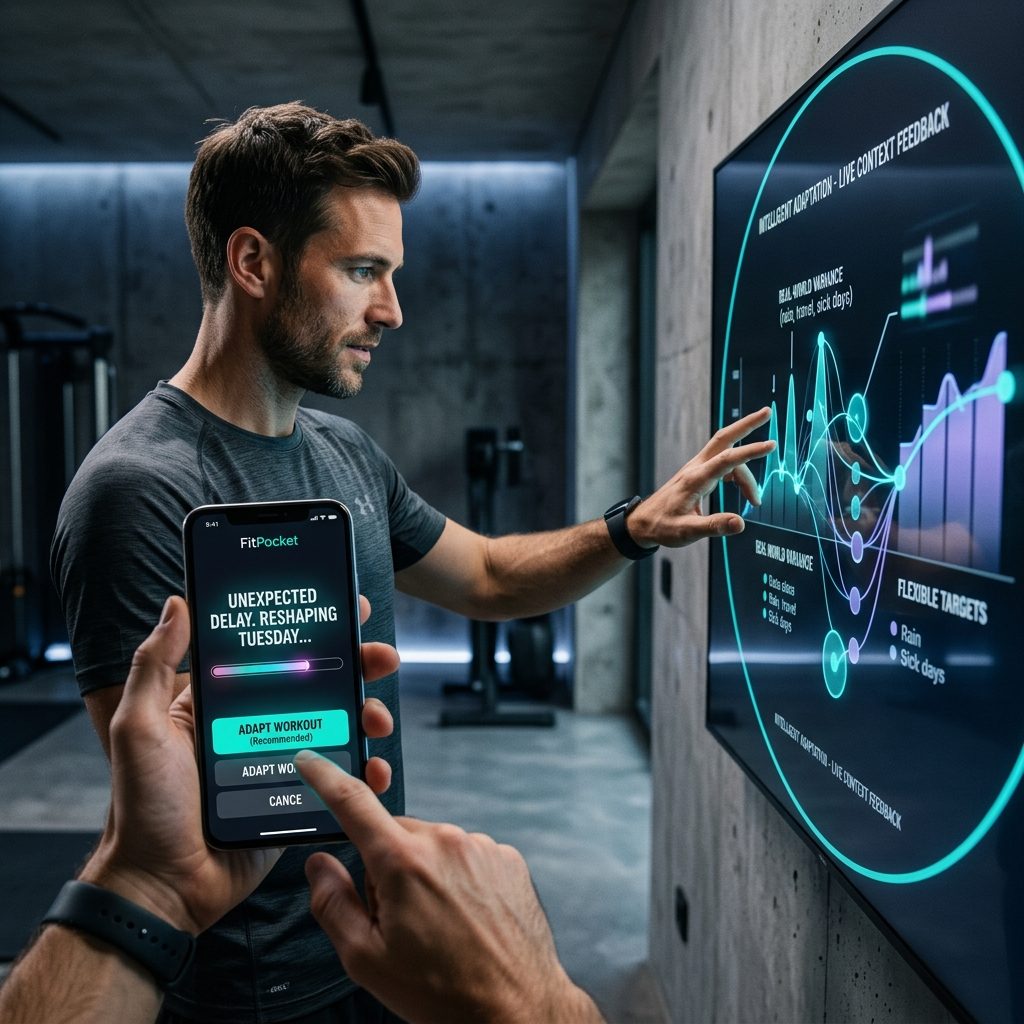
I made a different bet when I built FitPocket. Real-world variance is the terrain, and the system has to be designed for it from day one. Weather changes the workout. A missed session reshapes the week. A hotel room replaces the gym. The intelligence lives in the adjustment, and the adjustment happens without the user filing a request.
Key Point: Rigid AI products fail because they are optimized for controlled conditions, not the messy reality users actually live in.
How Adaptation Produces Measurable Results
Industry data from 2025 shows that contextually aware systems reduce the need for clarifying questions by up to 47 percent and increase first-response resolution rates by 39 percent compared to systems that process each query in isolation.
Context cuts friction. Friction is where behavior change dies.
A January 2026 study compared AI models across four configurations and found that systems combining personalization with context awareness dramatically outperformed non-personalized, non-contextual systems, with statistical significance at p < 0.001, across user satisfaction, trust, engagement, and perceived intelligence.
The researchers concluded that non-personalized, non-contextual systems are far behind the curve because they fail to meet changing user expectations.
Notice what people rated higher in that study: perceived intelligence. Users experience adaptation as intelligence. A system that knows a thousand facts and adjusts to none of them reads as dumb. A system that quietly reshapes itself around your Tuesday reads as smart.
Key Point: Contextual awareness is not a UX enhancement. It is a direct driver of trust, satisfaction, and perceived intelligence.
The Principles Behind How I Build
1. Adaptation beats optimization
A perfectly optimized plan for a life you don't live is worth zero. A decent plan that reshapes itself around your actual week compounds. Every skipped session becomes a signal the system absorbs.
2. If the tool requires willpower to maintain, the tool is broken
Willpower is a scarce, depleting resource. Systems that spend it daily go bankrupt fast. Sustainable behavior emerges from reduced friction. Every moment a user has to force themselves is a bug report.
3. Context is a first-class constraint
Weather, schedule, equipment, location. Most products handle these as edge cases in a backlog. They are core inputs, because for the user they are the whole game.
4. Intelligence should be invisible
The system works when you stop thinking about it. Conversation replaces configuration. You say what happened, in voice or text, and the plan reorganizes itself. Commands, menus, and settings screens are taxes on attention.
5. Data without context is noise
Body scans, measurements, photos, trends. Each one matters only when the system connects it to your circumstances and turns it into an adjustment. Tracking that produces charts and no decisions is theater.
Key Point: These five principles are not product features. They are architectural commitments that determine whether a system blames users or adapts to them.
Why This Extends Far Beyond Fitness
The pattern is now visible across the entire technology landscape.
A 2026 analysis observes that artificial intelligence is moving from novelty to infrastructure, with society adapting in real time. Once something becomes infrastructure, standards change. You tolerate quirks in a gadget. You demand reliability from a road.
Infrastructure that demands conformity from every user fails at scale, because users vary and infrastructure can't choose its users. Adaptive design stops being a nice philosophy and becomes a survival requirement.
Fitness is a brutal proving ground for this. The domain has decades of failed compliance-based products, high emotional stakes, and constant real-world interference. A system that keeps people training through chaotic real lives has solved something general about sustained behavior change.
That's why I think of fitness as the wedge. The deeper product is an intelligent layer between human intention and real-world execution, applicable to any goal that requires showing up repeatedly under imperfect conditions.
Key Point: Adaptive AI is not a fitness-specific solution. It is the foundational requirement for any system that must operate reliably across diverse, unpredictable human lives.
What I'd Ask You to Take From This
If you build software, audit your assumptions about your users' lives. List every condition your product silently requires: time, equipment, energy, consistency, ideal circumstances. Each unexamined requirement is a place your system will blame the user for its own rigidity.
Then invert the design question. Stop asking how to get users to comply. Start asking what your system can absorb on their behalf.
If you use software, and some app has convinced you that you lack discipline, consider the evidence above. The research shows that people abandon systems that fail to understand them, and that adaptive, context-aware systems measurably outperform rigid ones on trust, satisfaction, and results.
Your life was never the problem. Your life is the specification.
The most sophisticated technology removes the need for people to do the impossible. Everything at FitPocket follows from that single sentence, and the evidence already points the rest of the industry toward it.
Frequently Asked Questions
What does it mean for AI to "adapt to humans"?
It means the system adjusts its behavior based on a user's real-world context, including schedule, location, equipment, and preferences, rather than requiring the user to conform to a fixed set of assumptions baked into the product.
Why do most fitness apps fail users?
Most fitness apps are built on technology-centered design, optimizing for controlled conditions. They assume consistent schedules, available equipment, and predictable bodies. When real life interferes, the system has no adjustment mechanism, so the user absorbs the failure.
What does research say about adaptive AI versus rigid AI?
A 2026 study found that systems combining personalization and context awareness significantly outperformed non-adaptive systems across user satisfaction, trust, engagement, and perceived intelligence, with statistical significance at p < 0.001.
How does context-aware AI reduce friction?
By processing real-world signals such as weather, schedule changes, and location, context-aware AI eliminates the need for users to manually reconfigure their plans. Industry data from 2025 shows this reduces clarifying questions by up to 47 percent and increases first-response resolution by 39 percent.
Is adaptive AI only relevant to fitness technology?
No. Fitness is a high-stakes proving ground, but the principle applies to any system requiring sustained user behavior. As AI moves from novelty to infrastructure, adaptive design becomes a baseline requirement across all domains.
What is the connection between willpower and system design?
Willpower is a finite resource. Systems that require daily willpower to maintain deplete users and fail over time. Systems designed to reduce friction, not demand compliance, produce more sustainable behavior change.
How is perceived intelligence connected to adaptation?
Users experience a system as intelligent when it responds to their context, not when it demonstrates raw capability. A system with vast knowledge that never adjusts reads as unintelligent. A system that quietly reshapes itself around a user's Tuesday reads as smart.
What is the first step for a software builder who wants to design adaptively?
Audit every silent assumption your product makes about users' lives, including available time, equipment, energy, and consistency. Each assumption is a potential failure point where the system blames the user instead of adapting.
Key Takeaways
Most product failures are infrastructure failures. The system assumed a life the user never had.
Research confirms users want AI that understands them, not AI that explains itself better.
Context-aware AI reduces clarifying questions by up to 47% and improves first-response resolution by 39%.
Adaptive, personalized systems outperform rigid ones on trust, satisfaction, engagement, and perceived intelligence.
If a tool requires willpower to maintain, the tool is broken. Sustainable behavior comes from reduced friction, not increased discipline.
As AI becomes infrastructure, adaptive design is no longer optional. It is a survival requirement at scale.
The user's life is not the problem. The user's life is the specification.