I build fitness software for a living. I spend most of my time studying why people stop.
The more I dig into the data, the more one feature keeps showing up at the scene: the streak counter.
You know the one. A number that grows every day you show up. A number that resets to zero the day you miss.
The industry treats streaks as proven engagement design. I treat them as evidence in a retention failure that nobody wants to investigate. Roughly 80% of fitness app users abandon their app within three months, and the typical trigger is a missed workout or a plateau. The exact moments a streak punishes hardest.
My position after years of building in this category: streak mechanics manufacture the shame spiral they claim to prevent.
WHAT THE STREAK ACTUALLY MEASURES
A streak measures one thing. Consecutive compliance.
It does not measure fitness. It does not measure progress. It does not measure whether your training adapted to a week where your kid got sick, your flight got delayed, or it rained for four days straight.
It measures whether your life stayed perfectly stable long enough for a counter to keep incrementing.
Here is the design flaw hiding in plain sight. Real lives contain variance. Weather changes. Schedules collapse. Bodies respond differently than charts predict. A metric that only rewards zero variance is a metric that guarantees eventual failure for every single user.
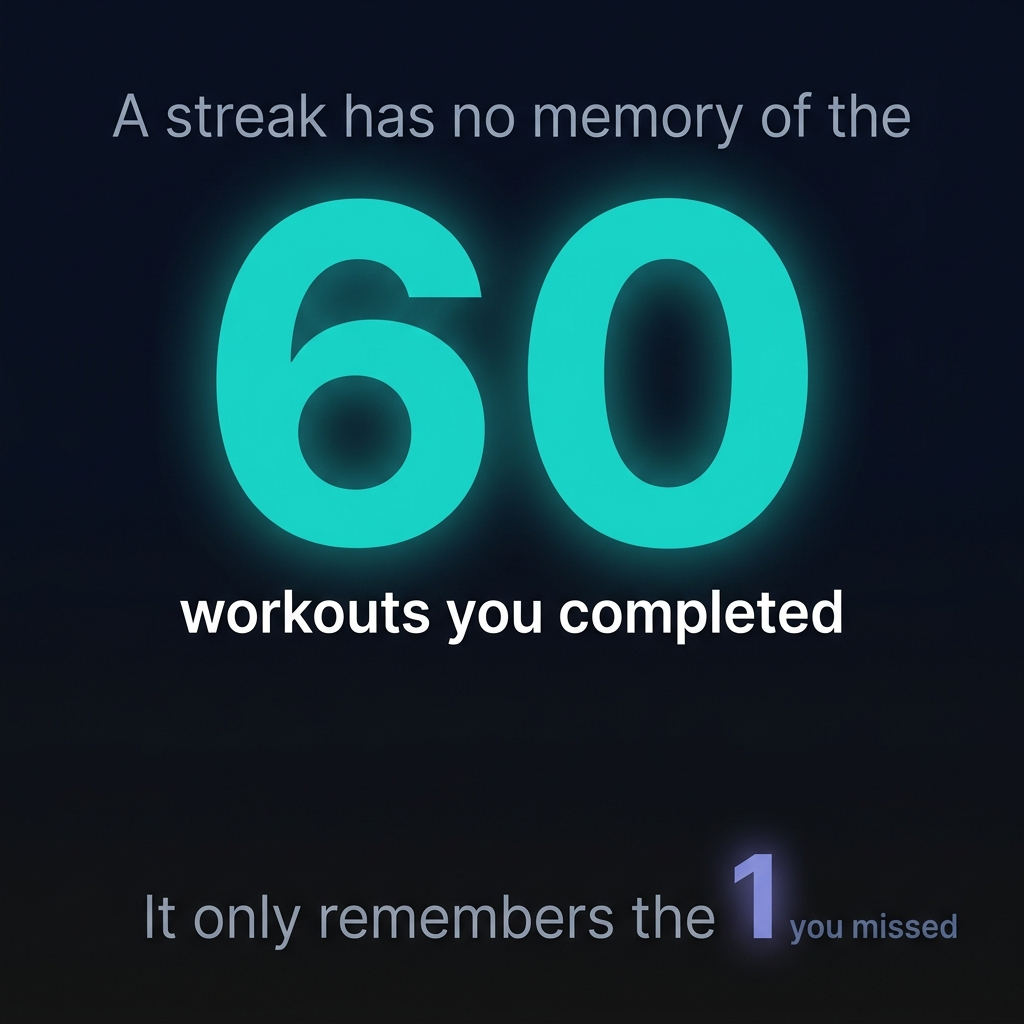
💡 A streak has no memory of the 60 workouts you completed. It only remembers the one you missed.
That asymmetry is the whole problem. The system stores months of effort in a single fragile number, then deletes it in one day. Loss aversion does the rest.
THE EVIDENCE: BROKEN STREAKS PREDICT ABANDONMENT
This is where the investigation gets uncomfortable for the industry, because the data exists and it is consistent.
Product research on healthtech retention found the mechanism directly:
"If a user misses a workout and loses the streak, many abandon (guilt + loss aversion)."
Apps like Fittr and HealthifyMe added "streak freezes" specifically because losing a streak drives users out instead of pulling them back. That is a patch on a wound the feature created.
Even the largest player in the category admits the pattern. MyFitnessPal, with over 220 million users, reports that long-term users experience streak fatigue, and that motivation drops sharply once a long streak breaks. The biggest app in the market has not solved post-break abandonment. That tells me the flaw sits in the mechanic itself, in its architecture.
Product analysts have started saying this out loud:
"A streak that increases DAU but lowers reactivation after breakage may not be improving long-term retention."
Translate that from metrics language into human language. The feature makes the dashboard look good this quarter and makes the user disappear next quarter.
THE PSYCHOLOGY: ALL-OR-NOTHING BY DESIGN
There is a documented behavior pattern in exercise research called all-or-nothing thinking. A 2025 study in BMC Public Health provided the first systematic examination of it, defining it as what happens when a person cannot adhere perfectly to their exercise plan and chooses to skip exercise entirely rather than modify the plan.
Read that definition again, then look at a streak counter.
The streak is all-or-nothing thinking rendered as a user interface. It takes a known cognitive trap, one that researchers identify as a barrier to sustained exercise, and turns it into a daily notification.
The downstream psychology follows a predictable sequence:
- Miss a day. Life intervened. A work trip, an illness, a schedule collapse.
- Watch the counter reset. Months of visible progress vanish in one screen refresh.
- Feel the loss as personal failure. The interface frames a context problem as a discipline problem.
- Avoid the app. Opening it now means facing the zero.
- Churn. Silently, permanently.
Research on the 14-day churn problem captures step five precisely: a streak that resets to zero because of a work trip feels hostile, and those users rarely come back.
Gamification studies keep finding the same emotional residue. Systems built on streaks, rankings, and rigid daily goals increase anxiety, guilt, dependency, and burnout. Psychology research adds the final piece: shame-based motivation sets people up for failure, while positive emotion makes habits stick. The streak runs on guilt as fuel. The science says guilt is the wrong fuel.
WHY THE INDUSTRY KEEPS SHIPPING IT
I want to be fair here, because the people building these features are not villains. The streak survives for three understandable reasons.
It moves the metric everyone reports. Daily active users. Streaks reliably lift short-term opens. The damage shows up months later, in a churn cohort nobody connects back to the feature.
It is cheap intelligence. A counter requires no understanding of the user. No context about weather, schedule, equipment, or recovery. It simulates accountability without doing any of the work of actual adaptation.
It borrows credibility from Duolingo. One famous success story became a design template for the entire consumer app world, applied to a domain where missing a day carries real physical and emotional weight.
⚠️ Extrinsic rewards work in the short term. IEEE research on gamification found that intrinsic motivators, personalization and social accountability, drive long-term habit formation. The streak sits entirely on the extrinsic side of that line.
This is commonly overlooked because the incentive structure hides it. The metric that gets the feature approved is measured in days. The damage is measured in months.
WHAT I BUILD INSTEAD: SYSTEMS THAT ABSORB VARIANCE
At FitPocket, I made a structural decision early. If a feature requires the user's life to stay perfectly stable, the feature is broken before it ships.
The alternative to the streak is a system that treats real-world variance as the terrain, as the default condition to design for.
Missed days become inputs, and the system adjusts the plan. A skipped workout is a signal about your week. Intelligent software reads that signal and reroutes, the way navigation reroutes around a closed highway.
Context becomes a first-class constraint. Weather, location, available equipment, schedule. When it rains, the outdoor session becomes an indoor session automatically. No counter breaks. No guilt loop starts.
Progress becomes multidimensional. Body scans, measurements, photos, trend lines. A single fragile number gets replaced by evidence that survives an imperfect week, because real progress always includes imperfect weeks.
Continuation replaces perfection as the core metric. The question the system optimizes for is whether you train again after a break. Behavioral scientist Michelle Segar's research shows that about half of all people who start a new exercise program quit within a few months. The return after a missed day is the exact moment where that outcome gets decided. It deserves the best design in the product. Today it gets a zero on a screen.
THE STANDARD I HOLD THE CATEGORY TO
Here is where I land after following the evidence.
When 80% of users leave within three months, the category has an infrastructure problem. Blaming user discipline stopped being a credible explanation years ago. The systems demand perfection from people whose lives contain variance, then log the inevitable mismatch as the user's failure.
The streak is the purest expression of that demand. It converts a scheduling reality into a moral event.
My editorial position, stated plainly: any engagement feature that makes returning after a break feel worse than staying away is working against the user. That is the test. Apply it to your own product, or to the app on your phone right now.
If your fitness app made you feel like a failure for having a life, the failure belongs to the software. The next generation of this category gets built by people who design for the missed day first. Everything else is a counter waiting to hit zero.