Most explanations of adaptive AI stay abstract. Machine learning. Personalization engines. Dynamic algorithms. The words sound impressive and tell you almost nothing about what happens when you use the thing.
I build adaptive fitness systems for a living. Here is my working definition, stripped of jargon.
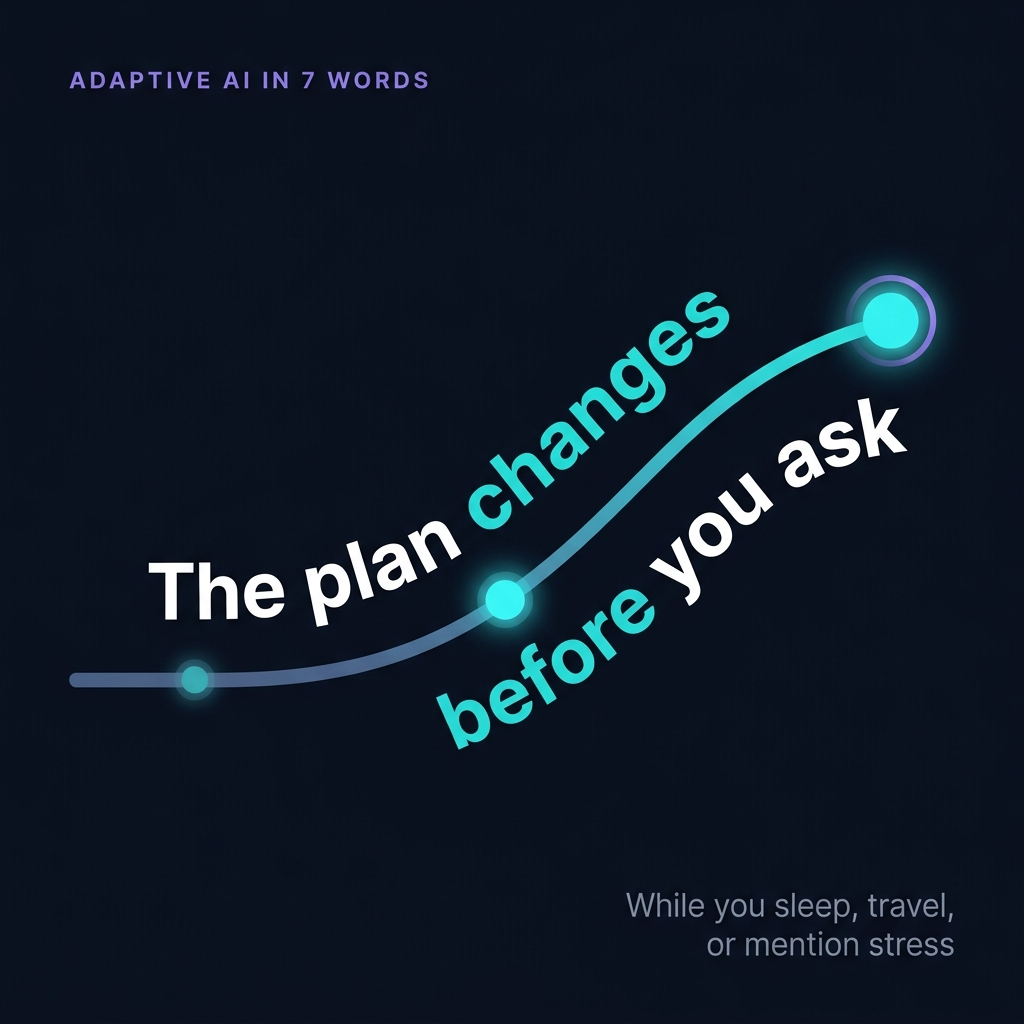
Adaptive AI means the plan changes before you have to ask.
You log a rough night's sleep. The next session gets adjusted before you open the app. You land in a hotel with no gym. The plan shifts to bodyweight. You mention stress in a voice note. Intensity drops.
That is the entire concept. Everything else is implementation detail.
The Gap Between the Label and the Experience
Nearly every fitness app now claims to be AI powered. Very few users can describe what that claim means in practice, because in most products it means very little.
A static twelve-week program with a chatbot bolted on top is still a static program. It assumes your sleep is consistent, your schedule is stable, your equipment never changes, and your stress stays flat.
Real life refuses to cooperate with those assumptions.
The data shows what happens next. Health and fitness apps hold on to roughly 3% of users by day 30, and 77% of daily users leave within three days. Among beginners, only 18.1% remain adherent at six months, with the median dropout hitting at week 14.
The common reading of those numbers blames motivation. People quit because they lack discipline.
I read them differently.
People quit because the system stopped matching their life, and the system never noticed.
💡 A useful test: if a plan requires willpower just to stay compatible with your week, the plan is already broken. Willpower is a finite resource being spent on a design flaw.
Three Moments That Define Adaptive Intelligence
Abstract claims are easy to make. Concrete moments are where the definition either holds or collapses. These three scenarios are my benchmark for whether a system deserves the word intelligent.
Moment one: the rough night
You slept four hours. Your training plan says heavy lower body today.
A static system presents the same session it would have shown you after nine hours of sleep. The burden of adjustment falls entirely on you. Most people either grind through a session their body cannot support or skip it and absorb the guilt.
An adaptive system reads the sleep signal from your connected devices and rewrites the session before you look at your phone. Lower load. Fewer sets. Recovery-focused work where it makes sense.
You never filed a request. The adjustment already happened.
Moment two: the trip
You travel Wednesday through Friday. Hotel room, no equipment, a schedule you control only partially.
The adaptive response treats location and equipment as first-class inputs. The plan converts to bodyweight sessions sized for a hotel room. Duration compresses to fit the gaps in your calendar. When you return home, the plan restores your normal structure and accounts for what you actually completed while away.
Travel stops being a failure state. It becomes a known condition the system already handles.
Moment three: the voice note
You record a quick message: work has been brutal this week, you feel wrecked.
The system parses that as a recovery signal. Intensity drops across the next several sessions. Volume comes down. The plan gives your nervous system room to reset, then rebuilds as your inputs improve.
Speaking a sentence into your phone changed your training plan. No forms. No settings menus. Conversation as the interface.
Why the Adjustment Has to Happen Before You Open the App
The timing detail matters more than it appears to.
Plenty of apps let you manually swap a workout after the fact. That is flexibility, and flexibility is useful. Intelligence sets a higher bar.
Intelligence means the system did the thinking so you did not have to.
Every time you open an app and see a plan that ignores your reality, you pay a small tax. You either edit the plan yourself, negotiate with yourself about skipping, or push through something misaligned with your body. Each of those costs energy.
Those small taxes compound. Week 14, the median dropout point, is roughly where the accumulated cost exceeds the perceived benefit.
Adaptive systems eliminate the tax at the source. The plan you see already reflects your sleep, your location, your equipment, your schedule, and your stated state. The friction between intention and execution gets removed structurally, upstream of your willpower.
Users feel this difference even when they cannot name it. According to McKinsey research from 2025, 68% of users prefer platforms that learn and adapt to their performance. People recognize the experience of being met where they are. It reads as the software finally being on their side.
Context Is the Raw Material, Adaptation Is the Product
Here is the pattern underneath all three moments.
Data alone accomplishes nothing. Millions of people wear devices that track sleep, heart rate, and activity. Most of that data lands in a dashboard and dies there. A graph of your poor sleep is a description of a problem, delivered to the one person who already knows about it.
Data without context is noise. Context without action is theater.
Adaptive systems close the loop. Signal comes in, the plan changes, and the change shows up in your next session. The full pipeline runs from input to adjustment to execution, and it runs continuously, at the level of individual days.
This requires treating context as core architecture. Weather, schedule collapses, equipment availability, travel, stress. Traditional program design labels these things edge cases and handles them later, which usually means never. I consider them the terrain itself. A system designed for controlled conditions has been designed for conditions that do not exist.
⚠️ A practical warning for anyone evaluating fitness technology: ignore the AI label entirely. Ask one operational question instead. Describe a disrupted week, then check what the system does about it without your manual input. The answer tells you everything the marketing page will not.
The Standard Worth Holding
The industry conversation about AI in fitness keeps drifting toward capability lists. Bigger exercise libraries. More integrations. More generated content.
My position, after building in this space, is that sophistication runs in the opposite direction of feature count. The most advanced version of this technology is the one you think about least. It reads your signals, absorbs your constraints, and hands you a plan that fits the day you are actually having.
The specific behaviors are the standard:
A rough night's sleep lowers tomorrow's load automatically. Travel converts the plan to whatever space and equipment you have. A voice note about stress reduces intensity. A missed session reroutes the week instead of breaking it.
Each behavior is small on its own. Together they redefine what a training plan is. It stops being a document you comply with and becomes a system that tracks your reality and keeps pace with it.
The retention statistics describe an industry that has spent years asking people to change their lives to fit their software. The 3% who survive day 30 are the people whose lives happened to fit already.
Building for everyone else means building systems that meet people where they are. That is what intelligent actually means. Everything else is a label.