TL;DR: Most AI fitness apps generate a workout plan once and never update it. Real coaching requires memory and continuous adaptation. If your AI trainer doesn't change tomorrow's session after a missed workout or a bad night of sleep, it's a document generator — not a coach.
Fitness apps retain only ~3% of users by day 30 — a system failure, not a motivation failure.
A workout generator produces a plan once. An adaptive coach updates every session based on real signals.
True adaptation processes missed workouts, sleep, injuries, schedule changes, and equipment availability.
Google's Health Coach (Gemini-powered, $9.99/mo) signals that dynamic adaptation is now the market baseline.
The test: miss reps, report it, and check if tomorrow's session changes. If it doesn't, you have a generator.
Miss the final reps of set three tonight. Then open your fitness app tomorrow morning and read what it prescribes.
I have run this test on more AI fitness products than I care to admit. The result is almost always the same. Tomorrow's workout looks exactly like it did before you touched a weight.
The plan never learned that anything happened.
This is the quiet flaw sitting inside most of what the industry currently sells as "AI coaching." A language model that produces a training plan on day one performs a single act of generation. Coaching is a continuous act of observation and adjustment. The gap between those two things explains a lot about why this industry loses almost everyone it acquires.
Why Do Fitness Apps Lose So Many Users?
The numbers here are stark, and I think they deserve to be read slowly.
Fitness apps retain roughly 3% of users by day 30. Day-one retention for health apps averages 20 to 30 percent, which means 70 to 80 percent of people who install an app never return after their first session.
It gets worse further out. A scoping review found a median of 70% of users discontinue within the first 100 days. Among premium subscribers — people who paid money — 46.8% churn within 90 days.
That number stayed with me. These are motivated people. They committed financially. They still left.
The industry's standard explanation blames the user. People lack discipline, the story goes. They lose motivation. They stop trying.
I read the same data and see an infrastructure failure.
When a system requires willpower to maintain, the system is broken. A plan that ignores missed sessions, bad sleep, a travel week, and a busted knee is a plan built for a person who does not exist. People leave because the software stopped being relevant to their actual life, usually within the first two weeks.
The most predictive churn signal in fitness apps is session frequency in the first two weeks. Users who complete fewer than three workouts in their first 14 days churn at 3 to 4 times the rate of users who establish a weekly habit.
Those first 14 days are exactly when real life intrudes hardest. A cold snap. A sick kid. A deadline. If the system treats those events as user failures instead of design inputs, the relationship ends there.
Key Point: A 3% day-30 retention rate is not a motivation problem. It is what happens when software ignores the variance of real human life.
Generation vs. Memory: What Is the Real Difference?
Here is the distinction I keep pushing whenever someone shows me a new AI fitness tool.
Ask it one question: what does it know about me on day 90 that it did not know on day 1?
A static plan holds identical value on day 1 and day 300. It carries zero accumulated knowledge of the user. Research on adaptive planners describes the alternative clearly: after three months, a system that learns builds a picture of training patterns, weak points, strongest training days, typical drop-off patterns, and optimal volume.
💡 A simple test for any AI trainer: skip a workout, sleep badly, and report a sore shoulder. If the next session arrives unchanged, you are holding a document generator with a chat interface.
Traditional human trainers update plans weekly at most and rely heavily on memory and recall. Adaptive systems refine plans session by session. That cadence matters because a body and a calendar change faster than a weekly check-in captures.
My working principle for years has been simple:
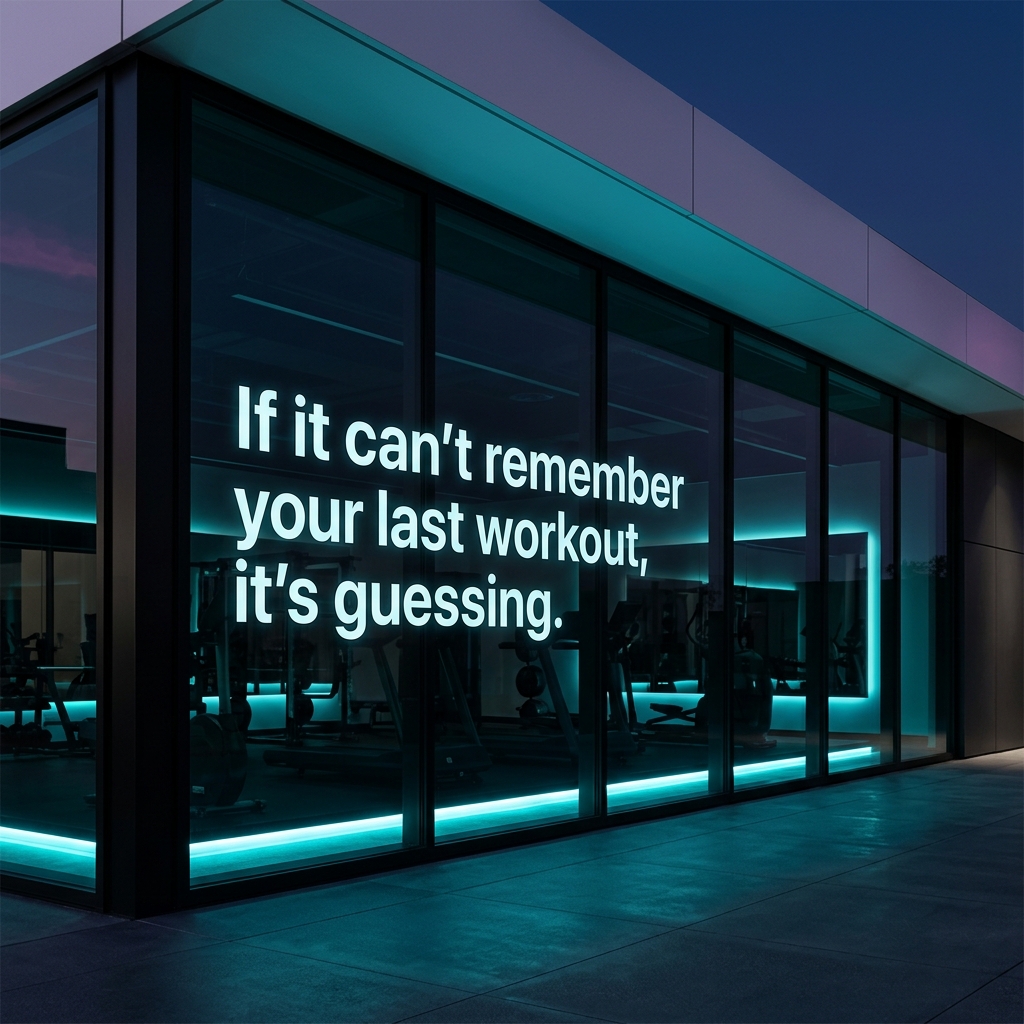
If it can't remember your last workout, it's guessing.
Key Point: Generation is a one-time event. Memory paired with response is what separates a coaching system from a content tool.
What Does a Truly Adaptive AI Fitness System Process?
The word "personalization" has become theater in this industry. It usually means the app asked your age and goal once during onboarding.
Real adaptation means the system treats specific signals as first-class inputs, every single session:
Completed and missed workouts. A skipped session reshapes the week instead of silently disappearing.
Performance within sets. Failing rep 10 of set three carries information. It should change tomorrow's load.
Recovery and sleep. Readiness data determines whether the plan pushes or pulls back.
Injuries and discomfort. Reported pain triggers substitutions immediately, in the middle of a session if needed.
Schedule and equipment. A hotel gym with two dumbbells produces a different workout than a home setup.
Weather and location. An outdoor run in a storm becomes an indoor session automatically.
Every item on that list is a piece of ordinary human variance. Weather changes. Schedules collapse. Bodies respond differently than charts predict.
Most products treat this variance as edge cases to handle later. I treat it as the terrain the system exists to serve. That single design decision determines whether software survives contact with a real life.
Key Point: Personalization that stops at onboarding is not personalization. A truly adaptive system ingests real-world signals continuously and responds before the user has to ask.
How Is the Mainstream Market Responding to This Shift?
This shift stopped being a niche argument the moment Google entered the category.
Google's new Health Coach, built on Gemini, launched at $9.99 per month and functions as a combined fitness coach, sleep expert, and wellness advisor. Its insights draw from fitness and sleep metrics, environment, nutrition, cycle tracking, and U.S. medical records where users grant access.
The design detail worth studying is how it handles change. Through a chat interface, users set goals and indicate available equipment, then receive plans that adjust dynamically based on readiness scores, sleep quality, injuries, and schedule changes.
Read that list again. Readiness. Sleep. Injuries. Schedule.
The largest technology company on earth just told the market that adaptation is the baseline definition of an AI health product. Every static workout generator now has to answer for its silence between sessions.
I welcome this. It moves the entire conversation toward the right question. The global fitness app market is expected to reach $40.26 billion by 2034 at a 13.5% annual growth rate, driven largely by AI integration. Growth of that size will attract plenty of products that generate plans and call it intelligence. The retention numbers will sort them out.
Key Point: Google's entry into adaptive AI coaching resets the market expectation. Dynamic plan adjustment is no longer a differentiator — it is the minimum viable product.
How Should These Tools Actually Be Judged?
I want to be careful here, because researchers studying AI in coaching add an important caveat. AI digests large volumes of biomechanical data far faster than a human coach and spots patterns a person misses. The same research emphasizes that effective coaching requires mentorship, motivation, and adaptability alongside the data.
Data without context is noise. Context without action is theater.
The systems that earn a place in someone's daily life are the ones where intelligence stays invisible. The user never manages the adaptation. They report a rough night of sleep by voice or text, and the session simply arrives adjusted. They travel, and the plan reshapes around a hotel gym without a settings menu.
This is commonly overlooked in product reviews, which tend to score feature lists. Feature counts measure the wrong thing. The measurement that matters is how the system behaves on a user's worst week — because the worst week is where 46.8% of paying subscribers walked away.
People carry years of quiet shame about abandoned fitness plans. When they encounter a system that flexes around their reality, something shifts. They stop defending past failures and start recognizing them as system failures. Architecture removes the shame more reliably than any encouragement ever did.
Key Point: Judge an AI fitness tool by its worst-week behavior, not its feature list. Invisible adaptation is the signal that a system is actually coaching.
What to Ask Before Subscribing to an AI Fitness App
Any large language model can produce a competent 12-week program in eight seconds. Generation has become a commodity. The scarce capability is memory paired with response: a system that knows what happened in the last session, the last night of sleep, and the next week of travel, then acts on all of it before the app is even opened.
Before paying for any AI trainer, run the test described at the top. Miss the final reps of set three. Report it. Watch what tomorrow looks like.
A changed workout means the system is coaching. An identical workout means it generated a document and stopped paying attention.
The strongest trend in this category is exactly this shift toward systems that meet people where they are. Fitness happens to be the wedge. The deeper opportunity is an intelligent layer between human intention and real-world execution — one that closes the gap between aspiration and what a life actually allows, through design rather than motivation.
The 3% retention number is an indictment of how this industry has built software so far. It is also the clearest roadmap I know for what to build next.
Key Point: Generation is now a commodity. Before subscribing, test whether the system actually responds to your real-life inputs — because a system that can't remember is a system that's guessing.
Frequently Asked Questions
What is the difference between an AI workout generator and an AI fitness coach?
A workout generator produces a plan once, based on initial inputs like age and goal. An AI fitness coach continuously updates the plan based on ongoing signals — missed sessions, sleep quality, injuries, equipment, and schedule changes.
Why do most fitness apps fail to retain users?
Fitness apps retain roughly 3% of users by day 30. The core reason is that static plans stop being relevant to a user's actual life within the first two weeks, when real-world disruptions — illness, travel, fatigue — first appear and go unaddressed by the system.
How can I tell if an AI fitness app is truly adaptive?
Miss a workout or report a sore shoulder, then check if tomorrow's session changes. If the plan arrives identical to what was already scheduled, the system is generating documents, not coaching.
What signals should a real adaptive fitness system process?
Completed and missed workouts, in-session performance (rep and set data), sleep and recovery metrics, reported injuries or discomfort, available equipment, location, and weather conditions.
Is Google's AI Health Coach a sign of where the market is heading?
Yes. Google's Gemini-powered Health Coach, launched at $9.99/month, adjusts plans based on readiness, sleep quality, injuries, and schedule changes. Its entry signals that dynamic adaptation is now the market baseline, not a premium differentiator.
What does "invisible intelligence" mean in an AI fitness app?
It means the system adapts without requiring the user to manage the adaptation. Adjustments happen automatically based on reported inputs \ the user sees only an updated plan, not a settings menu.
Does high churn in fitness apps mean AI coaching doesn't work?
High churn indicates that most current AI fitness apps are generators, not coaches. Adaptive systems that process real-time signals show meaningfully different retention behavior because they remain relevant to the user's actual life over time.
Why does the first 14 days matter so much for fitness app retention?
Session frequency in the first two weeks is the most predictive churn signal. Users who complete fewer than three workouts in their first 14 days churn at 3 to 4 times the rate of users who establish a weekly habit \ and those first 14 days are exactly when real-life disruptions hit hardest.
Key Takeaways
Fitness apps retain roughly 3% of users by day 30. That is an infrastructure failure, not a user motivation failure.
A workout generator creates a static plan once. An adaptive coaching system updates every session based on real signals: missed workouts, sleep, injuries, equipment, schedule, and weather.
The simplest quality test: miss reps, report it, and check if tomorrow's session changes. No change means no coaching.
Google's Gemini-powered Health Coach entering at $9.99/month resets the market baseline. Dynamic adaptation is now the minimum expectation, not a differentiator.
After three months with an adaptive system, the software holds accumulated knowledge of training patterns, weak points, peak days, and optimal volume. A static plan holds none.
Intelligence that stays invisible is the design goal. The user reports reality; the system responds. No settings menus, no manual overrides.
The 3% retention number is the clearest roadmap available for what to build next in this category.