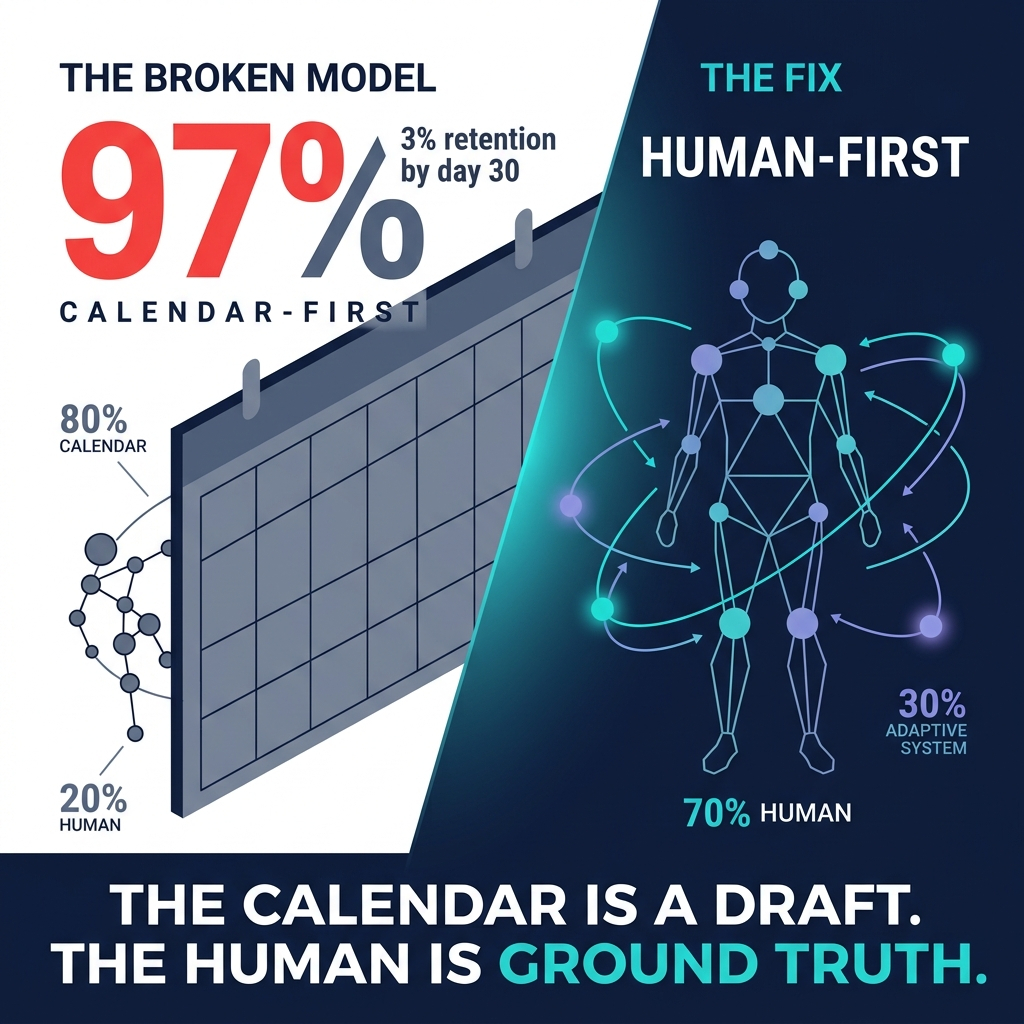
TL;DR: Most fitness apps are built around a static calendar that treats your schedule as ground truth and your actual life as noise. The result is 97% churn in 30 days — not because users lack discipline, but because the software never adapts to them. Adaptive architecture inverts this hierarchy, and the technology to do it already exists.
Health and fitness apps retain just 3% of users by day 30.
Calendar-first design treats sleep, travel, illness, and weather as edge cases instead of normal human conditions.
The willpower explanation has no empirical support — ego depletion failed replication across 23 labs.
Friction reduction consistently outperforms motivation and incentives as a behavioral intervention.
Adaptive architecture replaces red marks and broken streaks with real-time recalculation, removing shame as a design output.
What the Retention Data Actually Shows
Start where any investigation should start. The retention data.
Health and fitness apps hold just 3% retention by day 30. This category shows the steepest churn curve of any consumer subscription, with a massive January spike in sign-ups followed by 40 to 60% cancellations by February.
The most predictive churn signal is session frequency in the first two weeks. Users who complete fewer than three workouts in their first 14 days churn at 3 to 4 times the rate of users who establish a weekly habit.
The industry reads these numbers and reaches its standard conclusion: users lack discipline, motivation fades, people are the problem.
💡 People who download a fitness app in January want the result. They paid, they set goals, they showed up. When 97% of them leave inside a month, the software failed them before their motivation ever got a fair test.
Bottom line: The churn numbers are a product failure, not a user failure. The data indicts the architecture, not the people using it.
What a Static Calendar Actually Encodes
Consider what a static schedule assumes about your life.
"Monday leg day" encodes the assumption that your sleep, recovery, stress, travel, equipment access, and health status stay constant. Every one of those is a variable. The schedule flattens all of them into a single fixed instruction, then measures you against it.
Then real life delivers what real life always delivers:
A work trip lands on your heaviest training day, and the hotel gym holds two dumbbells and a broken treadmill.
A sick child wipes out the Tuesday session entirely.
Rain cancels the outdoor run the plan assumed.
Four hours of sleep turns the prescribed intensity into a genuinely bad idea.
The app registers every one of these events identically: a missed workout. A red mark. A broken streak.
The system had one model of your week. Reality delivered a different one. The software assigned the error to you.
How Other Industries Solved This
In healthcare, context-aware systems collect behavioral, physiological, and environmental data to adapt services to patient needs in real time. Navigation apps recalculate the route the moment you miss a turn. Logistics systems reroute around weather.
No one in those industries calls the user undisciplined when conditions change. The system absorbs the change. That is the job of the system.
Fitness software still hands out red marks for the same class of event.
Key Point: A static calendar is a prediction about the future, and it is always wrong. Every industry that handles real-world variance has moved beyond fixed plans. Fitness software has not.
Why the Willpower Explanation Fails
The calendar-first model survives on one core belief: users fail because they run out of willpower.
Science tested that belief directly. The original ego depletion research failed to replicate across 23 labs and 2,141 participants, with the effect size dropping to essentially zero. The premise that people deplete a willpower reserve holds no empirical weight.
The behavioral design literature points somewhere else entirely. Friction reduction ranks among the most effective interventions available, often outperforming information and incentives combined. Every extra step, decision point, or obstacle lowers the probability that a person follows through on an intention.
Research consistently shows that friction reduction is one of the most effective interventions in behavioral design, often more effective than information or incentives alone.
A rigid schedule manufactures friction at industrial scale. Every collision between the plan and your actual day forces a choice: override your body or absorb a penalty. The software creates the obstacle, then blames you for hitting it.
My working rule follows directly from this: if a system requires willpower to maintain, the system is broken.
Key Point: Willpower depletion is not the cause of fitness app failure. Friction is. A system that removes friction removes the need for willpower.
How Adaptive Architecture Works
Here is the core of the argument, stated plainly.
The human signal is ground truth. The calendar is a working draft.
A schedule is a prediction made in advance about conditions nobody can predict in advance. A well-designed system treats that prediction as provisional and treats live information about the actual person as authoritative.
This changes behavior at every layer of the architecture.
Step 1: Signals Become First-Class Inputs
Sleep, recovery markers, location, available equipment, weather, and stated preferences enter the system as primary data. Weather stops being an edge case. Travel stops being an edge case. These are the normal operating conditions of a human life, and the architecture treats them that way from day one.
Step 2: Interpretation Replaces Judgment
A skipped session on four hours of sleep reads as sound decision-making. The system logs it that way and updates the plan to fit the body that shows up today, with the training history actually accumulated.
Step 3: The Response Recalculates Instead of Penalizing
The overnight flight triggers a session built for a hotel room with two dumbbells. The fever triggers rest and a recalibrated week. The rain triggers an indoor substitution.
No red marks. No broken streaks. No penalty for living.
⚠️ One caution matters here. Adaptation without filtering produces chaos. A system that reacts to every weak signal whipsaws the user with constant changes. Real intelligence separates signal from noise, then adjusts quietly. When it works, you never think about it.
Key Point: Adaptive architecture does not remove structure — it makes structure responsive. The plan still exists; it just updates from reality rather than ignoring it.
Shame as a Design Output
There is a second consequence of calendar-first design, and it is the more serious one.
When the schedule holds the authority, every deviation becomes a personal failure. The app quantifies the failure, color-codes it, and displays it back. Years of this trains people to narrate their entire fitness history as a character defect.
When someone understands adaptive architecture, that narration reverses. They stop defending past attempts and start recognizing them as system failures. The rigid program failed to model their life, and the failure landed on the wrong party.
This removal of shame comes from architecture. A plan that flexes around real constraints never asks the impossible, therefore there is nothing to feel ashamed about when Tuesday collapses.
Sustainable behavior emerges from reduced friction. The design carries the burden so the person can carry the goal.
Key Point: Red marks and broken streaks are not motivational tools. They are shame mechanisms built into the interface. Adaptive design removes the mechanism because it removes the cause.
Why Calendar-First Design Still Dominates
An honest investigation has to ask why calendar-first design persists when the evidence against it is this strong.
The capability gap closed already. The apps achieving strong retention today deliver adaptive AI that learns user patterns and modifies workouts in real time. Machine learning systems continually adjust plans based on progress, feedback, and changing physical conditions.
The calendar-centric model persists for three quieter reasons.
It is easier to build. A static template ships in a sprint. An adaptive system requires real engineering across signals, interpretation, and response.
It is easier to sell. A 12-week program with a name and a grid photographs well on a landing page.
It is easier to defend. When users leave, the discipline story absolves the product. The roadmap never has to change.
That third reason is the most consequential. An architecture that externalizes its own failures onto users has no internal pressure to improve.
Key Point: Calendar-first design persists because it is commercially convenient, not because it works. The incentive to blame users removes the incentive to build better systems.
Where This Lands
The 30-day cliff, the two-week churn signal, the collapsed willpower science, and the proven adaptive technology all point in one direction.
The next generation of fitness software will treat the human as ground truth and the calendar as a draft.
The teams that build this way will keep users past the first two weeks, because the first collision between plan and life will produce a recalculation instead of a red mark. The teams that keep shipping fixed Monday sessions to a person running a fever will keep watching 97% of their users disappear.
This principle extends past fitness. Any goal requiring sustained behavior over months — whether health, learning, or money — runs into the same collision between static plans and variable lives. Fitness happens to be the sharpest test case, because the signals are measurable and the churn data makes the failure undeniable.
Open your app. Look at what it planned for tomorrow. Then ask yourself whether it knows anything about the day you actually had.
If the answer is no, you have found the reason it will eventually stop working for you. You have also found proof that every time it stopped working before, the fault sat inside the software.
Frequently Asked Questions
Why do fitness apps have such high churn rates?
Health and fitness apps retain just 3% of users by day 30. The primary cause is not user motivation — it is calendar-first architecture that fails to adapt when real-life conditions change. The first deviation from the plan produces a red mark instead of a recalculation, and users disengage.
What is calendar-first design in fitness apps?
Calendar-first design treats a pre-written schedule as the authoritative source of truth. The user's actual conditions — sleep quality, travel, illness, available equipment — are treated as noise or exceptions rather than primary inputs. The plan does not update; the user is expected to conform to it.
What is adaptive architecture in fitness software?
Adaptive architecture inverts the hierarchy. The human signal (sleep data, recovery markers, location, equipment, weather) becomes the primary input. The calendar becomes a working draft that updates in real time based on those signals. Deviations trigger recalculations, not penalties.
Does willpower depletion actually explain why people quit fitness apps?
No. The original ego depletion research failed to replicate across 23 labs and 2,141 participants, with the effect dropping to essentially zero. Behavioral design research points to friction as the more reliable predictor. Reducing friction outperforms motivation and incentives as an intervention.
How do other industries handle real-world variability that fitness apps ignore?
Navigation apps recalculate routes instantly when conditions change. Healthcare context-aware systems adapt services to real-time patient data. Logistics platforms reroute around weather. None of these industries penalize the user when conditions deviate from the plan. Fitness software is the outlier.
Why hasn't the fitness industry moved to adaptive systems if the technology exists?
Three commercial reasons keep calendar-first design in place: static templates are faster to build, fixed programs photograph well on landing pages, and the discipline narrative conveniently absolves the product when users churn. There is no internal pressure to change as long as user failure explains the numbers.
Does adaptive design mean there is no structure or plan?
No. Adaptive architecture preserves structure — it makes the structure responsive. The plan exists; it updates from live signals rather than ignoring them. The goal is separating real signal from noise and adjusting quietly, so the user experiences consistency without rigidity.
Does shame from fitness apps actually affect long-term behavior?
Yes, as a design output. When every deviation is color-coded as failure, users internalize those deviations as personal defects. Adaptive design removes this mechanism by removing the cause: a plan that never asks the impossible leaves nothing to feel ashamed about.
Key Takeaways
Health and fitness apps retain just 3% of users by day 30, therefore the churn problem is architectural, not motivational.
Calendar-first design treats human variability as an edge case. Adaptive architecture treats it as the default operating condition.
Ego depletion failed scientific replication. Friction reduction is the more effective and evidence-supported intervention.
A skipped workout due to fatigue or travel is sound decision-making. Software that penalizes it is broken by design.
Red marks and broken streaks are shame mechanisms. They are a product of calendar authority, not a feature.
The technology for adaptive fitness systems exists and is already deployed by apps with strong retention. The barrier is commercial, not technical.
The principle extends beyond fitness: any goal requiring sustained behavior change fails when static plans meet variable lives.