TL;DR: Wearables generate hundreds of data points daily but rarely explain the decisions they trigger. The trust gap in AI fitness coaching exists because systems change plans without justifying them. The fix is simple in concept and underutilized in practice: every adjustment needs a short, plain-language reason attached to it.
A person wearing two wearables generates over 500 data points per day, yet almost none translates into a decision users understand.
Users distrust AI coaching because adjustments feel arbitrary — the system changes the plan and stays silent about the logic.
Every meaningful adjustment needs a short reason, written in plain language, attached to the decision itself.
Raw metrics mislead without context. Interpretation — not data collection — is the actual product.
This principle extends beyond fitness into any AI domain that touches personal decisions.
The Dashboard Era Is Ending
I spent an evening reading Reddit threads about AI training plans. The pattern repeated in almost every thread.
People sync their Apple Watch, their Garmin, their Whoop. The app changes their workout. Nobody tells them why.
The reaction is always the same. "It cut my volume today and I have no idea what triggered it. I stopped trusting it."
That sentence explains more about the fitness tech market than any industry report I've read this year.
People own more health data than any generation in history. A person wearing two devices generates over 500 data points per day. HRV readings every five minutes. Sleep stages. Skin temperature. Recovery scores. Training load.
Almost none of it turns into a decision they understand.
I build FitPocket, an AI fitness system. The most common question I hear from users has nothing to do with features.
It's this: "Can it read my watch data and tell me what it actually means?"
Nobody asks for another chart. Nobody asks for a prettier sleep graph. They ask for meaning.
The research confirms what users already feel. Value in health tech is moving up the stack: from raw data to biomarkers, from biomarkers to scores, from scores to insights, from insights to actionable recommendations.
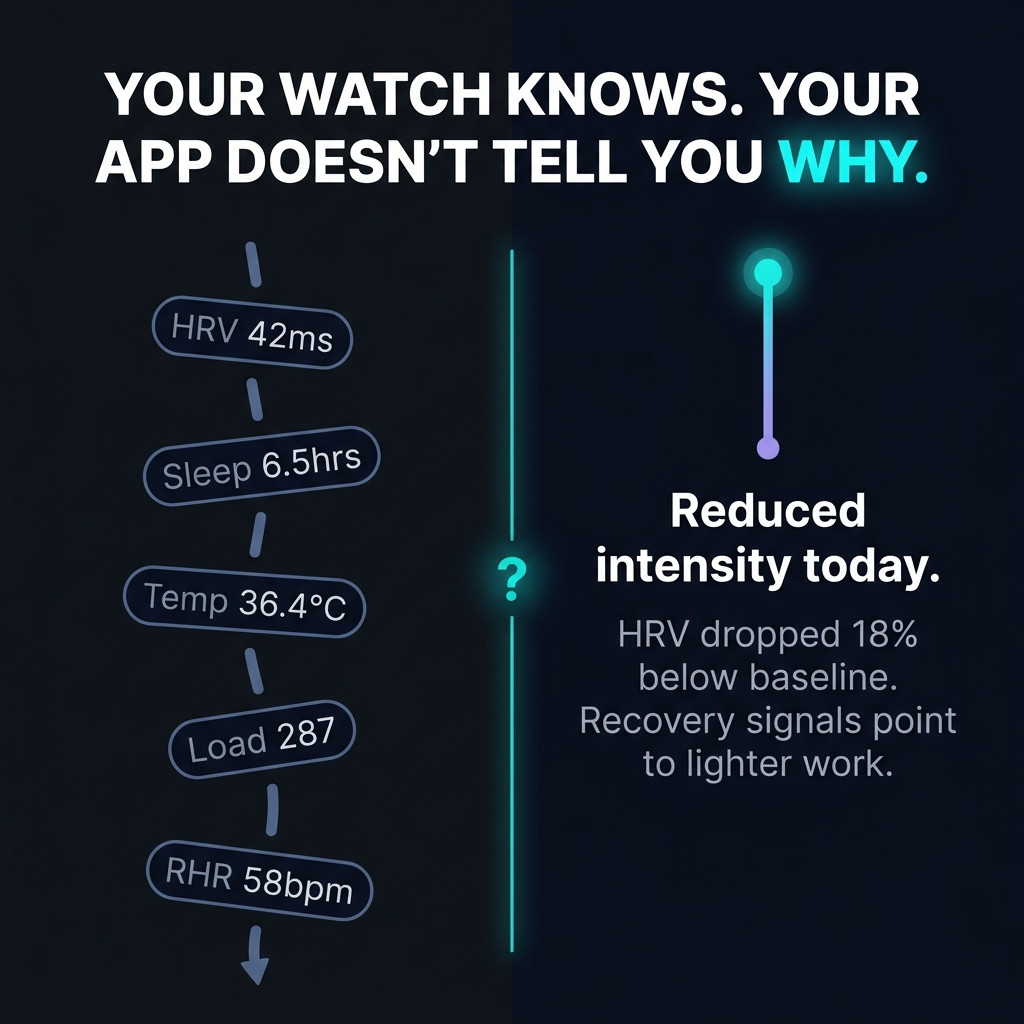
Today's wearables tell you what happened. You slept 6.5 hours. Your HRV was 42ms.
The systems that win next will tell you what to do about it. In plain language. With a reason attached.
Key Point: The wearable market is shifting from data collection to prescriptive intelligence. Displaying metrics is no longer sufficient — users expect meaning.
Why People Distrust AI Coaching
People distrust AI programming for a specific, rational reason: the adjustments feel arbitrary. The system changes your plan and stays silent about the logic.
A human coach who behaved this way would lose clients within a month. Imagine a trainer who reduces your squat volume, shrugs when you ask why, and expects compliance anyway.
Software gets away with this because we've normalized it. That period is ending.
Whoop, Oura, Apple Health, and Garmin Connect have all added AI-generated insights in 2026. The direction is clear across the industry: the wearable collects, the AI interprets. The quality varies widely, and that gap is where trust gets won or lost.
The academic research backs this up. Studies on explainable AI show a strong link between explanations and transparency, and explanations improve trust across users with very different levels of expertise.
💡 The practical takeaway: transparency in AI recommendations is foundational to adoption. Users adopt what they understand. They abandon what feels like a black box.
Key Point: Distrust in AI coaching is rational, not emotional. It stems from unexplained adjustments — a design failure, not a technology limitation.
How It Works: What Explained Decisions Look Like
Here's my core argument, and it's the design principle I build around:
Every meaningful adjustment needs a short why.
One or two sentences. Attached to the decision itself. Written for a human, in plain language.
Examples of what this looks like in practice:
"Reduced today's intensity." Your HRV dropped 18% below your 30-day baseline and your sleep came in under 6 hours. Recovery signals point to lighter work today.
"Moved your run indoors." Heavy rain in your area through the afternoon. The session keeps the same training load on a treadmill structure.
"Added a rest day Thursday." Your training load climbed 40% over two weeks. This spacing protects the progress you've already built.
None of this requires new sensors. None of it requires more data collection. It requires the system to show its reasoning at the moment of the decision.
This is commonly overlooked because engineering teams treat explanation as a UX detail. I treat it as infrastructure. A recommendation without a rationale is an instruction. A recommendation with a rationale is a decision the user can own.
Key Point: Explained decisions don't require new technology — they require design conviction. Attaching a plain-language reason to every adjustment is infrastructure, not decoration.
Why Context Changes Everything
There's a deeper layer here, and it's where most implementations fail.
Raw metrics mislead without context. Take HRV, the metric everyone obsesses over.
Life stress produces the same HRV patterns as overtraining. A hard week at work, poor sleep, or a mild illness all drag HRV down without any change in your training. Raw HRV scores also vary significantly between individuals. Comparing your number to someone else's tells you nothing. The signal lives in how today's reading compares to your own baseline.
This means a system that says "your HRV is low, rest" is doing half the job. The full job sounds like this:
"Your HRV is 15% below your personal baseline. Your training load has been stable, so this likely reflects sleep or stress rather than overtraining. Today's session shifts to lower intensity while we watch the trend."
That's interpretation. That's the difference between data and a decision.
⚠️ A warning for anyone building in this space: the integration layer is a solved problem. Unified APIs now connect Apple Health, Garmin, Fitbit, Oura, Whoop, and Strava through one interface, cutting development time from months to weeks. If your differentiation strategy is "we sync with wearables," you have no differentiation. Interpretation is the actual product.
Key Point: Metrics without context are noise. Personal baseline comparison — not population averages — is what transforms raw data into decisions users can act on.
What This Means Beyond Fitness
The demand for explained decisions signals something larger than a fitness trend.
Healthcare itself has this structural gap. Wearables generate continuous data around the clock while the medical system runs on episodic appointments measured in minutes. Patients hold more health information than ever and lack the clinical framework to interpret it. The device is a tool. The interpretation layer gives it value.
The same pattern will repeat in every AI domain that touches personal decisions. Finance. Nutrition. Sleep. Work scheduling. Users will accept algorithmic recommendations exactly to the degree that the algorithm justifies itself.
The evidence already shows the business case. A 2026 fitness coaching report found that coaches who explain their AI methodology early win trust, while those who hide it lose credibility. Fitness apps with wearable syncing already retain users at higher rates. Retention compounds when that data becomes meaningful instead of decorative.
My operating principle applies here: data without context is noise, and context without action is theater. The systems that survive will close both gaps.
Key Point: Explainable AI is not a fitness-specific problem. Any domain where algorithms influence personal decisions will face the same adoption barrier — and the same fix.
How to Evaluate Any AI System for Trust
When I evaluate whether an adaptive system deserves trust, including my own, I use three questions:
Does every adjustment carry a reason? If the plan changes silently, the system failed, regardless of whether the change was correct.
Is the reason grounded in the user's own baseline? Population averages produce generic advice. Personal trends produce decisions.
Can a non-expert understand the explanation in under ten seconds? A rationale written in jargon is a rationale withheld.
Apply this test to the tools you already use. Most of them fail question one.
The technology to fix this exists today. The data pipelines exist. The AI capability exists. What's been missing is the design conviction that users deserve the why, and that giving it to them builds the kind of trust no marketing budget can buy.
Your watch already knows what happened last night. The next generation of systems will tell you what it means, what to do, and exactly why.
I'm building toward that standard. I'd hold any product you use to the same one.
Key Point: Three questions determine whether an AI system earns trust: Does it explain every adjustment? Does it use personal baselines? Can a non-expert understand it in under ten seconds?
Frequently Asked Questions
Why don't fitness apps explain their AI recommendations?
Most engineering teams treat explanation as a UX detail rather than core infrastructure. Because users have normalized unexplained software behavior, the pressure to change it has lagged. That is shifting as AI-generated coaching becomes mainstream.
What is explainable AI in fitness?
Explainable AI in fitness means attaching a plain-language rationale to every automated adjustment — intensity changes, rest days, session substitutions — so users understand what triggered the decision and why it applies to them specifically.
How does HRV relate to training adjustments?
HRV is most useful when compared against a user's own personal baseline, not population averages. A drop in HRV can indicate overtraining, poor sleep, or life stress. The interpretation determines the right response, which is why context matters more than the raw number.
Do wearable integrations actually differentiate fitness apps?
No longer. Unified APIs now connect Apple Health, Garmin, Fitbit, Oura, Whoop, and Strava through a single interface. Wearable syncing is a baseline expectation. Interpretation of that data is where differentiation actually lives.
Does explained AI coaching improve retention?
Yes. A 2026 fitness coaching report found that coaches who explain their AI methodology early win trust, while those who obscure it lose credibility. Retention compounds when data becomes meaningful rather than decorative.
Is this only relevant to fitness apps?
No. The same dynamic applies to any AI system influencing personal decisions — finance, nutrition, sleep, work scheduling. Users accept algorithmic recommendations in proportion to how well the algorithm justifies itself.
What makes an AI coaching explanation effective?
Effective explanations are one to two sentences, written in plain language, attached directly to the decision, and grounded in the user's own data rather than generic population benchmarks.
How can I evaluate whether an AI fitness tool is trustworthy?
Apply three questions: Does every adjustment carry a reason? Is the reason based on your personal baseline? Can a non-expert understand it in under ten seconds? Most current tools fail the first question.
Key Takeaways
Wearables generate massive data volume — over 500 data points per day per user — but value lives in interpretation, not collection.
Unexplained AI adjustments are the primary driver of distrust in fitness coaching apps, because the behavior mirrors a coach who changes plans and refuses to say why.
Every meaningful adjustment needs a short, plain-language reason attached at the moment of the decision. This is infrastructure, not UX polish.
Raw metrics mislead without personal context. HRV, training load, and recovery scores are only actionable when compared to a user's own baseline.
Wearable integration is no longer a differentiator. Interpretation is the actual product.
Explainable AI will become the standard across any domain where algorithms influence personal decisions — fitness is the leading indicator, not the exception.
The technology exists. What's been missing is the design conviction that users deserve to understand the systems making decisions about their health.